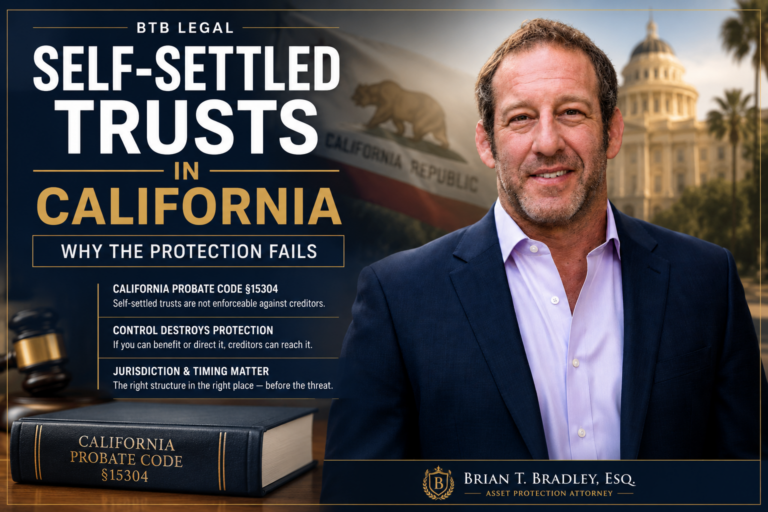


Protecting assets from lawsuits in California requires layered separation built before any claim exists: state-matched LLCs holding individual assets, a limited partnership with statutory charging-order exclusivity holding the LLC interests, and an offshore-capable trust holding the partnership interest. California forecloses self-settled trusts under Probate Code §15304, and out-of-state DAPTs fail here because California law governs the creditor question.
No single tool does it. Protection comes from separating ownership, control, and jurisdiction at every layer — and from doing it before a threat is foreseeable.
Key Points
- California has no DAPT statute and voids self-settled spendthrift protection under Prob. Code §15304.
- Nevada and Wyoming trusts do not travel. Huckaby (2026) applied California law to California real property despite a Nevada choice-of-law clause.
- California’s charging order is technically exclusive — but the exclusive remedy itself authorizes receivership and foreclosure of the interest under §17705.03.
- Reverse veil piercing is live here, and its boundaries are still being worked out, which is itself part of the exposure.
- Three variables decide every case: timing, control, and jurisdiction. Every structure that failed lost on at least one.
- Once a claim is foreseeable, most options close. The UVTA look-back is four years, with a seven-year outer repose.
A California Story
The following is a composite illustration drawn from patterns I see in practice. It is not an actual client.
Dr. Elena Vasquez had practiced internal medicine in Los Angeles for nineteen years. She owned her practice, a fourplex in Pasadena, and a commercial property in San Diego she had bought with a colleague three years earlier. Her total exposed net worth was just over $2.8 million.
She had done what her estate planning attorney recommended. A revocable living trust. A single-member LLC holding each property. Malpractice insurance with a $1 million per-occurrence limit. What she had built was a real estate investor’s structure — and real estate creates a category of liability exposure that entity structures alone were never designed to address.
When a patient filed a claim alleging delayed diagnosis — a claim her attorney believed was defensible — she assumed the structure she had built would hold.
It did not hold the way she expected.
The malpractice claim settled within the policy limit. But the plaintiff’s attorney had already filed a separate civil suit naming her personally, the LLC holding the Pasadena property, and her colleague in the commercial-property entity. The charging-order motion on the Pasadena LLC came three weeks later.
The argument that a single-member LLC provided exclusive charging-order protection failed under California law. The court was not interested in what Wyoming statutes said about charging orders. Elena lived in California. California law applied.
She had built a structure. It just was not the right structure for the state she actually operated in.
⸻
Why Does California Law Make Domestic Asset Protection So Difficult?
Because California has explicitly foreclosed the most commonly marketed strategies. Probate Code §15304 voids spendthrift protection in a self-settled trust, §18200 exposes every revocable living trust to the settlor’s creditors during life, and California has never enacted a domestic asset protection trust statute.
Start with the foundational rule. Under Probate Code §15304(a), a spendthrift clause provides no protection against the settlor’s own creditors where the beneficiary is also the person who created the trust. Under §15304(b), where the trustee has discretion, a creditor may reach the maximum amount the trustee could pay to or for the settlor’s benefit — so handing discretion to an independent trustee does not solve it either.
Federal courts applying California law have confirmed this repeatedly. In Cutter v. Seror (In re Cutter), 398 B.R. 6 (B.A.P. 9th Cir. 2008), aff’d 468 F. App’x 657 (9th Cir. 2011), the court held that a debtor could not shield assets through a trust created for his own benefit. The trust was irrevocable and properly drafted. It failed on control, because the debtor served as trustee and retained the ability to distribute to himself.
The California legislature reaffirmed the framework in AB 1866 (2022), effective January 1, 2023, which added §15304(c). That provision clarified that a trustee’s ability to reimburse the settlor for income taxes does not create a creditor-accessible benefit. It was a tax clarification, not an asset-protection loophole.
Probate Code §18200 handles the other common instrument. While a trust is revocable, its assets are reachable by the settlor’s creditors during the settlor’s lifetime to the extent of the power of revocation — which in an ordinary living trust means all of them. A revocable living trust is a probate-avoidance tool. It was never creditor protection.
e trust’s chosen state. A 2026 federal decision applied exactly that analysis.
In United States v. Huckaby, No. 2:23-cv-00587-DAD-JDP (E.D. Cal. Mar. 2, 2026), a self-settled Nevada spendthrift trust failed to protect California real property from a federal judgment lien under 28 U.S.C. §3201(a).
Robert Huckaby and Joyce Tritsch held a South Lake Tahoe property as joint tenants. In 2011 the interest was placed into a self-settled Nevada trust, with the same individuals serving as settlors, trustees, and beneficiaries. After a 2018 federal judgment against Huckaby for failure to honor IRS levies, the United States moved to enforce its lien and foreclose his one-half interest.
The court applied the Restatement (Second) of Conflict of Laws in two parts. Under §277, Nevada law governed interpretation of the instrument — the defendants were right about that. But under §280, whether a beneficiary’s interest in a trust of land can be reached by creditors is governed by the law of the situs of the land. The property was in California. California law controlled, §15304 applied, and foreclosure was authorized.
The court also rejected the argument that §15304 should not apply retroactively to property placed in trust before the lien arose.
This was a district-court order granting partial summary judgment — persuasive and directly on point, not binding appellate precedent.
Three design failures produced the loss: the asset was California real estate held directly in a domestic trust; the same individuals served simultaneously as settlors, trustees, and beneficiaries; and the structure relied on a sister-state statute California courts are not required to honor.
The pattern is not confined to California. In In re Huber, 493 B.R. 798 (Bankr. W.D. Wash. 2013), a bankruptcy court applied Washington law to an Alaska trust created by a Washington resident who retained control and strong home-state connections. In Dahl v. Dahl, 345 P.3d 566 (Utah 2015), the forum applied its own law over the trust’s chosen governing law — though that case arose in a divorce rather than a creditor action, which limits how far it travels.
Kilker v. Stillman, 2012 WL 12888640 (Cal. Ct. App. 2012) is frequently cited here, and it should be handled carefully: the opinion is unpublished and non-citable as authority under California Rule of Court 8.1115. It illustrates judicial attitude toward a California resident’s out-of-state trust. It is not precedent, and the rule does not depend on it — §15304, the UVTA, and Huckaby‘s situs analysis are all citable.
The consistent theme is not geography. It is control and domicile. When a California resident forms a trust in another state but keeps controlling assets from California, courts apply California law to determine creditor remedies.
The plain-English version: you cannot move dirt.
What Are the Limits of LLC Protection in California?
Real but narrower than advertised. California’s charging order is technically the exclusive remedy, but the exclusive remedy itself authorizes receivership and foreclosure of the interest. Reverse veil piercing adds a second layer whose boundaries are still being worked out.
Under Corporations Code §17705.03, a creditor may obtain a charging order against a debtor’s LLC interest and intercept distributions.
It is often said California’s charging order is not exclusive. That is not quite right, and the distinction matters more than the shorthand. §17705.03(f) states the section provides the exclusive remedy by which a judgment creditor may satisfy a judgment from a debtor’s transferable interest.
The problem is not exclusivity. It is what California’s exclusive remedy contains. §17705.03(b)(1) authorizes appointment of a receiver over the distributions. §17705.03(b)(3) authorizes foreclosure of the charging order lien and sale of the transferable interest itself.
California’s exclusive remedy includes the power to take the interest away and sell it.
Reverse veil piercing adds another layer. In Curci Investments, LLC v. Baldwin, 14 Cal.App.5th 214 (2017), the court held that reverse veil piercing may be available against an LLC and returned the question to the trial court to decide. It did not itself pierce, and it is frequently described as having gone further than it did. Four years later the Court of Appeal did go further, in Blizzard Energy, Inc. v. Schaefers, 71 Cal.App.5th 832 (2021), applying the doctrine to a multi-member LLC while requiring the trial court to weigh harm to an apparently innocent co-member.
The doctrine is live in California. How far it reaches is still being worked out, and that uncertainty is itself part of the exposure.
LLCs isolate operational liability, which is real and necessary. They rarely protect significant personal wealth standing alone.
What Framework Actually Works in California?
Three variables decide every case: timing, control, and jurisdiction. Every structure that failed lost on at least one of them. Effective planning addresses all three simultaneously and does it before a claim is foreseeable.
Timing. California follows the Uniform Voidable Transactions Act (Civil Code §3439.01 et seq.), which lets courts unwind transfers made with actual intent to hinder or delay creditors, or made without reasonably equivalent value while insolvent. Intent is evaluated using the eleven badges of fraud in §3439.04(b). Actual-intent claims run four years from the transfer or one year from discovery, with an outer repose at seven years under §3439.09(c). That repose only ever helps someone whose clock started in peacetime.
Control. Every structure that failed — Huckaby, Huber, Cutter, and the LLCs in Curci and Blizzard — turned on the same fact: the person facing the claim still controlled the assets. Retained control gives a court leverage to compel transfers, issue injunctions, or pierce entity structures. Effective planning separates legal ownership, operational management, and control authority.
Jurisdiction. Anything entirely inside U.S. jurisdiction remains reachable by U.S. courts. Huckaby illustrates it precisely: Nevada registration created no jurisdictional separation because the asset and the debtor’s connection both stayed in California. Jurisdictional separation changes the enforcement calculus only when it is genuine — embedded in the governing instrument from formation, not bolted on in response to litigation.
What Does the Layered Structure Look Like?
State-matched LLCs hold individual assets. An Arizona limited partnership holds the LLC interests and supplies statutory charging-order exclusivity. The Bridge Trust® holds the partnership interest and supplies the jurisdictional anchor. Each layer answers a different failure point.
Asset-level LLCs
Individual properties or businesses are held in separate state-matched LLCs, so a claim against one property does not automatically expose the others. Matching the LLC to the state where the asset sits controls which state’s law governs creditor remedies against that interest — the Huckaby situs problem, addressed at the entity level.
Reverse-veil-piercing risk is managed by maintaining genuine separation between entities and avoiding alter-ego facts. That is not paperwork. It is how the entities are actually operated.
The asset management limited partnership
The membership interests in the operating LLCs are held by an Arizona limited partnership. Under A.R.S. §29-3503, the charging order is the exclusive remedy against a limited partner’s interest, with no foreclosure authorization in the statutory text.
Compare California’s §17705.03, where the exclusive remedy includes foreclosure and sale. Arizona answered the question California left open. A creditor gets the right to wait for a distribution that may never come — no forced liquidation, no receivership over the entity, no stepping into management.
That difference is what ends most litigation before it escalates. A contingency-fee attorney who sees a charging order as the ceiling has little economic incentive to fund expensive litigation for an uncertain and illiquid return.
The Bridge Trust®
The limited-partnership interest is owned by the Bridge Trust® — one trust carrying two legal identities at once.
It is registered under an offshore jurisdiction such as the Cook Islands, Nevis, or Belize from inception, so the jurisdictional protection exists from day one rather than at some future conversion.
Two independent tax rules then apply, and conflating them is the most common error in commentary about this structure. Because the instrument is drafted to satisfy the court test and control test of Treas. Reg. §301.7701-7 — the two-part test under IRC §7701(a)(30)(E) — the IRS classifies it as a domestic trust. Separately, it is drafted to establish and maintain grantor-trust status under IRC §§671–677, so all income is reported on the settlor’s own U.S. return and the trust is disregarded for income tax purposes. One rule determines domestic-versus-foreign classification. The other determines who reports the income.
Because the assets remain includible in the settlor’s estate, the §1014 step-up in basis is preserved. There are no secret offshore accounts and no tax-avoidance mechanism. Under normal conditions the trust operates domestically, with no offshore filing burden.
If a genuine creditor threat arises, the Trust Protector — an independent party, not the settlor — may declare an Event of Duress, and control shifts to the pre-committed offshore Special Successor Trustee under the pre-existing terms of the instrument.
That declaration is the human judgment, and it is what separates this from the automatic designs. Nothing fires on the filing of a complaint. A qualified independent fiduciary evaluates the situation and makes a reasoned decision — which is precisely the record a court needs to see, and precisely what a mechanical trigger destroys. Courts read clauses tied directly to litigation events as obstruction.
This is not a transfer of assets. The assets belonged to the trust before the declaration and remain owned by the same trust afterward. What changes is who controls it, and where. Because the offshore jurisdiction does not recognize U.S. judgments and requires a creditor to re-litigate locally under a beyond-a-reasonable-doubt fraud standard, with a substantial bond and fee-shifting, the economics of contingency-fee litigation shift hard.
How this answers Huckaby directly
The real estate is not held directly in the trust — it sits in state-matched LLCs inside a limited partnership. The settlor is not settlor, trustee, and beneficiary with unchecked control — an independent Trust Protector holds the critical protective authority. And the jurisdictional anchor is not a sister-state statute California can override — it is an offshore legal system outside the California-Nevada conflict-of-laws framework that decided Huckaby.
Three failure points, three structural answers.
What Would This Have Meant for Someone Like Elena?
The liability would still exist. The ability to collect on it would not look the same — and in litigation, collectability drives settlement.
If she had implemented this structure before the malpractice claim arose, the plaintiff’s attorney would find operating LLCs owned by a limited partnership, with the partnership interest held by a trust operating under offshore jurisdiction.
A charging order on the partnership interest produces no distributions unless the partnership chooses to make them. The trust assets would be administered by an independent trustee operating under foreign law.
No structure makes anyone judgment-proof, and no lawyer can promise a courtroom outcome. What a properly built and properly timed structure changes is what a creditor can reach and what it costs to try.
FAQs
How can I protect my assets from lawsuits in California? Through layered separation built before any claim exists. Individual assets sit in state-matched LLCs; the LLC interests are held by an Arizona limited partnership where the charging order is the exclusive remedy under A.R.S. §29-3503; and the partnership interest is owned by an offshore-capable trust. No single tool does it.
Does a single-member LLC protect my assets in California? Only partially, and single-member is the weakest position on the charging-order axis. Under Corporations Code §17705.03 a creditor can obtain a charging order — and the statute authorizes receivership and foreclosure of the interest. Curci and Blizzard Energy also make reverse veil piercing a live doctrine here.
Can a California resident use a Nevada or Wyoming asset protection trust? Usually not effectively. Where the settlor lives in California or the asset is California real property, California law generally governs the creditor question regardless of the trust’s chosen state, as Huckaby applied in 2026.
Does California have an asset protection trust statute? No. California has never enacted a DAPT statute, and Probate Code §15304 voids self-settled spendthrift protection against the settlor’s own creditors.
Is my revocable living trust protected from creditors? No. Under Probate Code §18200, while a trust is revocable its assets are reachable by the settlor’s creditors during life to the extent of the power of revocation — which in an ordinary living trust is everything.
Is it too late to protect my assets once a lawsuit is filed? Largely, yes. California’s UVTA gives courts a four-year look-back to unwind transfers made when litigation was reasonably foreseeable, with an outer repose at seven years. Protection built after a claim is on the horizon invites attack.
Does this reduce my taxes? No. The structure is tax-neutral by design. Income is reported on your own return under the grantor-trust rules, and the §1014 step-up is preserved.
What about California real estate specifically? You cannot move dirt. Land is governed by the law where it sits, which is what Huckaby turned on. Real estate is protected through the ownership chain — state-matched LLC, partnership, trust — rather than by the trust holding the deed.
The Bottom Line for California in 2026
California is one of the most difficult jurisdictions in the country for protecting personal wealth. Domestic self-settled trusts are foreclosed by Probate Code §15304. Out-of-state DAPT statutes fail when California residents remain subject to California jurisdiction — a principle United States v. Huckaby confirmed with federal authority in 2026. LLCs help isolate operational risk but rarely protect personal wealth on their own, as Curci and Blizzard Energy show.
Effective protection requires layered structures created before any claim exists, where ownership, control, and jurisdiction are deliberately separated at every level. The Huckaby failure — direct trust ownership of California real estate, same-person control throughout, and reliance on a sister-state statute — is exactly the architecture this structure is built to avoid.
I spent years on the plaintiff’s side of the table in Los Angeles and Orange County, running discovery and taking these structures apart. The ones that came apart in my hands failed for the same reasons Elena’s would have: the debtor still controlled what he claimed to have given away, the real estate sat exposed, and the whole thing leaned on another state’s statute that California was free to ignore.
Those are build errors, and build errors are only fixable before the lawsuit — not after.
You don’t rise to the level of your income. You fall to the level of your legal structure.
Structure before stress.
📞 For a confidential legal consultation, contact Bradley Legal Corp. at (888) 773-9399, or complete the intake questionnaire at btblegal.com.
By: Brian T. Bradley, Esq. – National Asset Protection Attorney