
A foreign trust is only as offshore as the people who control the trustee. Everything else is decoration. The jurisdiction on the cover page, the statute someone quotes you, the thick binder on the table — none of it decides whether your structure holds when a creditor is finally in the room. One thing decides that. Whether the person who controls your offshore trustee sits somewhere a U.S. court cannot reach.
A surgeon sat across from me last year with a printout marked up in the margins. He had done well — a practice, a building he held the equity in, a brokerage account in his own name, and the kind of malpractice exposure that comes with operating on people for a living. He had been told to go fully offshore. Cook Islands. And he had been handed a checklist of things to “demand” from any attorney who suggested anything short of that.
He asked me the question the whole checklist was built to make him ask. “How do I know the offshore trustee will actually be there when I need it?”
Great question. It’s the right question. It’s just aimed in the wrong direction.
What a Foreign Trustee Is Actually For
Here is what going offshore is supposed to buy you. When your assets sit with a trustee that no U.S. court can command, a U.S. judgment loses its grip. The creditor wins in an American courtroom, walks the judgment over to the trustee — and the trustee, sitting under another country’s law, is not obligated to honor it. That distance is the protection. Not the paper. The distance.
So the entire value of the structure rests on one fact. The people who control that trustee have to be beyond the reach of the same court that just ruled against you.
Now hold that up against how some of these structures are actually built.
There is a sales pattern in my field worth naming out loud. The person selling you the trust sometimes also owns the trustee company he places you with. Think about what that does. He profits when he sells you the trust, and he profits again on the trustee that administers it — the trustee that is supposed to be the independent party standing between your assets and a court. “Use my trustee” was the conclusion he was always going to reach. That is not neutral advice. That is a man quoting you a price at two windows of the same store.
But the conflict is the smaller problem. The bigger one is structural.
If the person who owns your offshore trustee is a U.S. citizen — a U.S.-licensed professional living in a U.S. state — then he sits squarely inside a U.S. court’s personal jurisdiction. And a creditor does not have to chase anyone to the South Pacific. It can go straight at him, here, at home. Through him, at the trustee company he owns. Through the trustee, at your trust.
The whole point of offshore was a controller a court can’t reach. Put that controller back inside the court’s reach and you have paid offshore prices for domestic exposure. You have built your protection on the exact seam the structure was supposed to close.
The Three Questions
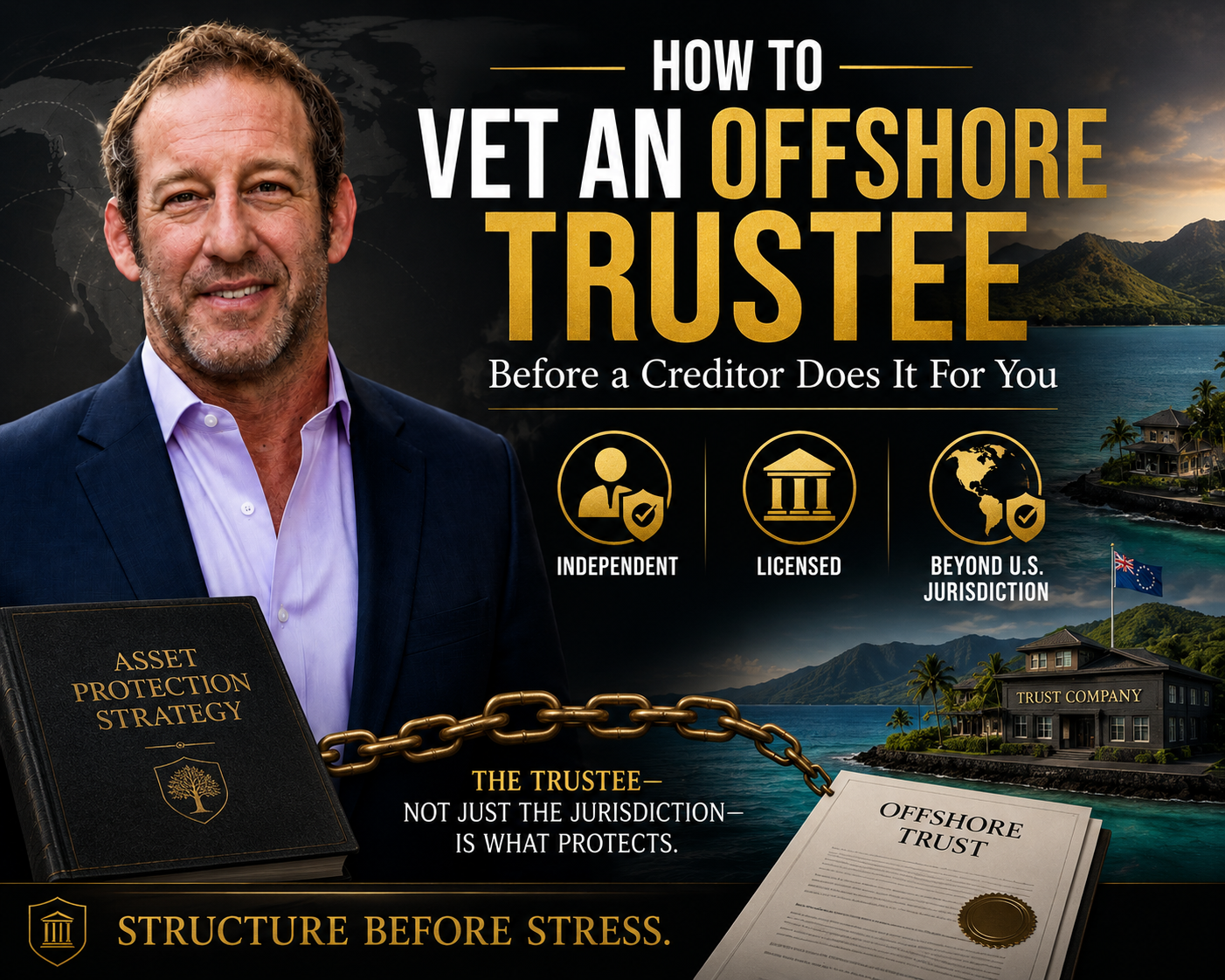
So when someone hands you a foreign trust, don’t demand a guarantee. Ask three plain questions instead.
First — who owns the trustee? Not who is the friendly voice on the phone. Who owns the company. If the answer is the same person selling you the trust, you do not have an independent trustee. You have a marketing funnel with a fiduciary title.
Second — where do the people who control that trustee live, and whose courts can reach them? If the controlling owner is a U.S. person on U.S. soil, the offshore wall has a domestic door in it — and a determined creditor knows exactly where the handle is.
Third — is the trustee a licensed, regulated trust company with a real track record, or a shell that exists to collect your fee? A legitimate offshore trustee answers to a license and a regulator in its own jurisdiction. That license is part of what keeps it honest — and part of why it does not simply walk away from a duty it signed up for.
That is the test. Independence, jurisdiction, and a license. And having the license is just the bottom threshold. Three questions, and you will learn more from the answers than from any binder.
Don’t Demand a Guarantee — It’s a Trick
And about that checklist — the one that tells you to demand a written, unconditional guarantee from the trustee that your outcome is safe. Don’t.
Not because a good trustee won’t give it. Some might. But because no trustee, no bank, and no attorney will give it. For example, as an attorney I am ethically forbidden from guaranteeing you a result. As a licensed attorney our governing rules of ethics forbids it. So is every honest lawyer, and so is every trustee they would ever use — the same rules bind all of us. A demand for a document that cannot exist, from anyone, ever, is not a test of strength. Can you think of any business that guarantees results? It is a trick, and the absence it “proves” proves nothing.
What actually stands between your assets and a creditor was never a promise on paper. It is a trustee that signed on as a party to your trust before any lawsuit existed — committed in advance during creation, not cold-called in a crisis. It is a licensed fiduciary that answers to its own regulator. And it is a record of that arrangement being honored, year after year, under real pressure. What is their track record over the years? A relief pitcher warming up under contract is a very different thing from a stranger in the parking lot you are hoping will play.
Where I Stand
Let me be clear about this, because it matters. I am not anti-offshore. I build fully foreign trusts, and I have for a decade — formed, funded, and defended them across the Cook Islands, Nevis, and Belize. When a client’s exposure genuinely calls for a fully foreign structure, I build it without hesitation.
Two things I will not do. I will not place every client with one trustee company because it happens to be the one I would profit from — I work with multiple independent, licensed trustees across multiple jurisdictions, so you are matched to the trustee and the country that fit your facts, not the one company I happen to own. And I will not be your offshore trustee myself. That is a line I keep on purpose, for the exact reason we just walked through. The moment your U.S. attorney also owns your offshore trustee, you have handed a U.S. court a domestic handle on the whole thing. The same standard governs the hybrid I build most often, the Bridge Trust® — its offshore trustee is an independent, licensed third party and a signatory to the trust from day one. Not me. Not my firm.
No structure makes you untouchable. Nothing does, and anyone who tells you otherwise is selling. What the right structure does — with a genuinely independent offshore trustee, out of reach, licensed, and committed in advance — is change the position you negotiate from. That is the entire game.
So before you sign anything, run the test. Who owns the trustee? Where they can be reached? What license stands behind them? Ask it before there is a claim on the horizon, not after — because timing is the one thing no trustee, foreign or domestic, can ever give back to you.
Structure before stress.
By: Brian T .Bradley, Esq.