

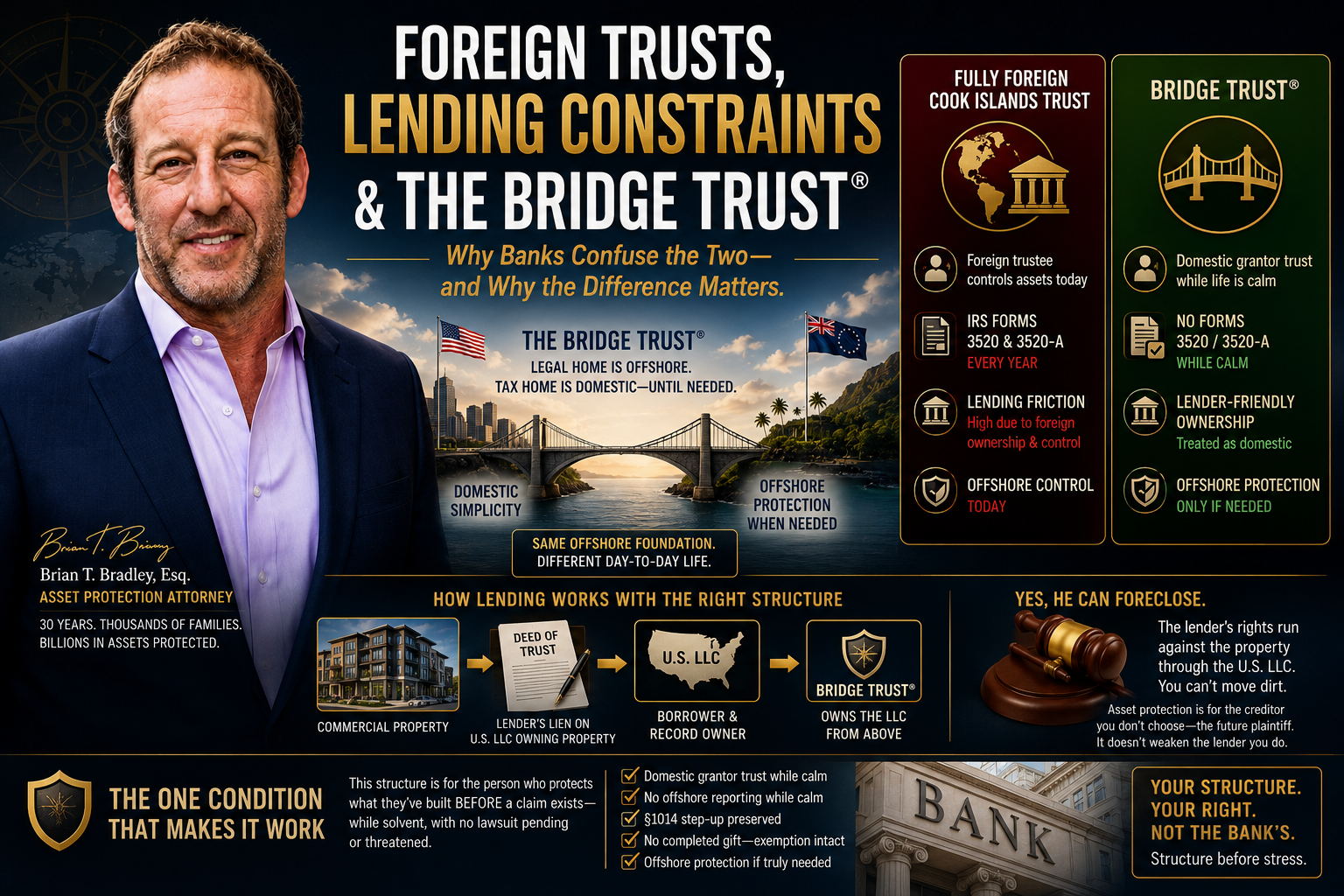
Almost every lender confusion I hear comes from the same mistake: the lender — and sometimes the client — assumes a Bridge Trust® is a fully foreign Cook Islands trust. It is not. It’s a hybrid, and that single distinction is the entire answer.
So let me draw the line clearly before anything else, because once it’s clear, the financing question, and the “no bank will lend” objection all resolve on their own.
The two trusts people confuse — and why they’re not the same
A purely foreign Cook Islands trust is exactly what it sounds like. The assets sit offshore, a foreign trustee controls them right now, and the trust is foreign for tax purposes — which means IRS Forms 3520 and 3520-A every year from the day you fund it, and the loss of the quiet domestic simplicity you’re used to. It is the strongest protection on paper, and in a genuine creditor fight that strength is worth every dollar. But you carry its full cost — reporting, a foreign trustee, and, as you’ll see, financing friction with lenders — every calm year, whether or not you’re ever threatened.
A hybrid Bridge Trust® separates the two things a purely foreign trust fuses together: a trust’s legal home and its tax status. While life is calm, it is a domestic grantor trust — you control it, you file a normal return, and there is no offshore reporting. Its legal home, though, has been offshore the entire time, registered and ready. It only becomes fully foreign if a real legal attack forces it to cross the bridge. Same protective foundation as the purely foreign trust; a completely different day-to-day life.
That is the distinction your lender is missing. He’s picturing the first trust. You have the second.
Why your lender pictured the wrong one
When a banker hears “Cook Islands,” he pictures money already wired offshore, under a foreign trustee who has control, in a jurisdiction his bank can’t reach. And, his caution would be reasonable. A fully foreign trust genuinely does look different to a lender, and genuinely does carry more friction. His instinct isn’t crazy — it’s just aimed at a structure you don’t have. The moment he sees the word “foreign,” he stops reading and lumps every trust into one bucket (fully foreign). Plenty of CPAs and estate planning attorneys make the same mistake. It’s understandable. It’s still wrong.
While life is calm, your Bridge Trust® is doing two things at once, under two different sets of code sections, and both matter to your lender.
First, it’s domestic. It qualifies as a domestic trust under IRC §7701(a)(30)(E) — a U.S. court has primary supervision, and U.S. persons control the substantial decisions — so it is not foreign for tax purposes, and there is no Form 3520 or 3520-A while it stays on this side of the bridge.
Second, it’s a grantor trust
The trust is drafted so that you, as settlor, retain the specific powers the grantor-trust rules (IRC §§671–679) treat as ownership: control over the beneficial enjoyment of the trust (§674), administrative powers over the trust property (§675), the power to revoke or unwind while calm (§676), and income that can be applied for the grantor (§677). Retain any one of those and the Code stops treating the trust as a separate taxpayer. Under §671, everything the trust owns is taxed straight to you. This is what keeps lending easy.
That’s why the day-to-day looks exactly like it did before you signed. You use your own Social Security number, not a separate trust EIN for filing; you report the income on your normal 1040 with no separate trust return (Treas. Reg. §1.671-4(b)(2)); the §1014 step-up in basis is preserved because the assets are still yours for tax purposes; and there’s no completed gift, so your lifetime exemption stays intact.
And yet the protection is real, because the trust’s legal home has been offshore the whole time — registered in the Cook Islands and Belize, with Nevis in that same tier of creditor-hostile jurisdictions, from the day it’s signed. The legal passport is foreign. The tax passport is domestic. Both are held at once. Just like dual citizenship.
To your lender, during calm, this is not a foreign trust at all. It’s you — a domestic taxpayer holding property the ordinary way, on your own return. The offshore strength stays holstered, named and ready, and only steps forward if a genuine legal attack ever forces the trust across the bridge.
The timing that exposes the purely foreign trust’s real limitation
Here’s the insight the promoters selling one offshore tool to everyone always skip. There is exactly one moment in time a purely foreign trust earns its keep — when you’re actually under attack and need a trustee no U.S. court can command. That fight, though, is contingent. It may never come. And every calm year before it, a fully foreign trust bills you for that strength anyway: the reporting, the foreign trustee, and — the part almost no one prices in — the financing / lending friction.
That friction isn’t a matter of opinion. It’s baked into how commercial real estate actually gets financed. Mainstream lenders — Fannie Mae and Freddie Mac multifamily programs, CMBS, banks, life companies — require the borrower and record owner of the building to be a U.S. single-purpose entity, almost always an LLC that holds only that one property. Fannie Mae’s own multifamily guidelines call for a single-asset U.S. borrower with U.S. ownership. A purely foreign Cook Islands trust is the opposite of that on every axis: foreign situs, a foreign trustee, creditor-hostile law, and limited recourse by design. Ask a bank to write a term loan directly to “the trustee of an offshore international trust,” and most won’t quote it at all — because enforcing that loan would mean litigating against the very protective machinery the trust was built to provide.
Here’s the irony that makes the point. The fix every lender reaches for is a domestic entity that holds title and borrows, with any foreign ownership sitting upstream — which is precisely the layered structure a properly built asset protection plan already uses. The building sits in a U.S. LLC that grants the deed of trust; the trust owns the LLC from above. So the lender’s requirement and sound asset protection design actually agree. The only real question is what sits at that upstream ownership layer. With a purely foreign trust, it’s a foreign, off shore trustee-controlled, 3520-filing entity — which drags the whole file into extra know-your-customer and anti-money-laundering review, foreign-law enforceability opinions, and often a flat “no.” With a hybrid Bridge Trust®, while life is calm, that upstream owner is a domestic classified grantor trust you control — so the ownership chain reads clean and domestic from the dirt all the way up.
Now line that up against timing. You refinance, draw a construction loan, or buy the next building in calm weather — never in the middle of a lawsuit. So a purely foreign trust imposes its heaviest friction during the exact stretch of time when you have the least use for offshore strength. That’s backwards. The hybrid fixes it by giving you a clean, domestic ownership chain for everything you do in calm weather — banking, financing, filing — while keeping the offshore protection holstered in reserve for the day you actually need it.
This is the same limitation I’ve documented twice before, wearing different clothes. In The 35% Penalty on Money You Never Owed Tax On it was the §6677 penalty machine; in The Risk Math of a Fully Foreign Trust it was the guaranteed annual bill against a threat that may never arrive. Financing / lender friction is simply the next line item on that same invoice — one more cost of going purely foreign that a hybrid doesn’t ask you to pay while nothing is happening.
So can he foreclose? Yes — either way
With all of that said, the question underneath your lender’s worry deserves a straight answer, and it’s reassuring: yes, he can foreclose. That was never actually in doubt — not with a purely foreign trust, and certainly not with your hybrid. Because you can’t move dirt.
A Dallas apartment complex cannot be shipped to the Cook Islands. It stays where it is, and so does the lien recorded against it. Your lender holds a deed of trust on the building through the U.S. LLC that owns it, and his remedy runs against that collateral. He doesn’t need to sue you, chase you, or go near the trust.
Here’s why that’s true by design, not by luck. There are two kinds of creditors, and they are opposites. Your lender is a voluntary creditor — you chose him, you signed, and you handed him a lien. Asset protection is built for the other kind: the involuntary creditor, the future plaintiff who sues you, wins a judgment, and never bargained for any claim on your building. That’s the person this structure is built to make work extraordinarily hard. The lender you chose it doesn’t touch, and was never trying to. So it doesn’t weaken his position — it changes the position you’d negotiate from against the plaintiff you didn’t choose.
Why I never let a lender design your protection
There’s a principle underneath all of this worth more than any single deal. Asset protection is you exercising your legal right to structure what you own. That right is yours; it doesn’t require your lender’s permission, and it isn’t his to grant. The moment you let a bank dictate how you hold your assets, the question quietly changes from what am I legally allowed to do to protect my family into what does the lender want me to do to protect the lender. Those aren’t the same thing. A bank’s job is to protect the bank. Your structure’s job is to protect you.
So the order matters. You put your structure in place first, correctly — then, if a specific lender raises a specific concern, your attorney answers it from a position of strength, with the code sections and the documents in hand. You don’t hand a bank a veto over your legal planning, and you certainly don’t unwind years of protection because an underwriter was unfamiliar with a nuance. You do not involve the lenders. In my experience, once a lender sees the difference between a purely foreign trust and a hybrid, the deal moves. The structure I work with has been built, funded, and defended for more than three decades (30 years) — across thousands of families and billions of dollars in real estate, much of it commercial. Your lender’s worry, reasonable as it sounds, is not new, and it is not a wall.
The one condition that makes it all work
All of this holds for one reason: it was done in calm weather. This structure is for the person who protects what they’ve built before a claim exists — while solvent, with no lawsuit pending or threatened. And be precise about the boundary, because I am with clients: the hybrid’s tax simplicity is deferral, not elimination. If the trust ever has to cross into full foreign mode to defend against a real threat, the foreign reporting regime does apply from that point forward. The advantage is that most clients never trigger, so most never carry that burden at all.
That’s the entire discipline behind the Bridge Trust®. Offshore protection when you need it. Domestic simplicity until you do.
For a confidential legal consultation with an Asset Protection Attorney, contact Bradley Legal Corp. at (888) 773-9399
By: Brian T. Bradley, Esq. – Asset Protection Attorney
Frequently asked questions
What’s the difference between a purely foreign Cook Islands trust and a hybrid Bridge Trust®?
A purely foreign trust operates offshore now — foreign trustee in control, foreign tax status, and Forms 3520/3520-A every year from the day it’s funded. A hybrid starts from that same offshore legal foundation but stays a domestic grantor trust for tax and everyday purposes, with you in control as trustee, and only becomes fully foreign if a genuine legal threat triggers it. Same protective foundation; very different day-to-day life — including how a lender sees you.
Will a mainstream lender finance property owned by a foreign trust?
Usually not directly. Agency (Fannie/Freddie), CMBS, and most bank and life-company programs require the borrower to be a U.S. single-purpose entity — typically an LLC holding just that one property — with U.S. ownership. A purely foreign trust doesn’t fit that seat, so lenders either decline or force a restructure. The standard fix is a U.S. LLC as borrower with the trust upstream, which is how the structure is already built. With a hybrid, that upstream owner reads as a domestic grantor trust you control, so the financing looks ordinary.
Can a bank foreclose on property in an irrevocable or foreign trust?
Yes. If the lender holds a recorded deed of trust on the property, it can foreclose on default regardless of whether the property is titled in an irrevocable trust, a foreign trust, or an LLC. The lien attaches to the real estate itself, and asset protection does not — and is not meant to — defeat a security interest you voluntarily granted.
Can you get a mortgage or commercial loan on property in an asset protection trust?
Yes. In practice the property is held in a U.S. LLC, and the lender lends to that LLC (or to you personally) and records against the building — standard commercial-loan mechanics: typically a larger down payment, portfolio or commercial pricing, and often a personal guarantee.
Will a lender make me take the property out of the trust to refinance?
Some do, as internal policy rather than law. When that happens, the property can be titled to close the loan and then re-integrated afterward, or held at the LLC level the lender is comfortable with. It’s a sequencing question, not a barrier to protecting your equity.
Do I need a personal guarantee, and does it weaken my protection?
Commercial lenders frequently require one. A guarantee to a single lender you chose doesn’t open your structure to unrelated future plaintiffs — it’s a consensual obligation to one identified creditor, which is a different thing entirely from a stranger’s judgment.


