
In today’s world of lawsuits, debt exposure, and massive generational wealth transfers, family-held real estate has become one of the most common — and most dangerous — financial traps.
Many families inherit property together, believing shared ownership strengthens family bonds. In reality, it often mixes liability, blurs control, and creates conflict that can destroy both wealth and relationships.
This updated 2025 case study follows two sets of siblings who learned those lessons the hard way — and how they could have protected everything with the right legal structure.
⸻
👬 The Brothers’ Journey: Good Intentions, Bad Structure
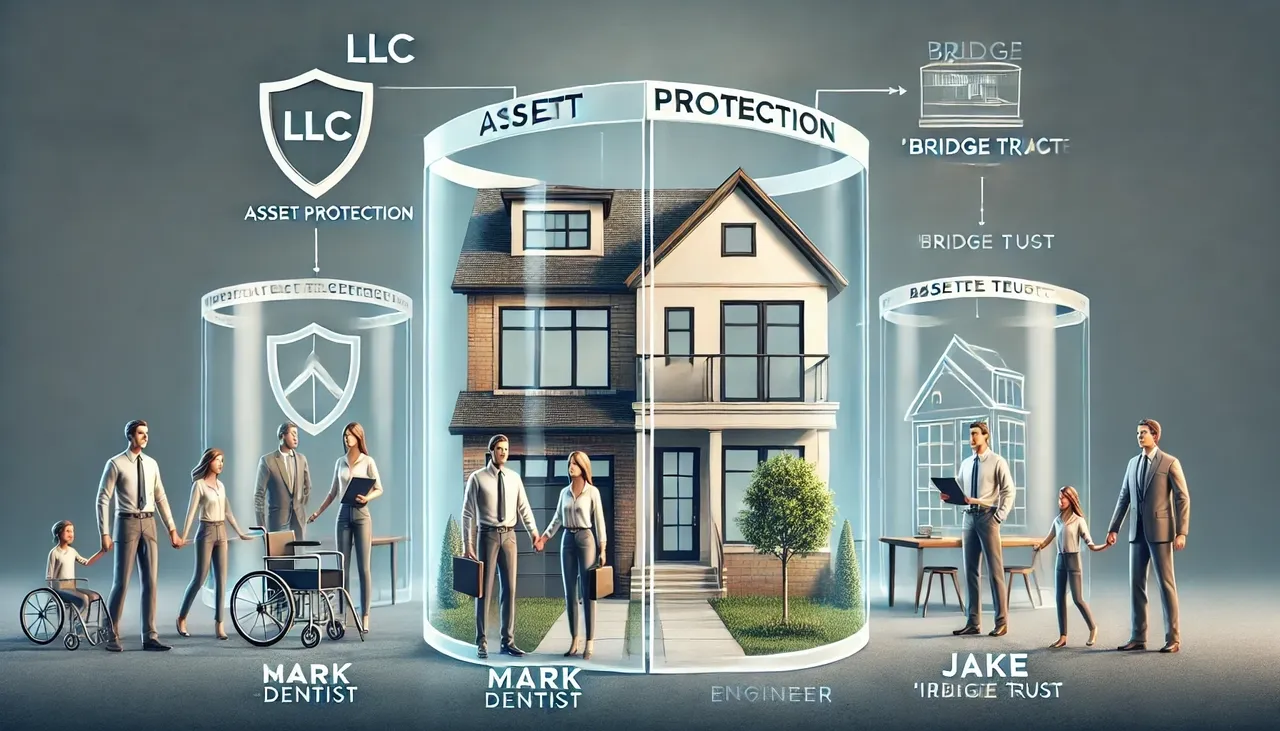
Mark, a successful dentist, and Jake, a computer engineer, decided to pool their resources to invest in rental real estate.
Mark had built a thriving practice, while Jake had done well in tech and crypto. Together, they purchased two duplexes in a growing neighborhood — both listed on the same title, owned jointly.
Everything seemed perfect at first. The brothers split expenses, hosted family gatherings at their properties, and watched rental income grow. But beneath that success was a serious structural flaw — co-ownership without protection.
During a family dinner, Mark voiced concerns about malpractice lawsuits.
Jake admitted his own worries about potential liability from client data breaches.
“I guess we’ll just cover each other,” Jake joked. But that was exactly the problem.
By sharing ownership personally, they had unknowingly tied each other’s fortunes together.
If Mark were ever sued, Jake’s share of the duplexes could be at risk — and vice versa.
In the eyes of the law, a creditor could attach liens, force partition, or compel a sale of Mark’s ownership share to satisfy a judgment, even if Jake did nothing wrong.
⸻
⚖️ The Legal Reality in 2025: Shared Title = Shared Risk
Across the U.S., co-owned and inherited real estate continues to generate some of the most common intra-family lawsuits. According to 2024–2025 data from estate law sources:
• Partition actions — lawsuits forcing the sale of co-owned property — remain widespread. Any one owner can compel a sale, even if other siblings object.
• Creditor reach: A creditor can’t seize the entire property, but can force liquidation of the debtor’s share, often destabilizing or devaluing the asset.
• Ownership form matters: Tenancy in common is particularly risky, because each sibling’s share is individually attachable by creditors.
• Community property states increase this risk, as spousal claims can add new layers of exposure.
In short, when siblings share inherited property without legal separation, they inherit each other’s liabilities along with the real estate.
👭 The Sisters’ Story: Inheritance Without Protection
Lisa and Sarah inherited multiple properties from their parents — residential rentals and a few small commercial buildings. Their parents had worked hard but passed away without setting up any asset-protection plan.
The sisters kept the properties in their own names, co-managing everything. They agreed to “trust each other” and save legal costs. But when Lisa’s business was later sued for a contract dispute, that trust was tested.
Lisa’s creditors quickly discovered her ownership interests in the inherited properties.
Although Sarah wasn’t part of the lawsuit, the entire portfolio was suddenly at risk of forced sale or lien attachment.
What began as an inheritance turned into a potential loss — all because their parents didn’t structure ownership properly before passing, and the sisters didn’t restructure it afterward.
⸻
🚨 The Hidden Danger: Partition and Probate Chaos
In 2025, partition actions are among the top three causes of family property loss nationwide.
One heir can force a sale even if the others disagree.
Creditors can attach judgment liens to a debtor-sibling’s share.
And when combined with probate disputes or divorces, inherited property can become a legal minefield.
Real estate law firms continue to report cases where siblings lose inherited properties because one family member’s creditors demand liquidation, or because a lack of legal structure allows courts to compel sale of the entire property.
🧱 The Legal Fix: Separate, Structure, and Shield
Families like Mark and Jake — and Lisa and Sarah — could have avoided all of it with a layered legal structure that separates ownership, limits liability, and ensures IRS compliance.
Step 1: LLCs — Contain the Risk
Each property should be titled to its own Limited Liability Company (LLC).
If one property or sibling faces a lawsuit, the claim stays within that LLC and doesn’t endanger personal assets or other holdings.
Step 2: AMLP or Family Limited Partnership — Centralize Control
The siblings’ membership interests in those LLCs should be consolidated inside an Asset Management Limited Partnership (AMLP).
The AMLP allows unified management, keeps ownership proportional, and introduces charging-order protection—preventing creditors from taking control of the assets even if they win a judgment.
Step 3: Bridge Trust® — Final Firewall
To achieve maximum protection, the AMLP can be owned by a Bridge Trust®, a hybrid domestic-offshore trust that operates as a domestic grantor trust under IRC §§ 671–677 and § 7701 for IRS compliance.
No offshore reporting or Form 3520/FBAR is required until it “bridges” offshore under attorney supervision.
Once activated, it gains Cook Islands-level protection, where foreign judgments are not recognized and fraudulent transfer must be proven beyond a reasonable doubt.
This structure—LLC → AMLP → Bridge Trust®—is now the 2025 best practice standard for protecting inherited or co-owned family real estate.
⸻
💼 Estate Planning Before Death: How Parents Can Prevent It
Parents can eliminate these future headaches entirely by planning ahead:
• Title all family real estate inside an LLC before death.
• Place LLC ownership in a family AMLP or irrevocable trust with clear operating and buy-sell provisions.
• Integrate an asset protection trust (Bridge Trust® or equivalent) into the estate plan for ultimate flexibility and control.
This ensures the next generation inherits a protected structure — not just the property.
⸻
📈 The 2025 Reality: Inheritance Is Rising, So Is Risk
The U.S. is experiencing the largest intergenerational wealth transfer in history — with baby boomers passing on more than $70 trillion in assets, much of it in real estate.
As properties change hands, more heirs are discovering the hard truth: shared inheritance means shared liability.
Real estate is emotional, indivisible, and highly exposed to litigation. That’s why 2025 estate planners overwhelmingly recommend separating ownership through LLCs and trust layering rather than leaving property jointly titled among siblings.
⸻
💡 Key Lessons from the Siblings’ Stories
✅ Co-owning or inheriting property jointly without legal separation is dangerous — one lawsuit can jeopardize everyone’s assets.
✅ The best protection combines an LLC, Asset Management Limited Partnership, and a Bridge Trust®.
✅ Parents should pre-structure estates to prevent sibling disputes and creditor reach.
✅ Bridge Trust® structures remain fully IRS-compliant, court-defensible, and human-supervised — no automatic triggers.
✅ The right legal structure preserves family relationships while protecting wealth across generations.
⸻
⚙️ Conclusion: Protect Family Wealth Before It’s Too Late
Mark and Jake wanted to build their future. Lisa and Sarah just wanted to preserve their parents’ legacy. Both families learned the same lesson:
trust alone isn’t protection — structure is.
With proper planning, families can collaborate on investments, share success, and still keep individual liability separate.
The key is acting before conflict or crisis — not after.
“The Bridge Trust® combines domestic simplicity with offshore strength when you need it most.
Because you don’t rise to the level of your income — you fall to the level of your legal structure.”
Don’t let shared liabilities jeopardize your financial future. Separate your plans and protect your assets today!
Schedule a legal consultation with our experienced asset protection attorneys today at (888) 773-9399.
By: Brian T. Bradley. Esq.