

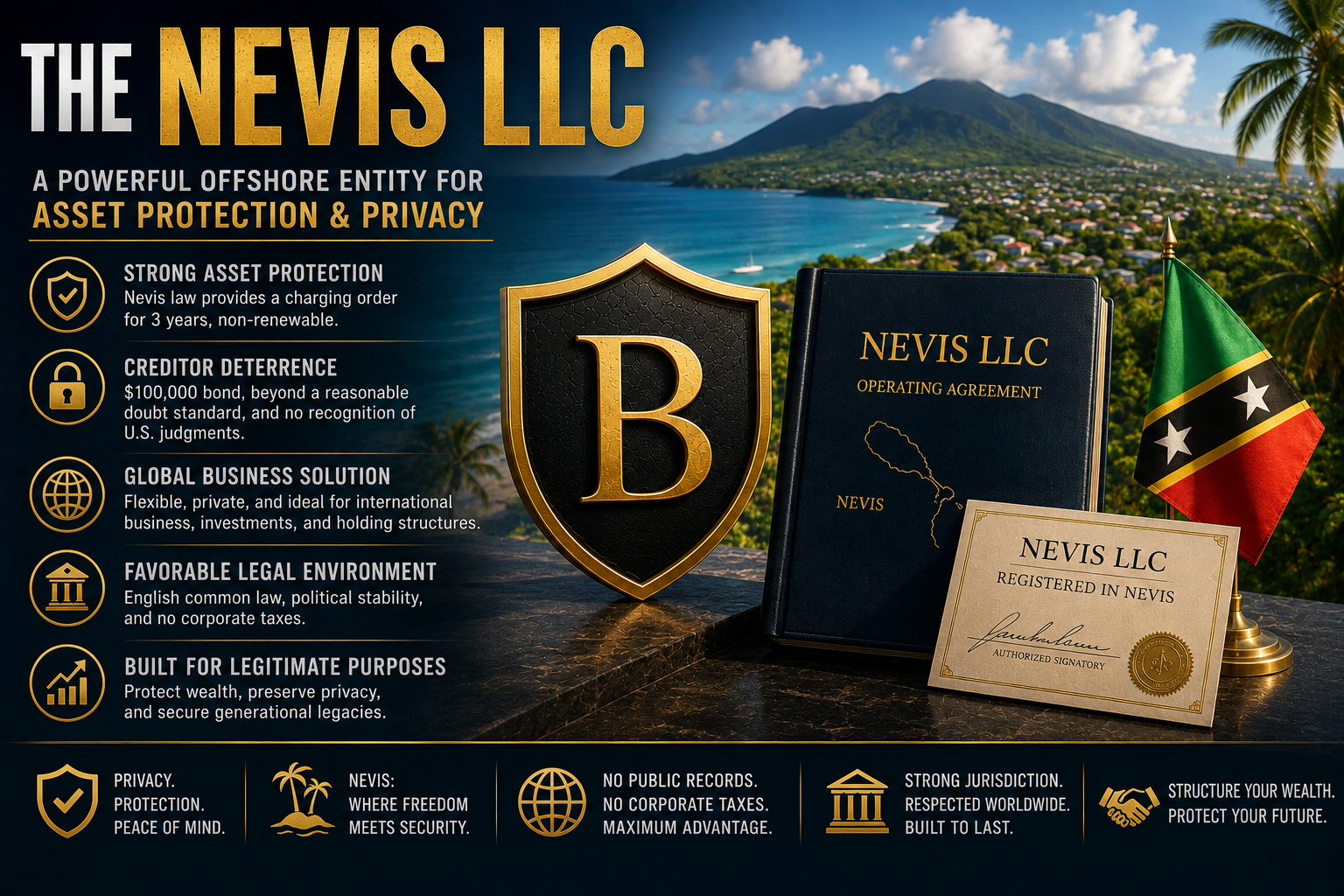
A Nevis LLC is a limited liability company formed under the Nevis Limited Liability Company Ordinance, and a Nevis trust is formed under the Nevis International Exempt Trust Ordinance. Both give a creditor a hard road: no recognition of foreign judgments, a substantial bond required before filing, a beyond-a-reasonable-doubt burden on fraudulent transfer, and short limitation periods. Neither reaches U.S. real estate, and neither exempts you from U.S. tax reporting.
This page covers what each one actually does, what they cost, how they compare to the Cook Islands, and where they fit in a structure.
Key Points
- The charging order is the exclusive remedy against a Nevis LLC member’s interest, and it expires after three years and cannot be renewed.
- Single-member Nevis LLCs get the same statutory protection as multi-member. That is the opposite of U.S. law, where single-member is the weakest position.
- Fraudulent transfer must be proven beyond a reasonable doubt under §61(1) of the LLC Ordinance — plus proof that the transfer caused insolvency.
- The limitation period is an absolute bar — two years from accrual, or one year from the transfer.
- The $100,000 creditor bond is a trust-ordinance mandate, not an LLC requirement. For LLCs the court imposes security for costs at the same benchmark.
- Nevis does not recognize foreign judgments. A U.S. creditor has to re-litigate the underlying claim locally.
- Nevis does not protect U.S. real estate. Land is governed by the law where it sits.
- Nevis is not a tax structure. U.S. persons file the same returns and more of them.
Where Is Nevis and Why Does Its Law Matter?
Nevis is part of the Federation of St. Kitts and Nevis in the Eastern Caribbean, with a legal system built on English common law. It enacted its Asset Protection Trust ordinance in 1994 and its Limited Liability Company Ordinance in 1995, deliberately following the Cook Islands model, and has amended both since.
Nevis built its statutes for one purpose: to make creditor enforcement uneconomic for anyone holding a foreign judgment. It is not an accident of the legal system there. It is the product.
Nevis is a co-equal offshore jurisdiction, not a discount version of the Cook Islands. That framing matters, because the way Nevis is usually marketed — as the budget option — understates what the statute does. On every load-bearing point that decides whether a creditor can reach assets, Nevis and the Cook Islands are functionally equivalent: neither recognizes foreign judgments, both apply a beyond-a-reasonable-doubt standard to fraudulent transfer, both impose short limitation periods, and both require a creditor to post a bond before filing.
Cost is a real difference. It is not the difference in protection.
In practice I work with licensed trustees in more than one offshore jurisdiction and place each client with the one that fits their facts. Which jurisdiction is right for a given structure is a design question, not a price question.
What Is a Nevis LLC?
A limited liability company formed under the Nevis Limited Liability Company Ordinance. It functions much like a U.S. LLC for tax and operational purposes — pass-through treatment, member-managed or manager-managed — but the creditor remedies available against a member’s interest are dramatically narrower than in any U.S. state.
The term appears in searches both as “Nevis LLC” and as “Nevis limited liability company.” Same entity.
For U.S. tax purposes it is typically treated as a foreign disregarded entity if single-member, or a foreign partnership if multi-member, unless an election is made otherwise. It does not reduce U.S. tax. It is not a tax structure at all.
What it changes is the enforcement math.
What Does the Nevis LLC Ordinance Actually Provide?
Five features that operate together: an exclusive charging order that expires in three years, a bond requirement before a creditor can file, a criminal-standard burden of proof on fraudulent transfer, a short limitation period, and non-recognition of foreign judgments.
The charging order is the exclusive remedy, and it is narrower than any U.S. equivalent. A creditor obtaining one gets no voting rights, no management control, and no ability to force a distribution. And it expires after three years and cannot be renewed — a feature no U.S. state offers. A creditor who waits out a Nevis charging order gets nothing and has to start over.
The burden of proof on fraudulent transfer is beyond a reasonable doubt. Under §61(1) of the Nevis Limited Liability Company Ordinance (Cap. 7.04), a creditor seeking to set aside a transfer of property to an LLC must establish intent to defraud beyond a reasonable doubt — a criminal standard applied in a civil proceeding — and must additionally prove the transfer rendered the member insolvent. Two independent burdens, one of them the highest in law.
The limitation period is a hard bar. Under §61(4), an action is absolutely barred if not brought within two years of the cause of action accruing, or within one year of the date of the transfer. Not a presumption, not a tolling framework — a bar.
Nevis does not recognize or enforce foreign judgments, including U.S. judgments. A creditor cannot arrive with a U.S. judgment and domesticate it. They must re-litigate the underlying claim from scratch, in Nevis, under Nevis law, against the criminal standard, within that window.
On the bond, a distinction worth getting right. The frequently cited $100,000 creditor bond is a statutory requirement under the trust ordinance, not the LLC ordinance — and most content on this topic conflates the two.
§61 of the Nevis International Exempt Trust Ordinance (Cap. 7.03) requires a creditor to deposit a bond of $270,000 with the Ministry of Finance before bringing an action against trust property. Under the interpretation clause at §2 of Cap. 7.03, “dollars” means Eastern Caribbean dollars, and at the fixed rate of 2.70 XCD to 1.00 USD that is exactly $100,000 USD.
For a Nevis LLC, that fixed figure is not written into Cap. 7.04 as an automatic requirement. Instead, the High Court exercises its ordinary civil-procedure authority to require out-of-jurisdiction creditors to post security for costs, and courts have consistently treated the $100,000 figure as the working benchmark.
The practical effect on a contingency-fee creditor is similar either way. The legal basis is not the same, and anyone describing the LLC bond as a statutory mandate has not read the ordinance.
Single-member LLCs receive the same statutory protection as multi-member. This is worth pausing on, because it is the exact inverse of U.S. law. In Florida, Olmstead and Fla. Stat. §605.0503(4) authorize foreclosure against single-member interests. In California, the Curci alter-ego reasoning applies most forcefully to sole members. In Oregon, ORS 63.259 is silent on exclusivity. In the U.S., single-member is the weakest position on the charging-order axis. In Nevis it is not a weakness at all.
Statutory citations verified as of September 2026. Nevis has amended both ordinances since enactment; verify against current text at each annual review.
Can the Offshore Trustee Simply Refuse to Serve?
No, not in a properly built structure — because the decision to serve is made at the outset, not in the middle of a crisis. The Special Successor Trustee is a signatory party to the trust agreement from formation, and completes its due diligence and acceptance before any threat exists.
This is the most common attack on any hybrid or standby offshore structure, and it deserves a direct answer.
The concern is real when the trustee is merely named in a document it has never seen. A trust that identifies a future offshore trustee without that trustee ever having reviewed the file, run compliance, or agreed to anything is relying on a stranger’s cooperation at the worst possible moment.
That is not how this is structured. The Special Successor Trustee signs the trust agreement as a party, alongside the settlors, trustees, and Protector. KYC, due diligence, compliance review, and onboarding are all completed at formation — the fundamental decision about whether the trustee is willing to serve is made at the outset, before any threat exists, not after an Event of Duress has been declared.
Upon a properly declared Event of Duress, the trustee completes its acceptance, arranges for the trust to be registered in Nevis, and administers it thereafter under Nevis law and the governing documents.
Refusal without legitimate fiduciary grounds would carry contractual, fiduciary, reputational, and regulatory consequences for a licensed trust company. And if a named successor genuinely cannot serve, the instrument gives the Trust Protector authority to appoint another — the drafted answer to exactly this objection.
There is also a historical answer. In FTC v. Affordable Media, the offshore trustee refused a U.S. federal court’s repatriation order twice, then defeated the FTC in the offshore forum with costs awarded against the agency. When the mechanism has been tested under maximum pressure, it has held.
If you are evaluating a structure and this is the question holding you up, raise it in a consultation. There is documentation on this point I can walk you through directly.
What Is a Nevis Trust?
An international trust formed under the Nevis International Exempt Trust Ordinance, holding assets under Nevis law with a licensed Nevis trustee. It carries the same core creditor deterrents as the LLC — no recognition of foreign judgments, a bond requirement, a criminal burden of proof, and a short limitation period.
The Nevis trust is the jurisdiction’s answer to the Cook Islands trust, and the statutory architecture is deliberately parallel.
Formation requires a licensed Nevis trustee, a trust deed, and registration. The settlor may retain certain powers, though as with any asset protection trust, retained control is the variable most likely to defeat the structure in a U.S. contempt proceeding — a point FTC v. Affordable Media settled and every serious practitioner designs around.
The protection operates on the same principle as the LLC, with one difference in the bond. A U.S. judgment is not enforceable in Nevis. But for trust property, the bond is a statutory mandate rather than a matter of court discretion — §61 of the Nevis International Exempt Trust Ordinance (Cap. 7.03) requires a creditor to deposit $270,000 XCD, or $100,000 USD at the fixed rate, with the Ministry of Finance before bringing an action against trust property.
That is a hard gate. A creditor’s attorney must front six figures, in a foreign jurisdiction, before making a single argument — and then still meet a beyond-a-reasonable-doubt standard within a short limitation window.
Where it is used: offshore investment holdings, international business interests, intellectual property, and as an alternative to a Cook Islands trust for clients where cost is a meaningful factor.
Where it is not: U.S. real estate, U.S.-sited operating businesses, or any situation where the settlor cannot genuinely relinquish control.
Nevis vs. Cook Islands: Which One?
Statutorily they are close to equivalent — both refuse foreign judgments, both apply a beyond-a-reasonable-doubt fraud standard, both impose short limitation periods and bond requirements. The differences are cost and tested case law. Nevis is meaningfully cheaper. The Cook Islands has the deeper judicial record.
| Nevis | Cook Islands | |
|---|---|---|
| Recognizes U.S. judgments? | No | No |
| Fraud burden of proof | Beyond a reasonable doubt — LLC Ordinance §61(1) | Beyond a reasonable doubt |
| Limitation period | Absolute bar: 2 yrs from accrual / 1 yr from transfer — §61(4) | Short, measured from transfer |
| Creditor bond | $270,000 XCD (~$100,000 USD) mandated for trusts — Trust Ordinance §61; security for costs at court’s discretion for LLCs | Statutory bond required |
| Charging order term (LLC) | Three years, non-renewable | N/A |
| Single-member LLC protection | Same as multi-member | N/A |
| Tested case law | Thinner | Deeper — Anderson, Grant, Riechers |
| Relative cost | Lower | Higher |
The Cook Islands’ advantage is not statutory. It is evidentiary.
In FTC v. Affordable Media, LLC, 179 F.3d 1228 (9th Cir. 1999), the Cook Islands trustee refused a U.S. federal court’s repatriation order — twice, including after the settlors tried to install their children as replacement trustees. The FTC then litigated in the Cook Islands and lost on every point on August 10, 1999, with costs awarded against it. The assets never came back.
That is a documented record of the jurisdiction performing under maximum pressure. Nevis has the statutes. It has less of the courtroom history.
For most clients, the statutory protection is what matters and Nevis is sufficient. For clients facing sustained, well-resourced adversaries — or where the difference in cost is immaterial relative to what is at stake — the Cook Islands’ track record is worth paying for.
What Does a Nevis LLC or Trust Cost?
Formation and annual maintenance vary by provider and complexity. As a general range, a Nevis structure typically runs lower than a comparable Cook Islands structure at both formation and annually. Ask any provider for a written schedule covering formation, trustee or registered agent fees, annual government fees, and U.S. tax preparation.
Cost is one of the most common searches on this topic, and it deserves a straight answer rather than a “contact us.”
The honest version: quoted ranges vary widely depending on whether you are buying a bare entity from a formation agent or a designed structure from counsel, and whether the quote includes the U.S. tax compliance that follows.
The line item most people forget is annual U.S. reporting. A Nevis LLC or trust generates filing obligations that a domestic structure does not, and the preparation cost is recurring. That is a real number and it belongs in any comparison.
[CONFIRM: the prior version published specific ranges — $10,000–$35,000 setup and $5,000–$10,000 annual for Nevis, $25,000–$40,000 and $5,000–$10,000 for the Cook Islands. Those figures are unsourced. Confirm they reflect your current engagement structure or they should stay out, because a published price a prospect can hold you to is a different thing from a market estimate.]
What Are the U.S. Reporting Requirements?
Substantial, and non-negotiable. A Nevis structure is legal and it is not private from the IRS. Depending on how the entity is classified and what it holds, you may file Form 8858, Form 5471, Forms 3520 and 3520-A, Form 8938, Schedule B, and an FBAR.
Form 8858 — for a single-member Nevis LLC treated as a foreign disregarded entity.
Form 5471 — where the foreign entity is treated as a corporation.
Forms 3520 and 3520-A — for foreign trusts and transactions with them.
Form 8938 (FATCA) — for specified foreign financial assets above the reporting thresholds.
Schedule B (Form 1040) — foreign account disclosure.
FinCEN Form 114 (FBAR) — where aggregate foreign account balances exceed $10,000 at any point in the year.
The penalties are why this matters more than the forms suggest. Foreign trust reporting failures under IRC §6677 carry a penalty of the greater of $10,000 or a percentage of the amount transferred or of trust assets. Willful FBAR violations can reach 50% of the account value. These penalties are measured against your assets, not against tax owed — you can owe zero additional tax and still face six-figure exposure from a missed form.
On the Corporate Transparency Act: under FinCEN’s March 2025 Interim Final Rule, foreign entities not registered to do business in the U.S. are treated differently from domestic entities for beneficial ownership reporting purposes.
[CONFIRM: CTA requirements have moved repeatedly and this page has not been updated since November 2025. Verify FinCEN’s current position before publishing.]
When Should You Not Use a Nevis LLC?
For U.S. real estate, for anything where you cannot genuinely relinquish control, and if the appeal is avoiding disclosure. Offshore ownership does not override a U.S. court’s authority over U.S. land, and a Nevis entity is legal but fully reportable.
U.S. real estate. Real property is governed by the law of the place it sits. United States v. Huckaby, No. 2:23-cv-00587-DAD-JDP (E.D. Cal. Mar. 2, 2026) applied exactly this reasoning — under Restatement (Second) of Conflict of Laws §280, creditor rights against land are determined by the law of the situs, not the law of wherever the holding entity was registered. You cannot move dirt. Use a state-matched U.S. LLC for real estate, held inside the larger structure.
If the appeal is avoiding reporting. A Nevis entity is entirely legal and entirely reportable. Anyone selling it as a way to stay invisible to the IRS is describing a crime, not a structure.
If you cannot relinquish control. Every adverse offshore case turns on retained control or reactive timing. A structure where you keep the ability to reverse the protection is a structure a U.S. court will use against you personally.
If the timing is already bad. Structures built after a claim is foreseeable are voidable transfers, and offshore ones additionally invite contempt exposure.
Where Does a Nevis LLC Fit in a Real Structure?
As one layer, not as the structure. Risk assets sit in state-matched U.S. LLCs. Those interests are held by a limited partnership with statutory charging-order exclusivity. The partnership interest is held by a trust carrying offshore jurisdiction from inception.
Layer one — state-matched LLCs. Operating and investment assets are held in LLCs formed where the asset sits, so the entity’s governing law matches the law that will control in an enforcement proceeding.
Layer two — the asset management limited partnership. The LLC interests flow up into an Arizona limited partnership, where A.R.S. §29-3503 makes the charging order the exclusive remedy against a limited partner’s interest, with no foreclosure authorization in the statutory text.
Layer three — the Bridge Trust®. The partnership interest is held inside the trust.
Two independent tax rules apply, and conflating them is the most common error in commentary on this structure. Because the instrument is drafted to satisfy the court test and control test of Treas. Reg. §301.7701-7 — the two-part test under IRC §7701(a)(30)(E) — the IRS classifies it as domestic. Separately, it is drafted to maintain grantor-trust status under IRC §§671–677, so income is reported on your own return. One rule determines domestic-versus-foreign classification. The other determines who reports the income.
The trust is foreign in legal character and registered offshore from inception, in Belize, with a pre-committed Special Successor Trustee in a co-equal jurisdiction such as the Cook Islands or Nevis. During normal operations it runs domestically — no Form 3520 or 3520-A, no offshore filing burden.
If a legitimate creditor threat arises, an independent Trust Protector — an attorney exercising professional judgment, not the settlor — may declare an Event of Duress. That declaration is the trigger, and it is what separates this from automatic designs: nothing fires on the filing of a complaint. Once declared, the instrument operates and the Protector may appoint the offshore trustee.
No structure guarantees an outcome, and no honest lawyer promises a courtroom result. What a properly built and properly timed structure changes is what a creditor can reach and what it costs to try.
Nevis FAQs
What is a Nevis LLC? A limited liability company formed under the Nevis Limited Liability Company Ordinance. It offers pass-through treatment for U.S. tax purposes and far narrower creditor remedies than any U.S. state provides.
Is a Nevis LLC legal for a U.S. citizen? Yes. It is fully legal and fully reportable. It does not reduce U.S. tax and it does not exempt you from disclosure.
How long does a Nevis charging order last? Three years, and it cannot be renewed. That is a feature no U.S. state offers.
Are single-member Nevis LLCs protected? Yes — the same as multi-member entities under the ordinance. That is the reverse of U.S. law, where single-member is the weakest position.
Does Nevis recognize U.S. court judgments? No. A creditor must re-litigate the underlying claim in Nevis, under Nevis law, from the beginning.
Is there really a $100,000 bond? For trusts, yes — it is a statutory mandate. §61 of the Nevis International Exempt Trust Ordinance requires a creditor to deposit $270,000 XCD, which is $100,000 USD at the fixed 2.70 rate, with the Ministry of Finance before bringing an action against trust property. For LLCs, the figure is not written into the ordinance; the High Court imposes security for costs on out-of-jurisdiction creditors and has treated $100,000 as the working benchmark. Most articles on this topic conflate the two.
How long does a creditor have to challenge a transfer to a Nevis LLC? Under §61(4) of the LLC Ordinance, an action is absolutely barred if not brought within two years of the cause of action accruing or one year of the date of the transfer.
What does a creditor actually have to prove? Under §61(1), intent to defraud beyond a reasonable doubt — the criminal standard — and separately that the transfer rendered the member insolvent. Two burdens, not one.
Nevis or Cook Islands — which is better? Neither is better. They are co-equal jurisdictions on every point that decides whether a creditor can reach assets — no recognition of foreign judgments, a criminal burden of proof on fraudulent transfer, short limitation periods, bond requirements. Nevis costs less. The Cook Islands has the deeper tested record, including Anderson, where the trustee refused a U.S. federal court and the FTC then lost in Cook Islands court with costs awarded against it. Which one fits is a design question, not a price question.
Can the offshore trustee refuse to step in when it matters? Not in a properly built structure. The Special Successor Trustee signs the trust agreement as a party at formation and completes due diligence and acceptance before any threat exists — the decision to serve is made at the outset, not during a crisis. If a named successor genuinely cannot serve, the Trust Protector may appoint another.
Does a Nevis LLC protect my U.S. real estate? No. Land is governed by the law of the place it sits, which is what Huckaby applied in 2026. Real estate goes in a state-matched U.S. LLC inside the structure.
What forms do I have to file? Depending on classification and holdings: Form 8858 or 5471, Forms 3520 and 3520-A for trusts, Form 8938, Schedule B, and an FBAR. Penalties are measured against asset value, not tax owed.
Can I set up a Nevis structure after I’ve been sued? No. A transfer made after a claim is foreseeable is voidable, and an offshore transfer at that stage adds contempt exposure on top of the fraudulent transfer problem.
The Bottom Line
Nevis has built one of the strongest creditor-deterrence statutes in the world, and the three-year non-renewable charging order plus single-member parity are genuine advantages over anything available domestically.
It is also not a tax strategy, not a privacy strategy from the IRS, and not a solution for U.S. real estate. And like every offshore structure, it works because of timing and control — not because of geography.
The jurisdiction is a tool. Whether it belongs in your structure depends on what you own, where you own it, and how much time you have before something happens.
You don’t rise to the level of your income. You fall to the level of your legal structure.
Structure before stress.
📞 For a confidential legal consultation, contact Bradley Legal Corp. at (888) 773-9399, or complete the intake questionnaire at btblegal.com.
By: Brian T. Bradley, Esq. – Asset Protection Attorney


