

Marcus owned twelve rental properties spread across four states—Washington, Texas, Florida, and Arizona, with three properties in each state. Each state had its own LLC, formed locally to match the jurisdiction. His stock portfolio was pushing $3 million, and he held passive limited-partner interests in three syndications. By any measure, Marcus had built something substantial.
What he did not have was a structure above the LLCs. Everything flowed up to him personally. The LLC membership interests were assets he owned. The brokerage account was in his name. The syndication K-1s reported income directly to his Social Security number.
When a tenant injury lawsuit in Texas produced a jury verdict exceeding his insurance coverage by $1.4 million, the plaintiff’s attorney requested financial disclosures and began mapping Marcus’s balance sheet.
⸻
Why the Wyoming LLC Answer Is the Wrong Question
Wyoming LLCs do offer real advantages. Wyoming requires no public disclosure of member names, maintains investor-friendly statutes, and provides genuine privacy benefits. For investors who want anonymity in ownership records, Wyoming can be a useful tool.
But Marcus wasn’t asking about privacy. He was asking about protection. And those are two very different things.
A Wyoming LLC formed as a management company above Marcus’s state LLCs runs into a fundamental issue: enforcement jurisdiction follows the debtor, not the entity. Courts typically apply the forum state’s enforcement procedures when determining how a judgment creditor may reach a debtor’s assets. That means a creditor enforcing a Texas judgment against Marcus may ask a Texas court what remedies are available under Texas enforcement law, even if the entity holding the asset was formed in another state.
Privacy is also the first thing to go once a judgment exists.
Post-judgment discovery — written interrogatories to a judgment debtor, and a debtor’s examination under oath — asks Marcus directly what he owns and what entities he is involved in. An anonymous formation filing protects against a stranger running a search. It does very little against a creditor with a judgment and a courtroom.
Marcus would own and manage the Wyoming LLC himself. In single-member structures like this, courts often conclude that the policy rationale behind charging-order protection—protecting innocent co-members from disruption—does not apply. Florida’s Supreme Court reached exactly that conclusion in Olmstead v. FTC, 44 So.3d 76 (Fla. 2010), ordering a debtor to surrender all right, title, and interest in a single-member LLC; Florida had to amend its statute the following year to close the hole. The Wyoming LLC as a management company therefore gives Marcus an additional entity, but it does not meaningfully change what courts can compel.
The Limited Partnership as the Management Company
Most investors are familiar with limited partnerships from the outside.
They have participated in real estate syndications as limited partners. They contributed capital, received periodic K-1s, had no management authority, and understood their liability was limited to their investment.
What many investors never consider is using that same statutory structure inside their own asset-protection architecture.
That is precisely what the Asset Management Limited Partnership (AMLP) is designed to do.
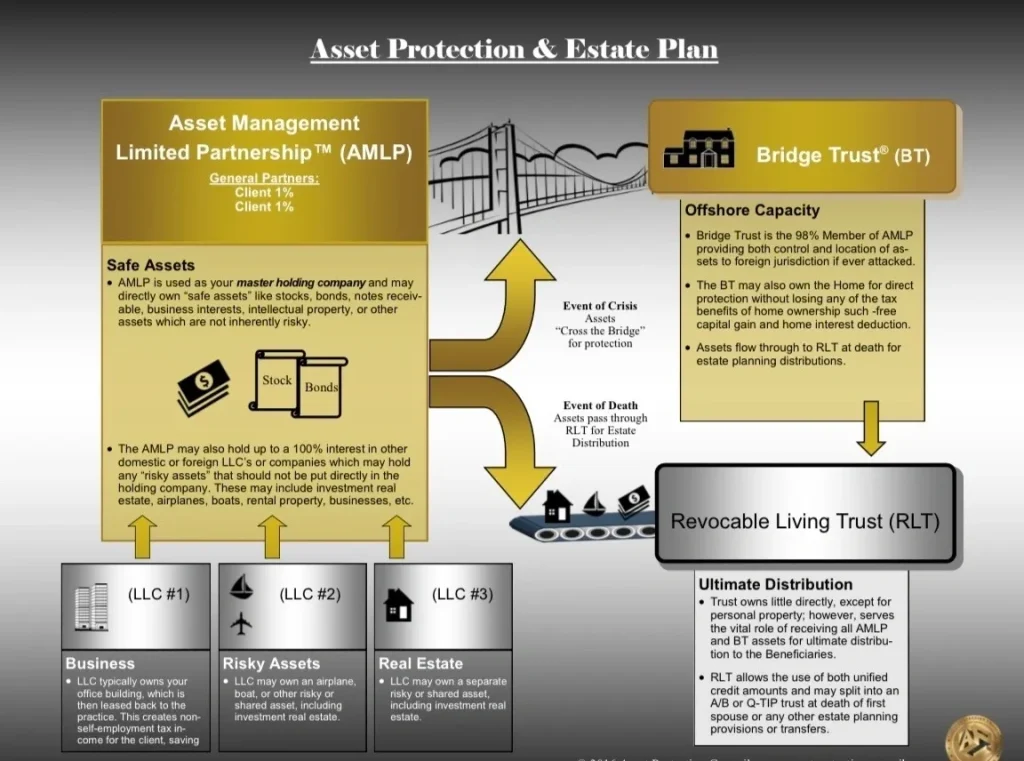
The AMLP is an Arizona limited partnership that functions as the master holding company and management hub for the entire structure. It sits above the operating LLCs and owns their membership interests. It can also hold brokerage assets, syndication interests, and other investment positions as a centralized ownership vehicle.
Because the entity is a limited partnership rather than an LLC, the legal relationship between Marcus and his assets changes.
In the AMLP structure:
- Marcus serves as a general partner, responsible for management decisions.
- The Bridge Trust® serves as the 98% limited partner, holding the equity ownership.
This separation matters.
Marcus’s personal balance sheet is no longer defined by direct ownership of the underlying assets. Instead, his role is primarily managerial.
That distinction becomes critical when a creditor attempts to enforce a judgment.
A creditor holding a judgment against Marcus personally does not thereby reach the AMLP’s underlying assets. The partnership owns the operating LLCs, the brokerage accounts, and the partnership investments. Marcus owns an interest in the partnership. Those are different things, and the law does not collapse them. California’s Supreme Court put it plainly decades ago: a limited partner “is given no property interest in the specific partnership assets as such,” and those assets are therefore “not available to satisfy a judgment against the limited partner in his individual capacity.” Evans v. Galardi, 16 Cal.3d 300 (1976). The court also held that the size of the partner’s ownership stake does not change the analysis.
The statutory remedy available under Arizona law is a charging order against Marcus’s partnership interest.
A charging order grants the creditor the right to receive distributions if and when they are made.
It does not grant control over the partnership, management authority, or access to the underlying assets. Courts elsewhere have drawn the same boundary — holding that a charging-order creditor gets no participation in partnership decisions, no consent rights, no access to partnership information, and no accounting. Green v. Bellerive Condominiums Limited Partnership, 135 Md. App. 563 (2000); Gaslowitz v. Stabilis Fund I, LP, 331 Ga. App. 152 (2015).
Two limits belong here, and I would rather Marcus hear them from me. A structure does not launder a fraudulent transfer: assets moved into an entity after a claim is foreseeable remain attackable under voidable-transaction law, and courts routinely unwind them. And charging-order exclusivity is a rule about how a judgment creditor collects — it does not survive a bankruptcy filing, where 11 U.S.C. § 541 pulls the interest into the estate and a trustee may succeed to control rights. Fursman v. Ulrich (In re First Protection, Inc.), 440 B.R. 821 (9th Cir. BAP 2010). Timing and solvency do the work here, not the entity type.
⸻
Why Arizona Is Used for the Limited Partnership
The choice of Arizona is not arbitrary.
Arizona partnership law includes specific statutory features that make it well suited for this role in a layered structure.
Under A.R.S. § 29-341, the charging order is not merely the usual remedy — it is the stated one. The section provides that a judgment creditor of a partner may obtain a charging order, that “to the extent so charged, the judgment creditor has only the rights of an assignee of the partner’s partnership interest,” and that “this section provides the exclusive remedy by which a judgment creditor of a partner may satisfy a judgment out of the judgment debtor’s interest in the partnership.” The creditor does not obtain voting rights or management authority and cannot force liquidation of the partnership’s assets.
What is not in § 29-341 matters as much as what is. There is no foreclosure provision — no authority for a court to foreclose the charged interest and sell it. That omission reads as deliberate when you set the section beside A.R.S. § 29-1044(B), which governs Arizona general partnerships and expressly provides that “the court may order a foreclosure of the interest subject to the charging order at any time.” Same title, same subject, different answer. The legislature wrote a foreclosure remedy where it wanted one.
I will be straight about the limits of that argument. No Arizona appellate court has yet construed § 29-341, so the analysis rests on the statutory text and on decisions from other states applying the same formula. The Oregon Supreme Court, construing an identical exclusive-remedy provision, cut back a creditor’s attempt to load a charging order against several limited partnerships with disclosure requirements and transaction restrictions — precisely because the charging order exists to prevent an invasion of the rights and interests of the non-debtor partners. Law v. Zemp, 362 Or. 302 (2018). That is persuasive authority, not controlling authority, and the distinction is worth knowing before someone else points it out.
Arizona law also lets the partnership agreement decide, in advance and in writing, when a limited partner may step out. A.R.S. § 29-333 provides that “a limited partner may withdraw from a limited partnership at the time or upon the happening of events specified in writing in the partnership agreement.” That is a drafting tool, not a courtroom argument. The triggering events are defined at formation, in the document itself, in peacetime — which is the only time they can be defined cleanly.
Two conditions have to be built for that to work, and neither comes free with the form. First, A.R.S. § 29-334(A) sets Arizona’s default the other way: on the withdrawal of a limited partner, “except as otherwise provided in writing in the partnership agreement,” the withdrawn partner has no right to a distribution by reason of the withdrawal and holds only an assignee’s rights. The distribution consequence has to be written in; the statute will not supply it. Second, A.R.S. § 29-337 bars any distribution that would leave the partnership’s liabilities exceeding the fair value of its assets, and fraudulent-transfer law sits on top of that. A provision drafted years before any claim exists is governance. The same provision exercised after a claim is visible is the transfer a plaintiff’s lawyer builds a case around.
This is an important structural distinction from the Wyoming LLC scenario.
Rather than relying on an out-of-state statute being respected elsewhere, the AMLP is formed in the jurisdiction whose law governs the partnership itself.
What Changes for Marcus
Before implementing the structure, Marcus’s balance sheet was fully accessible.
His LLC membership interests were assets he owned personally. His brokerage account was in his name. His syndication K-1s identified him as the direct investor.
A judgment creditor could pursue those assets through ordinary enforcement procedures.
After restructuring, the same assets still exist.
But their ownership pathway changes.
The operating LLCs remain in the states where the properties are located. That first layer isolates operational liability between individual assets.
Above those entities sits the AMLP, which holds the membership interests in the LLCs as well as Marcus’s brokerage assets and syndication interests.
A judgment creditor pursuing Marcus personally can reach only his partnership interest through a charging order.
Above the AMLP sits the Bridge Trust®, which holds the majority limited-partner interest.
During normal operation, the Bridge Trust is drafted to be treated as a domestic grantor trust under IRC §§ 671–677 and § 7701, maintaining IRS transparency and tax compliance.
If enforcement pressure escalates significantly, control — not ownership — may shift to an independent offshore trustee under the trust’s governing instrument.
Jurisdictions such as the Cook Islands do not automatically recognize U.S. judgments and require independent local proceedings before enforcement can occur, including proof of a fraudulent disposition under a heightened evidentiary standard.
The debt against Marcus remains real.
What changes is what a creditor can compel through enforcement. No structure makes anyone judgment-proof, and no lawyer can promise a courtroom outcome.
Tax and Lending Considerations
The AMLP can also provide structural advantages for investors managing larger portfolios.
Partnership tax rules allow guaranteed payments under IRC § 707(c) — payments to a partner for services or the use of capital, determined without regard to partnership income, which are generally deductible by the partnership and taxable as ordinary income to the recipient partner. Where a general partner performs real management work, that structure lets the compensation be treated as what it is rather than as a naked draw.
The comparison worth being precise about is not limited partnership versus LLC. It is partnership tax treatment versus owner draws. A multi-member LLC taxed as a partnership can make guaranteed payments under § 707(c) on the same terms. What many investors actually have is a single-member LLC disregarded for tax purposes, where distributions are simply owner draws that create no entity-level deduction. The AMLP brings the assets under one partnership return with a real management arrangement documented on top of it. Any specific treatment should be confirmed with your CPA.
For financing purposes, lenders evaluating real-estate investors often rely heavily on partnership K-1 income when it shows consistent distributions, documented guaranteed payments, and a clear partnership balance sheet.
A partnership structure that produces stable K-1 history can therefore help present a clearer financial picture during underwriting.
⸻
The Takeaway
Marcus’s first instinct — forming a Wyoming LLC as a management company — reflects what many investors believe is the logical next step in an asset-protection strategy.
Wyoming does provide privacy advantages, but this differs fundamentally from actual protection mechanisms. A single-member management LLC owned and controlled by the same individual doesn’t meaningfully change what courts can compel when enforcing a judgment.
A limited partnership functions as the second layer in a structure introducing something an LLC doesn’t always provide: statutory separation between ownership and management. This separation changes how creditor remedies operate.
The AMLP sits at the center of the structure not because it is exotic, but because it aligns with long-standing partnership law designed to protect passive capital and preserve business continuity.
The properties remain where they are. The equity remains real. What changes is the path a creditor must follow to reach it — and it only changes if the structure was built before the claim, not after.
📞 Ready to build a real asset protection system? Call Bradley Legal Corp. at (888) 773-9399 to schedule your consultation. You don’t rise to the level of your income — you fall to the level of your legal structure.
By: Brian T. Bradley, Esq.