
A client can owe zero additional tax on a foreign trust and still face a six-figure penalty. If you send a client offshore without pricing that in, you are the one who gets the call three years later.
I want to write this one for the CPAs, wealth managers, and financial advisors who send me clients — because you are the professional standing closest to this decision, and the one most exposed if it goes sideways. When a client sets up a fully foreign trust on someone else’s advice and discovers the real cost later, they do not go back to the person who sold it. They come to you and ask why you did not warn them.
So here is the math I would want you to run before you bless a fully foreign structure.
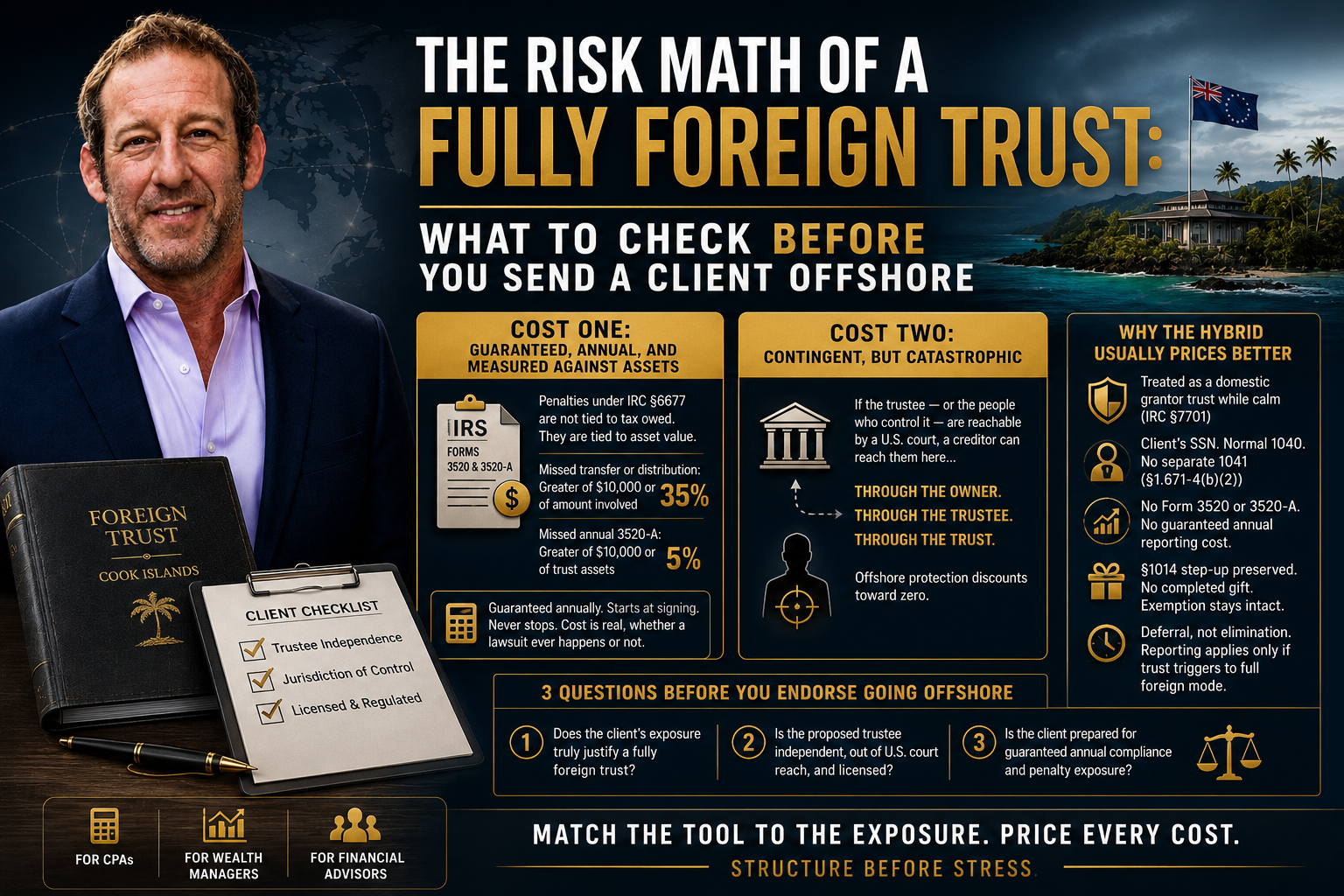
Cost One: Guaranteed, Annual, and Measured Against Assets
A foreign trust triggers reporting under IRC §6048 — Form 3520 on creation and on every reportable transfer or distribution, and Form 3520-A every year. These are information returns. They generally produce no tax. The penalties under §6677 are the problem, and they are not tied to tax owed. They are tied to asset value.
For a missed or incomplete transfer or distribution: the greater of ten thousand dollars or thirty-five percent of the amount involved. For a missed annual 3520-A: the greater of ten thousand dollars or five percent of the trust assets treated as owned by the U.S. person — for a foreign grantor trust, five percent of the entire trust.
Make it concrete. A client funds the trust with two million in securities, later moves in a one-million-dollar LLC interest, and takes a two-hundred-fifty-thousand-dollar distribution. Miss the funding on the reporting and the exposure is seven hundred thousand dollars — thirty-five percent. Miss the distribution and add roughly another eighty-seven thousand. Every dollar of income can be reported correctly on the 1040 and the penalty still lands. No underpayment required.
Two traps you already know your clients will walk into. First, timely filing is not a safe harbor — §6677 penalizes incomplete or incorrect returns too, so a client can file every form on time and still get assessed because one transaction was omitted or one hard-to-value asset was valued wrong. Second, the constructive-benefit problem — an LLC held by the trust pays what looks like an ordinary expense, a meal, travel, a manager reimbursement, and it can become a reportable event with no bright-line answer.
Then the recurring hard cost. These are specialist returns; many preparers decline them. Realistically several thousand dollars a year — commonly in the range of thirty-five hundred to eight thousand, more for complex structures — on top of trustee and legal fees. Over the life of the trust, six figures is routine, none of it tied to any actual litigation.
Frame it for the client the way I do. The lawsuit is contingent — it may never happen. This reporting cost is guaranteed — it starts at signing and never stops. Most foreign-trust pitches only price the contingent risk. You are the one positioned to price the guaranteed one.
Cost Two: Contingent, but Catastrophic
The second cost is not annual. It is the risk that the protection is worth far less than the fee at the one moment it is tested.
A foreign trust’s strength comes entirely from a trustee that no U.S. court can command. If the people who control that trustee are themselves reachable by a U.S. court — say the trustee company is owned by a U.S.-based professional inside U.S. jurisdiction — then a creditor never has to leave the country. It reaches the owner here, and through the owner, the trustee, and through the trustee, the trust. The offshore protection quietly discounts toward zero, and no one finds out until a judgment is already in hand.
So the independence questions belong on your checklist as much as mine. Who owns the trustee. Whether the people controlling it sit outside U.S. court reach? Whether it is a licensed, regulated trust company with a track record? If the person selling the trust also owns the trustee, that is a conflict and a structural weakness in one — flag it.
Why the Hybrid Usually Prices Better
Here is the part that matters most to a tax professional, because it is where the mechanics are cleanest.
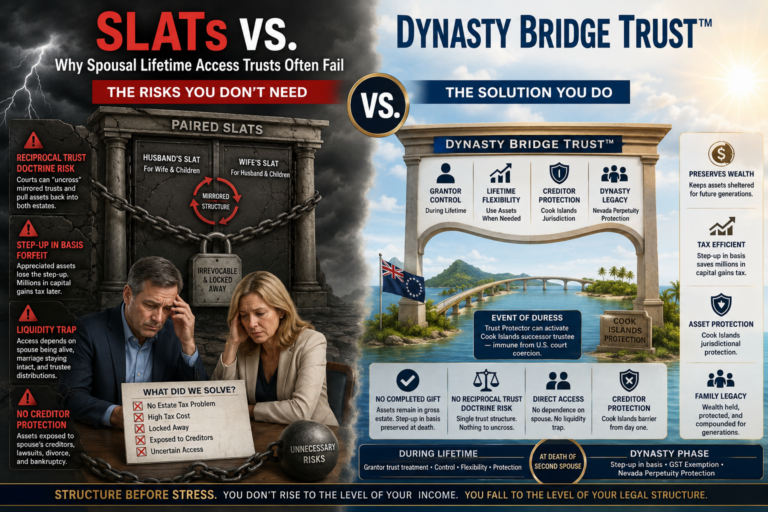
While a Bridge Trust® is calm, it is treated as a domestic grantor trust for tax purposes under IRC §7701 and the grantor-trust rules. That means the client’s own SSN, a normal 1040, no separate 1041 under Treas. Reg. §1.671-4(b)(2), and — critically for your planning — no Form 3520 or 3520-A. The §1014 step-up in basis is preserved because the trust is disregarded during life, and there is no completed gift, so lifetime exemption stays intact. Cost One simply does not accrue.
Be precise with your client about the boundary, because I am. This is deferral, not elimination. If the trust ever has to cross into full foreign mode to defend against a real creditor threat, the foreign reporting regime — 3520, 3520-A, FBAR, FATCA — does apply from that point. The advantage is that most clients never trigger, so most never carry that burden at all. They pay for protection only if and when they actually need it.
The Three Questions Before You Endorse Going Offshore
Before you sign off on a fully foreign structure for a client, I would ask three things.
One. Does the client’s actual exposure — the size and the litigation profile — genuinely justify a fully foreign trust, or is it being sold one size too large?
Two. Is the proposed trustee independent, outside U.S. court reach, and licensed, or is it owned by the person selling the trust?
Three. Is the client truly prepared for guaranteed annual compliance and its penalty exposure, for a threat that may never materialize?
If the honest answers do not line up, the client probably needs the hybrid, not the full offshore machine — same protection, same flexibility, without the guaranteed annual bill or the completed-gift and step-up costs.
That is the entire job — matching the tool to the exposure, and pricing every cost, not just the one on the brochure. Any attorney who resists getting on the phone with you, the client’s tax advisor, before this decision is made is someone I would be wary of. I would rather have that call first than clean up after it.
Structure before stress.
By: Brian T. Bradley, Esq.