
Someone scheduled a legal consultation with me last spring after watching my videos. Emergency medicine physician, thirteen years in. Several million in real estate, an interest in a surgical center, a brokerage account, a paid-off home. He understood he had exposure. That’s why he called.
Then he learned what a comprehensive plan costs. He canceled two days out.
Not because he decided he didn’t need protection. Because someone had already told him all he needed was an LLC and an umbrella policy — and once he had that sentence in his head, every number above it looked like a markup.
That’s becoming one of the most expensive misconceptions I encounter.
The question he was actually asking wasn’t “why is this so expensive.” It was: why does one attorney tell me an LLC is enough while another recommends a structure that costs sixty times more?
That’s a fair question. Here’s the honest answer.
Why the confusion exists
It isn’t that people are unsophisticated. The people who call me are physicians, developers, founders, and investors. They’re rigorous everywhere else in their financial lives.
The confusion exists because five different professionals use the same two words to describe five different jobs.
Your insurance broker says he protects your assets. Your CPA says she helps protect your assets. The online formation service advertises asset protection. Your estate planning attorney describes his work as protecting what you’ve built. And so do I.
Every one of us is telling the truth. We’re all talking about different risks.
Nobody in that list is doing anything wrong. But when five people describe five different products with one phrase, a consumer reasonably concludes he’s already bought the thing — and stops looking.
Four different questions
Rather than ranking these, look at what each one is actually built to answer. They aren’t competing tiers. They’re separate problems with separate legal machinery.
Insurance asks: is this claim covered? It’s the first line of defense and it should be. It’s efficient, it defends you, and it resolves the overwhelming majority of what actually happens.
Business entities ask: does this liability stay inside the business? An LLC exists to keep a claim arising from the business from reaching the owner personally.
Estate planning asks: what happens when I die or become incapacitated? Who inherits, who manages, how do we avoid probate, how does wealth transfer efficiently. Excellent work, essential work, and entirely oriented toward a different event.
Asset protection asks: what stands between a future creditor and the wealth I hold right now, while I’m alive and healthy? Different objective. Different bodies of law — creditor rights, fraudulent transfer, conflict of laws, trust situs. Different engineering.
An estate planning attorney is not failing at asset protection any more than a cardiologist is failing at reading a shoulder MRI. Both are physicians. Only one does shoulders. The failure isn’t that anyone gave bad advice — it’s that a question got answered by someone who was never asked it.
Now the four places that separation breaks down in practice.
Misconception one: an LLC protects everything
An LLC isolates liability that arises inside the entity. Tenant injured at a properly capitalized, properly maintained rental LLC — that claim generally stops at the entity.
That’s inside liability, and it’s the smaller half.
The larger half is outside liability: the malpractice verdict, the auto accident, the personal guarantee, the business dispute that names you personally. There the creditor isn’t attacking the LLC at all. He has a judgment against you, and your membership interest is simply an asset he executes against. What you’re relying on then is the charging order — and charging-order protection is far less uniform than the internet suggests.
In Olmstead v. FTC, 44 So. 3d 76 (Fla. 2010), the Florida Supreme Court held the charging order was not the exclusive remedy against a single-member LLC; the creditor reached the entire interest. California’s LLC statute, Corp. Code §17705.03, contains no blanket exclusivity of the kind owners assume. And in Curci Investments, LLC v. Baldwin, 14 Cal. App. 5th 214 (2017), a California court permitted reverse veil-piercing to reach LLC assets for a member’s personal debt despite sole-remedy language.
I won’t tell you single-member LLCs are routinely pierced — that overstates what the law supports. The accurate statement is narrower and sufficient: a single-member LLC may provide considerably less protection than its owner assumes, particularly against personal creditors and in states whose law lets a creditor reach the interest itself. It is the weakest position on the charging-order axis, and it’s what online formation defaults to.
One related point, since it usually travels with this one. Under the Corporate Transparency Act, 31 U.S.C. §5336, beneficial-ownership reporting exists at the federal level. Whatever the current state of that regime, the strategic lesson holds: anonymity was never protection. It was obscurity, and obscurity survives until the first subpoena.
And forming in a debtor-friendly state doesn’t import that state’s law into your fight. The court hearing the case applies its own state’s public policy. The Illinois Supreme Court said so in Rush University Medical Center v. Sessions, 2012 IL 112906. More recently, in United States v. Huckaby, No. 2:23-cv-00587-DAD-JDP (E.D. Cal. Mar. 2, 2026), a self-settled Nevada spendthrift trust could not shield California real property from a federal judgment lien — the court applied California law because the land is in California, and under Cal. Prob. Code §15304 a settlor cannot also be the protected beneficiary. That’s a district-court order granting partial summary judgment, not binding appellate authority, and I’ll say so. It’s still a clean picture of the failure mode. Formation state is not enforcement state.
Misconception two: insurance solves everything
Insurance is your first line of defense, not your last. Those aren’t competitors. They’re teammates, and the mistake is fielding one of them alone.
Every policy has limits, and your exposure doesn’t observe them. A $2 million umbrella against $6.4 million of net worth leaves the top $4.4 million with nothing in front of it.
Every policy has exclusions, and the claims most likely to end a financial life are disproportionately found inside them. California Insurance Code §533 bars indemnity for a willful act; most states apply an equivalent public policy, and punitive damages are uninsurable in many jurisdictions.
Every policy carries coverage risk — reservation-of-rights letters, denials, and the bad-faith litigation that follows, all arriving at the worst possible moment. And under many policies, defense costs erode the limits while you’re using them.
Finally, your carrier’s incentive is to settle inside its limits. Yours is to survive above them. Those are not the same interest.
If a verdict exceeds the policy, or the carrier denies coverage, you don’t wish you’d bought another umbrella. You wish you’d had a structure.
Misconception three: my living trust protects me
A revocable living trust provides zero lifetime creditor protection. That isn’t a criticism of the instrument — it’s the design. It’s revocable. You can pull the assets back, which means a creditor can reach them. California states it outright at Prob. Code §18200: during the settlor’s lifetime, revocable trust property is subject to the claims of the settlor’s creditors. Other states say the same thing in their own language.
The instrument is doing exactly what it was engineered to do. It was engineered to answer the death-and-incapacity question, and it answers it well. It was never built to stand in front of a judgment.
Misconception four: asset protection should be inexpensive
This is the one worth sitting with, because it’s a market conditioning problem more than a legal one.
The last twenty years taught consumers that legal services are commodities.
An LLC for $99.
A will for $299.
A trust for $999.
That conditioning is correct for a large share of the population, which is exactly why it’s so durable — some people genuinely do need the $99 version and nothing more.
It stops being correct at the point where someone has three, ten, or fifty million dollars exposed and is one adverse event away from discovering that these were never the same product.
So why does one cost $500 and another $35,000?
Not because one attorney charges more per hour. Because you’re buying three things, and only one of them is on paper.
A diagnosis. Which assets are exposed and which aren’t, which liabilities are inside versus outside, which state’s law governs each piece, where the seams are, and — the question almost nobody asks — what you’d actually need on the day someone is holding a judgment. That analysis is the work. Documents are its output.
Integration. State-matched LLCs isolating risk by class at the bottom, a limited partnership as the management and holding layer above them, and an asset protection trust at the top holding the partnership interest — ownership separated from control. Under A.R.S. §29-3503, for example, the charging order is the exclusive remedy against an Arizona limited partner’s interest, with no access to voting, management, or liquidation. That’s a materially different barrier than a membership interest in a single-member LLC. But it only works assembled. Entities bought separately from separate vendors don’t become a system; they become a pile.
That system carries jurisdictional planning, trustee relationships, protector provisions, tax coordination so the structure stays tax-neutral rather than tax-reducing, custom drafting rather than a template, and ongoing administration — plus the accumulated creditor-rights case law that sits behind each provision and the reason it’s worded the way it is.
Time. This is the one that cannot be purchased later at any price.
Under the Uniform Voidable Transactions Act — Cal. Civ. Code §§3439.01 et seq. and every state’s analog — a transfer made with intent to hinder, delay, or defraud a creditor can be unwound, with a four-year reach and a discovery-rule tail. In bankruptcy, 11 U.S.C. §548(e) extends a ten-year lookback for transfers into a self-settled trust. A structure built before any claim is on the horizon starts a clock running in your favor. A structure built after a claim appears starts an argument you will probably lose.
The $35,000 plan and the $500 LLC aren’t two prices for one product. They’re two different products, and one of them includes the only component with an expiration date.
The comparison people are actually making
Consumers compare legal products when they should be comparing legal objectives and outcomes.
They set an LLC beside a layered trust structure and ask which is the better value, the way you’d compare two sedans. But that’s comparing a Honda Civic to a Formula One car because both have four wheels.
A Civic is an excellent machine. Safe, reliable, and for the overwhelming majority of driving, the correct purchase. Nobody needs an F1 car to get to the office.
An F1 car isn’t a nicer Civic. It’s a different machine solving a different problem — surviving forces the Civic was never engineered to encounter. Carbon monocoque, HANS device, crash structures tested to loads no consumer vehicle will ever see. You don’t buy it because it’s luxurious. You buy it because of what you’re about to drive into.
Nobody asks why open-heart surgery costs more than urgent care. Nobody asks why an architect costs more than house plans downloaded online. The question was never how much car do I want. It’s what am I about to hit.
So the better question isn’t why sophisticated asset protection costs $35,000. It’s this: why would anyone expect a legal system engineered to stand between millions of dollars and catastrophic litigation to cost about what it costs to file an LLC online?
Who each of these is actually for
I’d rather say this than have you hear it somewhere else.
If you’re starting your first business with modest assets, a W-2 income, no rental property, and limited liability exposure, an LLC and appropriate insurance may be entirely appropriate — and a $35,000 structure would be an expensive answer to a problem you don’t have. I’ll tell you that on the call.
What I build is designed for a specific profile: roughly $1 million to $25 million in exposed assets, real outside-liability exposure, and enough runway to plan before a claim exists. At that point the question isn’t whether an LLC is useful. It obviously is. The question is whether it’s enough.
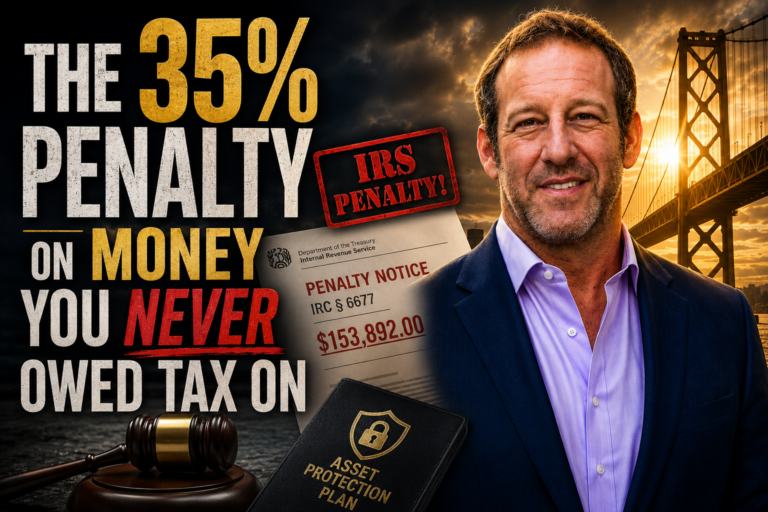
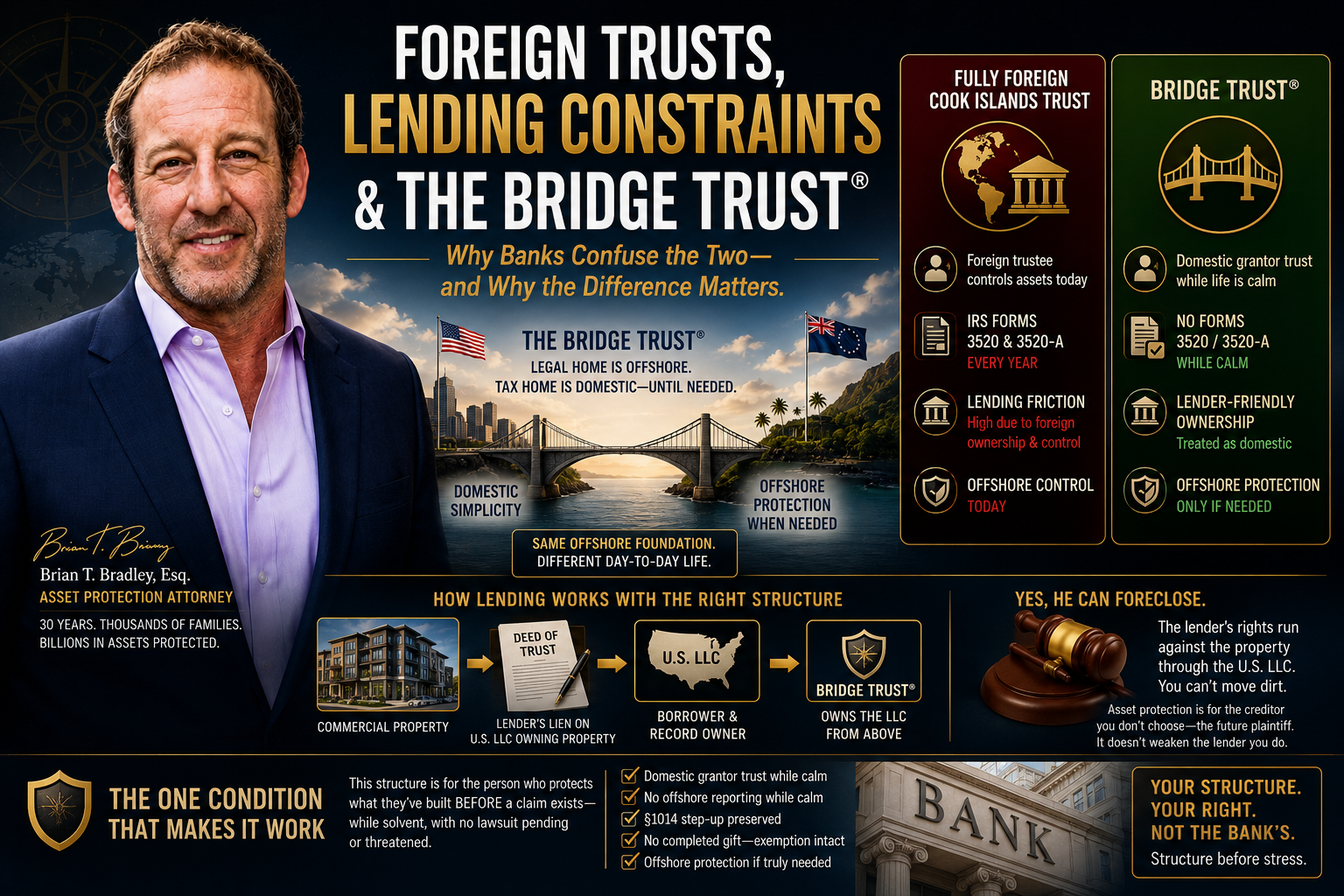
The reverse is also true. There’s a route that costs more than mine — a fully foreign trust, offshore from day one. It’s the right answer for some people, and I use those structures when the facts call for them. It also carries Form 3520 and 3520-A reporting from inception under IRC §6048, with penalties under §6677 reaching 35% of a transfer whether or not a dollar of tax is owed, plus annual preparation that routinely exceeds $100,000 across two decades. Most people who get sold one didn’t need one.
That’s the real landscape. Two wrong answers dominate this market — fully domestic in a state that won’t be doing the enforcing, or fully offshore with a compliance tail that eats you alive. The hybrid structure I build exists because most families sit between them.
What to do next
I spent my career on the plaintiff’s side of civil litigation before building an asset protection practice, and I work alongside a firm that has been doing this work since the field was created. I know how creditors use discovery. I know which structures collapse under a deposition and which ones change what the other side will accept.
I don’t sell certainty. No attorney, trustee, or bank can guarantee a legal outcome — mine included, and anyone promising otherwise is telling you something the rules forbid them to say. What a properly built structure changes is the position you negotiate from. Are you collectible? That’s usually the whole thing.
If you’re weighing a template LLC against a real layered out plan, don’t decide on price. Decide on exposure. Book a legal consultation, bring your actual numbers — assets, titling, entities, policy limits, states — and let’s find out what you’re carrying. If the answer is that you don’t need me, you’ll hear it in the first fifteen minutes.
The clock on all of this is already running, and it only runs one direction.
Structure before stress.
By: Brian T. Bradley, Esq.
Common questions
Does a single-member LLC protect personal assets from a lawsuit?
It protects against liabilities arising inside the entity. Against an outside judgment naming you personally, your membership interest is an asset the creditor pursues, and charging-order protection varies significantly by state — in Olmstead v. FTC a creditor reached the entire interest in a single-member LLC.
Does a revocable living trust protect assets from creditors?
No. Because it’s revocable, the settlor’s creditors can generally reach the assets during the settlor’s lifetime; California states this at Prob. Code §18200. A living trust answers probate and incapacity, not liability.
Is umbrella insurance enough for a high-net-worth family?
It’s the correct first layer and insufficient as the only layer. Limits, exclusions for willful acts, uninsurable punitive damages, coverage disputes, and defense-cost erosion all cap what it can absorb.
Why do asset protection quotes range from $500 to $50,000?
Because they aren’t the same product. The low end is a document. The high end is a diagnosis, an integrated multi-entity system, and protection established before a claim exists — the one element that cannot be added later.
Can I set this up after I’ve been sued?
Generally not effectively. Transfers made once a claim is foreseeable face voidable-transaction challenge under the UVTA, with a four-year reach and a ten-year lookback in bankruptcy under 11 U.S.C. §548(e).