
A financial advisor in Newport Beach had worked with a cardiothoracic surgeon for eleven years.
He managed the surgeon’s retirement accounts, investment portfolio, and family trust distributions. He knew his goals, his risk tolerance, and his family.
The plan was comprehensive.
Until it wasn’t.
Eighteen months ago, a malpractice claim came in above policy limits.
Discovery mapped every asset.
The revocable living trust — assumed to be protective — wasn’t.
It was fully reachable under California Probate Code §18200.
The portfolio was exposed. The real estate equity was exposed. Everything was visible.
The advisor called me after the settlement.
Not to understand what went wrong.
But to understand what he needed to do differently for the forty-three other clients in his book who looked exactly like this one.
That’s the conversation this article is meant to have.
⸻
The Gap Nobody Is Addressing
Most high-net-worth clients have two conversations happening in parallel:
With you:
Investment strategy, retirement planning, portfolio growth, and distribution modeling.
With their estate attorney:
Revocable trust, A/B structure, beneficiary designations, transfer at death.
Both are necessary.
Neither answers this question:
If a judgment is entered against your client tomorrow—what can a creditor actually collect?
That’s not an investment question.
That’s not an estate planning question.
That’s a collectability question.
And for most clients over $5M–$10M, it has never been answered.
⸻
What That Gap Actually Costs (You and the Client)
Consider a client with $20 million:
• Revocable trust
• Multiple LLCs
• Managed portfolio
• Standard insurance
A tenant claim comes in at $8 million.
Insurance covers $3 million.
The rest comes from the balance sheet.
The trust provides no barrier.
The entities provide limited resistance.
The assets are reachable.
The result:
• Forced liquidation of managed assets
• Capital gains triggered on sale
• Portfolio strategy disrupted
• Real estate refinanced or sold
• Retirement projections reset
This is not just a client problem.
It’s a practice-value problem.
A $4 million loss in client assets is:
• A direct reduction in AUM
• A reduction in recurring revenue
• A disruption to long-term planning
• And in some cases, a damaged client relationship
This outcome is not rare.
And it is almost always preventable—if the structure existed before the claim.
⸻
What the Dynasty Bridge Trust™ Actually Solves
This structure addresses two problems most plans leave open.
1. Lifetime Exposure (While Your Client Is Alive)
A lawsuit doesn’t just create liability.
It creates enforcement risk.
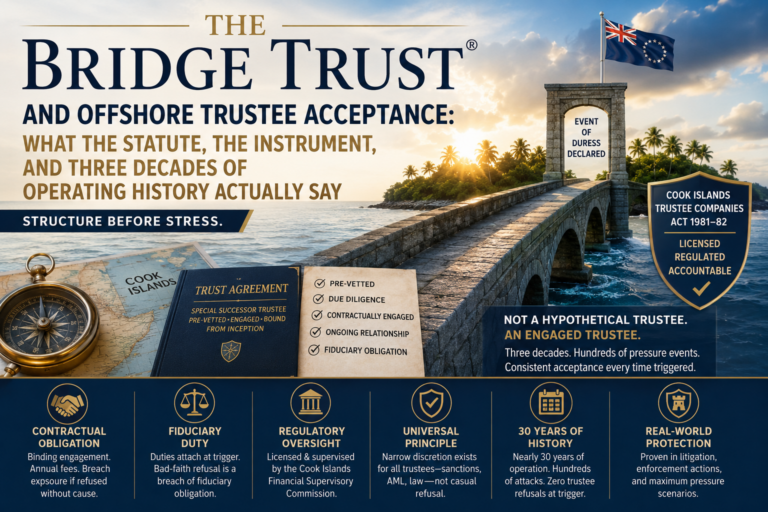
The Bridge Trust® component introduces a jurisdictional barrier.
This doesn’t eliminate liability.
It changes collectability.
It’s not about hiding assets.
It’s about changing where enforcement can legally occur.
During normal conditions:
• The trust functions as a domestic grantor trust (IRC §§671–677)
• Your client remains in control within the structure
• You continue managing the assets
• No offshore reporting requirements apply
If a serious legal threat arises, the structure’s built-in governance allows a shift in control to a jurisdiction that does not recognize U.S. judgments, significantly increasing the difficulty and cost of enforcement.
⸻
2. Generational Exposure (After Your Client Is Gone)
Standard estate plans transfer wealth.
They don’t protect it after transfer.
The dynasty trust layer ensures:
• Assets do not pass outright
• Beneficiaries receive distributions—not ownership
• Creditors cannot force distributions
• Divorce claims cannot reach principal
• Estate and GST taxes do not apply at each generational transfer
A $15 million estate growing at 6% over 40 years becomes approximately $155 million.
Inside a properly structured dynasty trust, that growth transfers without repeated taxation.
Outside of it, the erosion is substantial.
⸻
What This Means for Your AUM (The Real Question)
Advisors usually ask one question first:
“Do the assets leave my management?”
No.
• Accounts remain where they are
• Custody does not change
• Investment strategy does not change
• You remain the advisor
The only thing that changes is the legal ownership layer.
The trust becomes the account holder.
Your client acts through the structure as Investment Advisor.
Operationally, nothing changes.
Legally, everything does.
⸻
Five Questions to Ask at Your Next Review
You don’t need to explain the structure.
You need to identify the gap.
Ask:
1. What are the most realistic ways someone could sue you today?
2. If a $10M judgment hit tomorrow, which assets do you believe are protected?
3. Have you ever spoken with an asset protection attorney—not just an estate planner?
4. If your child went through a divorce, how protected would their inheritance be?
5. Do you have any personal guarantees or large contingent liabilities?
If there’s hesitation in any answer, the planning is incomplete.
⸻
How the Referral Works (Without Disrupting Your Relationship)
You position the conversation as a planning gap—not a product.
Example:
“I work with an attorney who focuses specifically on protecting high-net-worth clients from exactly this type of exposure. It’s a legal consultation, not a sales call, and everything is privileged. I’d like to connect you.”
From there:
• The legal analysis happens independently
• Your client’s financial data stays with you
• You remain the primary advisor relationship
• The structure is implemented without disrupting AUM
You are not replacing your role.
You are strengthening it.
⸻
What Your CPA Needs to Know
During normal operations:
• The trust is treated as a domestic grantor trust
• Income is reported on the client’s personal return
• No foreign reporting (Forms 3520/3520-A/FBAR) unless triggered
If the structure activates under stress:
• Foreign reporting requirements apply
• These are informational, not additional tax liabilities
• Proper coordination ensures compliance
Most CPA concerns come down to unfamiliarity—not complexity.
A short call resolves it.
⸻
The Clients in Your Book Who Need This Conversation
You already know who they are:
• The physician with growing malpractice exposure
• The real estate investor with concentrated equity
• The entrepreneur after a liquidity event
• The executive with concentrated stock and estate tax exposure
These clients trust you to see what they don’t.
And most of them have never been asked:
What happens if a judgment exceeds your coverage?
What happens when your children inherit outright?
⸻
The Question That Protects Both You and the Client
You’ve built the plan.
You’ve grown the assets.
You’ve structured the investments.
But if a major claim hits tomorrow—
does the structure actually hold?
And if it doesn’t—
are you going to find that out now…
or when it shows up in a settlement statement?
Structure before stress.
For a confidential legal consultation with an Asset Protection Attorney, contact Bradley Legal Corp. at (888) 773-9399
By: Brian T. Bradley, Esq. – National Asset Protection Attorney