
The Dynasty Bridge Trust™ is a single instrument that provides offshore creditor protection during your lifetime and continues into a dynasty phase after your death, so wealth passes to your children and grandchildren inside a protective structure rather than outright. It preserves the IRC §1014 step-up in basis that traditional completed-gift dynasty trusts forfeit, and it carries no offshore filing burden unless and until a real threat moves it into its foreign phase.
It is not two trusts. It is not a client shuttling between an estate planning attorney for the tax piece and an asset protection attorney for the lawsuit piece. It is one instrument doing both jobs, across your lifetime and across your family’s generations.
Key Points
In an illustrative $15M case, roughly $75 million more reaches the third generation, plus about $22.7 million in capital gains eliminated by the step-up.
One instrument, four layers. State-matched LLCs, an asset management limited partnership, the Bridge Trust®, and downstream dynasty provisions already written into the same agreement.
No separate dynasty trust to create later. Every Bridge Trust® already contains the language. The same trust continues into its dynasty phase through Continuing Beneficiary Trusts.
The step-up survives. Assets stay in your gross estate during life, so §1014 applies. A completed-gift dynasty trust gives that up.
No Form 3520 during the domestic phase. The foreign-trust reporting regime attaches only if an Event of Duress moves the trust offshore.
Your children never own the assets outright, so their creditors and divorcing spouses cannot reach what is held in trust.
The Problem, in One Client’s Words
A cardiothoracic surgeon in Orange County called me with what he described as an impossible problem.
He had built a practice worth $7.2 million, held a personal stock portfolio of just over $5 million, owned two commercial properties in Orange County, and operated three short-term rentals in Palm Springs through a management company he ran with his wife. His total exposed net worth was approaching $12 million.
He had done what his advisors recommended. His estate planning attorney had a Dynasty Trust drafted. His financial advisor managed the brokerage accounts. His CPA had set up LLCs for the rental properties. His malpractice carrier covered him at $2 million. On paper, each piece looked reasonable.
Then a malpractice claim came in on a case he believed was defensible. His attorney agreed it was defensible. The plaintiff’s attorney disagreed — and spent the first three months of discovery not litigating the medical facts but mapping every asset he owned. The brokerage accounts. The commercial properties. The rental income stream. The LLC structures. The Dynasty Trust his estate planning attorney had set up with him as a discretionary beneficiary.
California Probate Code §15304 rendered that trust’s spendthrift provisions void as to his own creditors. The LLCs held individual properties, but without a charging-order-exclusive holding structure above them, a California court could reach through to the underlying assets. The stock portfolio sat in his personal name, entirely exposed.
He settled for far more than his policy limit. The gap came out of his personal assets, and liquidation began.
He called me two months after the settlement closed and asked one question: “I’m rebuilding. Can I build one structure that protects me from lawsuits today and protects my kids after I’m gone?”
The answer is yes.
Why Do Two Separate Problems Require One Integrated Solution?
Because personal creditor exposure and generational exposure are structurally different legal problems, and the standard tools each solve one while leaving the other open. A dynasty trust gives the person who funds it no creditor barrier. A standard offshore trust gives the settlor a barrier but stops protecting when the settlor dies.
The first problem is personal creditor exposure. You are a physician, real estate investor, business owner, or entrepreneur operating in a high-liability environment. A lawsuit filed tomorrow could try to reach everything you own. The legal question is what enforcement barriers stand between a creditor’s judgment and your assets.
The second problem is generational, and it has two faces.
The tax face: everything above the federal exemption is exposed at death to a 40 percent federal estate and generation-skipping transfer tax — and one of the two exemptions that shelters your family is not portable between spouses, so it can be lost entirely if the planning is not in place before the first death.
The creditor face: if the transfer happens outright — a direct inheritance, a deed, a distribution — your children and grandchildren become the owners. Their creditors, their divorcing spouses, and any judgment against them can reach what you spent decades protecting.
Most structures solve one of these adequately. None of the standard domestic tools solve both. A dynasty trust is a powerful generational vehicle that provides no creditor barrier for the person who funded it in high-litigation states like California, New York, Florida, Texas, and Illinois. A standard offshore trust protects the settlor but lacks the dynasty provisions that keep protecting after the settlor’s death.
How Is the Dynasty Bridge Trust™ Structured?
Four layers in one ownership chain: state-matched LLCs hold the risky assets; a limited partnership holds the LLC interests and supplies charging-order exclusivity; the Bridge Trust® holds the partnership interest and supplies the offshore barrier; and dynasty provisions in the same instrument carry the wealth forward after death.
Layer one: state-matched LLCs
Individual risk assets — investment properties, business interests, high-liability holdings — are each held in separate state-matched LLCs. A California rental property in a California LLC; a Nevada property in a Nevada LLC. Matching the LLC to the state where the asset sits controls which state’s charging-order statute governs creditor remedies against that interest.
This layer answers the asset-placement problem that United States v. Huckaby, No. 2:23-cv-00587-DAD-JDP (E.D. Cal. Mar. 2, 2026) illustrated directly. Under Restatement (Second) of Conflict of Laws §280, creditor rights against real property are governed by the law of the state where the property sits. You cannot move dirt. Holding real estate inside a correctly matched LLC means a creditor reaches the LLC interest rather than the property, and the remedies against that interest are governed by the layers above it.
Each LLC is a separate liability firewall. A claim against one property does not cross-contaminate the others.
Layer two: the asset management limited partnership
The membership interests in the state-matched LLCs are held by an Arizona limited partnership — the Asset Management Limited Partnership. The client serves as general partner with a nominal 2 percent interest, retaining management control; the Bridge Trust® holds the 98 percent limited-partner interest.
Under A.R.S. §29-3503, a charging order is the exclusive remedy against a limited partner’s interest in an Arizona limited partnership. A court cannot force liquidation of partnership assets and cannot step into management. A creditor who obtains a charging order receives only the right to intercept distributions if and when the partnership chooses to make them.
Compare California’s own statute, Corporations Code §17705.03, which expressly authorizes foreclosure of a debtor’s transferable interest and contains no exclusive-remedy language. Arizona answered the exclusivity question that California left open.
That difference is also what ends most litigation before it escalates. A contingency-fee attorney who sees a charging order as the ceiling — distributions entirely at the partnership’s discretion — has little economic incentive to fund expensive litigation for an uncertain and illiquid return.
[CONFIRM: the live version says “Arizona appellate authority has recognized charging-order exclusivity for limited-partnership interests” without naming a case, and the sentence is grammatically broken. I have removed it rather than leave an uncited claim on your highest-value product page. If you have the citation, it belongs here and it strengthens the section considerably.]
Layer three: the Bridge Trust®
The Bridge Trust® holds the 98 percent limited-partner interest and sits at the top of the ownership chain.
It is not a domestic trust and it is not a Domestic Asset Protection Trust. It is one trust that carries two legal identities at once — think of it as holding two passports.
Two separate rules are doing two separate jobs, and conflating them is the most common error in commentary about this structure:
- Domestic-versus-foreign classification is determined by the court test and control test in Treas. Reg. §301.7701-7, under IRC §7701(a)(30)(E). The trust satisfies both during the domestic phase, so the IRS classifies it as domestic.
- Who reports the income is determined separately, by the grantor-trust rules at IRC §§671–677. The instrument is drafted to establish and maintain grantor-trust status, so income is reported on your own return and the trust is disregarded for income-tax purposes.
A green-card holder is a foreign national taxed as a U.S. resident. The Bridge Trust® is a foreign trust taxed as a domestic one. Foreign in legal character, domestic for tax — no contradiction, and still only one trust.
The registration is real and it is immediate. The trust is registered offshore at inception — in Belize, whose international-trust statute does not entertain a foreign-law fraudulent-transfer claim against a qualifying trust from the date of registration — with a pre-committed Special Successor Trustee standing ready in a co-equal jurisdiction such as the Cook Islands or Nevis.
The point is not to hide anything or to defeat a legitimate creditor. It is that the jurisdictional firewall exists from day one, for a trust funded while the settlor has clean hands and no claim on the horizon. Those jurisdictions do not recognize U.S. judgments. A creditor has to start over locally, under local law, against a beyond-reasonable-doubt standard for fraudulent-transfer claims, within short limitation periods, after posting a substantial upfront bond, and subject to fee-shifting that puts a losing plaintiff on the hook for both sides’ costs. For the overwhelming majority of contingency-fee creditors, that is economically prohibitive.
The structure does not make a judgment disappear. It changes the position a creditor negotiates from.
One thing worth knowing about how the instrument is written, because it tells you what this is and is not: the trust contains an express anti-fraud carve-out stating on its face that it is not intended to defraud legitimate creditors, launder funds, or shield criminal proceeds. That language is in the document. A structure built to hide assets does not write that clause.
During normal operations the Bridge Trust® functions as a domestic grantor trust. You report all income on a personal U.S. return. No Form 3520. No annual offshore compliance overhead. No foreign banking complexity. The offshore capacity is built in and available, but dormant.
The Event of Duress mechanics
When a legitimate creditor threat arises, the Trust Protector — an independent professional party, not the settlor — may issue a written Declaration of Duress. The instrument provides that the Protector’s determination is final and binding without court approval or a court proceeding.
The distinction between what happens automatically and what happens by fiduciary judgment is worth stating precisely, because it is the difference between a defensible structure and one a court calls built-in obstruction.
Mandatory on declaration. Standing consents are revoked. The grantor’s powers to appoint or remove the Protector and the Special Successor Trustee are suspended. Distributions are suspended. Further amendment is barred. The settlor does not have to act, and cannot act.
Discretionary thereafter. The Protector may remove the domestic trustee and install the pre-committed offshore Special Successor Trustee. The Protector may change governing law or situs. The Protector may move title or custody. These are fiduciary judgments exercised by an independent party, not a mechanical switch that fires on the filing of a complaint.
That successor trustee is not a stranger summoned in a crisis. It signs the trust agreement as a party at inception, with KYC, due diligence, and onboarding completed years in advance.
This is also the structural answer to the restraining-order argument critics rely on. A restraining order aimed at a domestic trustee cannot reach a Trust Protector’s written declaration, because the Protector is a separate party acting under separate authority. The mechanism does not require the domestic trustee to resign on command, or assets to physically migrate offshore in real time during litigation.
Across roughly three decades these structures have drawn court challenges over three hundred times — about four a year — and where a structure was properly established and funded in time, no court has forced assets out of one. That is platform history and leverage, not a guarantee. No honest lawyer promises a courtroom outcome.
Layer four: the dynasty phase
There is no separate dynasty trust. This is the point most explanations get wrong, including some written about this structure.
At the death of the second spouse, the same instrument continues into its dynasty phase — carrying wealth forward through Continuing Beneficiary Trusts under the same master agreement rather than through a newly created vehicle. Every Bridge Trust® already contains this language. A trust established today purely for lawsuit protection can carry into its dynasty phase later without drafting a new instrument or making a transfer a creditor could attack.
The governing law is Nevada, with a built-in authorization to migrate to South Dakota or another advantageous jurisdiction if Nevada’s law changes. Nevada permits a 365-year term under NRS 111.1031 — the state abolished the common-law rule against perpetuities — and imposes no state income tax on trust income. California, by contrast, follows the Uniform Statutory Rule Against Perpetuities with a 90-year ceiling and permits no perpetual trusts.
The beneficiary — your child or grandchild — did not fund the trust, does not control it, and has no unfettered access to principal. Distributions are at the discretion of an independent trustee, consistent with health, education, maintenance, and support as defined in the instrument. Because the beneficiary is not the settlor of these downstream trusts, the self-settled-trust doctrine does not apply.
That distinction is what makes the protection survive the transfer. Cal. Prob. Code §15304, N.Y. EPTL §7-3.1, Fla. Stat. §736.0505, Tex. Prop. Code §112.035, and 760 ILCS 3/505 all reach only the settlor’s own beneficial interest in a self-settled arrangement. A child receiving discretionary distributions from a properly structured third-party trust is protected from their own creditors, a divorcing spouse, and any judgment entered against them for as long as the assets remain inside the structure.
Does the Dynasty Bridge Trust™ Preserve the Step-Up in Basis?
Yes, and this is the structural advantage that decides the choice for most families. Because the trust is an incomplete-gift grantor trust, the assets remain in your gross estate at death and receive the IRC §1014 step-up. A traditional dynasty trust is funded as a completed gift, so the assets are out of the estate and the step-up goes out with them.
Under IRC §1014, when an asset that is part of the decedent’s gross estate passes to heirs, its basis resets from original cost to fair market value at death.
A founder who bought $200,000 of company stock that grew to $8 million during her life — holding it inside a structure that keeps the asset in her estate — dies with that stock at an $8 million basis. Her heirs can sell it the next day and pay no federal capital-gains tax. The $7.8 million of appreciation accrued during her life is wiped clean.
A traditional dynasty trust forfeits this entirely. Funding it is a completed gift that removes assets from the estate. Not in the estate at death means §1014 does not apply. The heirs inherit the original $200,000 basis and pay capital-gains tax on the full $7.8 million when they sell. At combined federal and state rates frequently above 30 percent, that is more than $2.3 million of liability.
The specific mechanism, since a good CPA will ask: the instrument gives the grantor a non-fiduciary power of substitution under IRC §675(4)(C) — the ability to reacquire any trust asset by substituting property of equivalent value. That swap power is what maintains grantor-trust status, which is what keeps §1014 alive. The step-up is a function of compliant drafting, not of jurisdiction, and it is not something any trust gets automatically.
The Dynasty Bridge Trust™ avoids the trade-off by using each treatment at the right time. During life: assets in the estate, grantor has full access, step-up preserved, offshore barrier defending against creditors. At the second death: step-up captured, GST exemption allocated, trust moves into its dynasty phase.
For families below the federal exemption — $15 million per individual, $30 million per couple in 2026, permanent and indexed — this is the argument that ends the discussion. The exemption shelters the assets from estate tax. Grantor-trust status preserves the step-up. The dynasty phase extends the wealth without erosion at each transfer. All three at once.
An advisor who recommends a completed-gift dynasty trust to a family below the exemption is trading away a significant tax benefit for transfer-tax planning the exemption alone already accomplishes.
What Does the 40% Generational Tax Actually Cost?
On an illustrative $15 million estate growing at 6% across two 25-year generations, roughly $88.7 million is extracted in transfer tax without planning. With the Dynasty Bridge Trust™, one taxable transfer occurs instead of two — leaving approximately $74.9 million more to the third generation, plus about $22.7 million in capital gains eliminated by the step-up.
The lawsuit is the visible risk. The generational tax is the quiet one, and across a few decades it is usually the larger loss.
There is also a trap most families never learn about until it is too late to fix. Two different exemptions shelter your family, and they do not behave the same way. The estate-tax exemption is portable between spouses — when the first spouse dies, the survivor carries over the unused portion. The GST exemption is not. If the first spouse dies without allocating his GST exemption into a dynasty structure, roughly $15 million of shelter is simply gone.
Here is the arithmetic. An illustration, not a projection. It assumes a married California couple with $15 million today, 6 percent annual growth, two 25-year generations, and the 2026 combined exemption of $30 million held flat. Because the exemption is actually indexed, these figures likely overstate the tax. The shape of the problem does not change.
Without planning
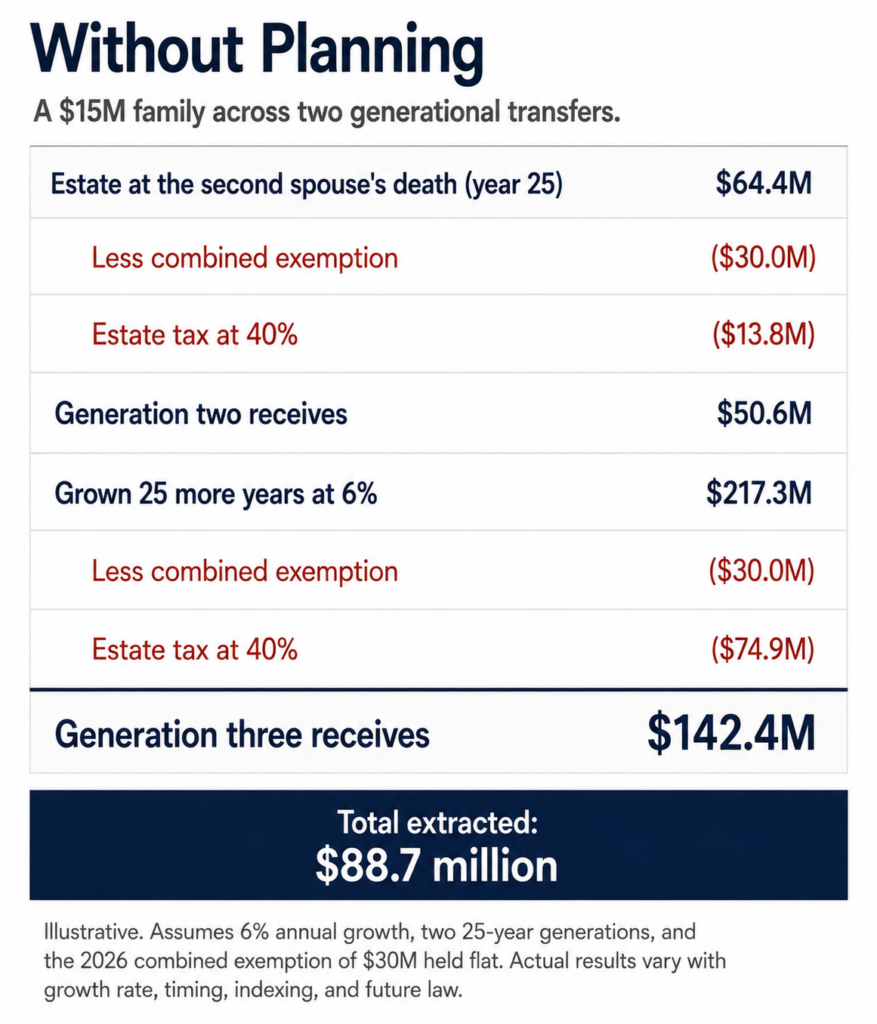
Total extracted: $88.7 million.
With the Dynasty Bridge Trust™
The first transfer is identical. Estate inclusion during life is deliberate — it is what buys the step-up — so the exemption applies and the excess is taxed once.
What changes is everything after.
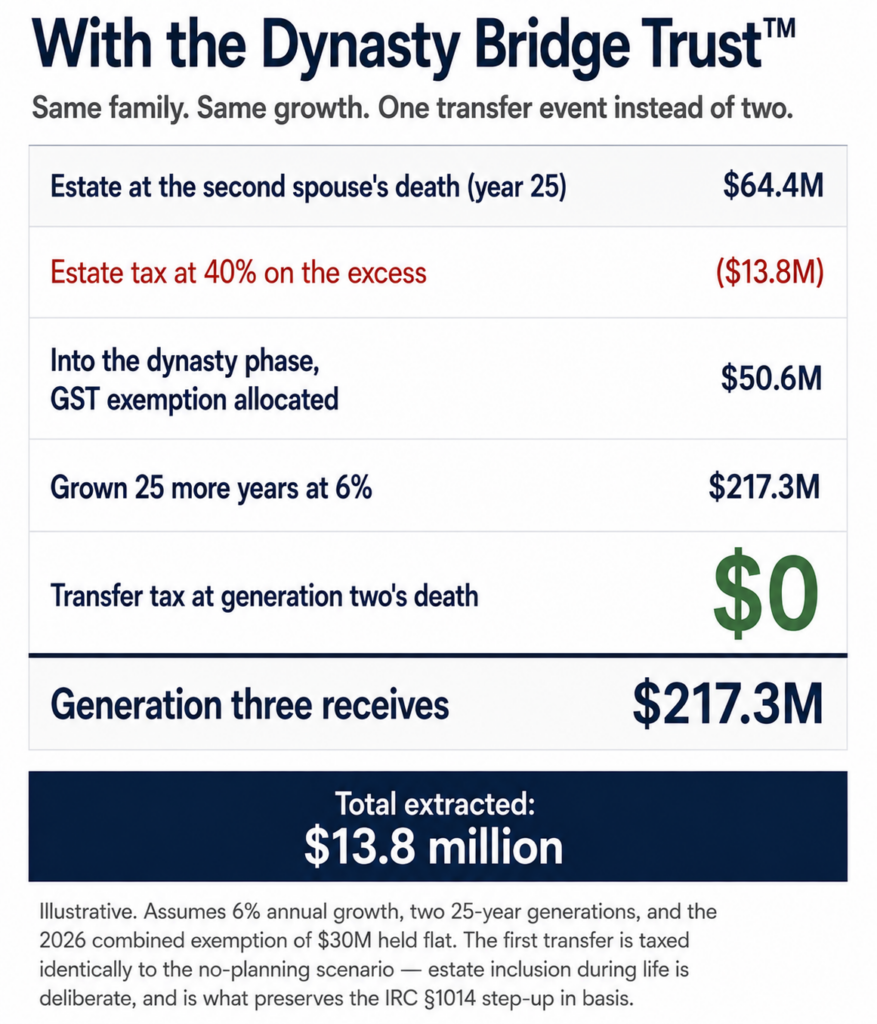
Total extracted: $13.8 million.
The difference
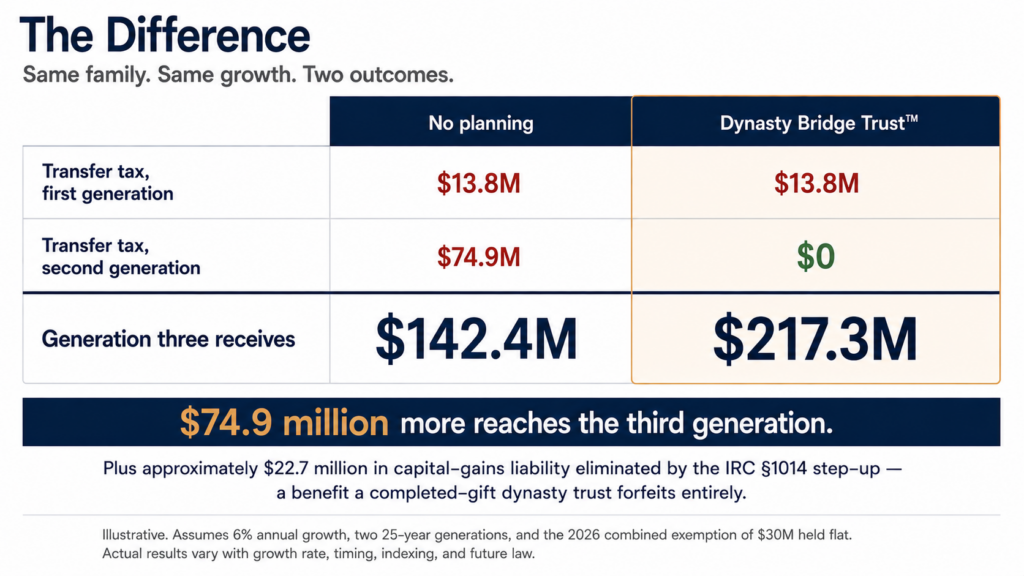
$74.9 million more reaches the third generation. Add the step-up — assuming a $3 million original basis, §1014 wipes roughly $61.4 million of gain, eliminating approximately $22.7 million in capital-gains liability a completed-gift dynasty trust hands to the heirs.
Combined, roughly $97 million — while you keep full access and control the entire time.
One point I want your CPA to hear directly, because it is where plans fail. The trust document does not allocate GST exemption. The instrument references GST planning, but the allocation itself happens on a tax return. Tax efficiency across generations depends on that allocation being made correctly and on time, which makes this a coordination question between your attorney and your CPA — not something a well-drafted document handles by itself. I would rather tell you that now than have you find out from a return filed without it.
Why Not Just Use a Fully Foreign Trust?
Because it is more tool than most situations require, bought at the price of control, flexibility, and a permanent compliance burden that begins the day it is funded. For a client already in a live fight or with an unusually large estate, it can be exactly right — and I build them. For most families under roughly $30 million, the hybrid delivers the same protection while keeping domestic simplicity until the day you actually need to give it up.
A Porsche 911 may be the best sports car ever built. It is the wrong car for hauling lumber or seating a family of five. Best and right are not the same word.
There is a specific reason I do not put a family worth twelve million dollars into a fully foreign trust and call it a day. A fully foreign trust triggers one of the most punishing reporting regimes in the Internal Revenue Code, every year, whether or not a lawsuit ever comes.
Foreign-trust reporting arises under IRC §6048, with penalties under IRC §6677. Miss or misreport a single reportable transfer and the penalty is the greater of $10,000 or 35 percent of the amount transferred. For the annual trust return, Form 3520-A, the failure penalty is the greater of $10,000 or 5 percent of the trust assets treated as owned by the U.S. person — for a foreign grantor trust, five percent of the entire trust.
These penalties are measured against the value of your assets, not against any tax owed. A family can owe zero additional income tax and still face penalties in the hundreds of thousands of dollars. Filing does not eliminate the risk either — an incomplete or incorrectly valued filing is penalized the same way.
That is a guaranteed, recurring cost. Annual preparation of Forms 3520 and 3520-A commonly runs $3,500 to $8,000 or more, exclusive of trustee and legal fees, often well over $100,000 across a twenty-year horizon.
One risk — the lawsuit — is contingent and may never happen. The other — the compliance regime — is certain and begins the day the foreign trust is funded.
The Dynasty Bridge Trust™ is engineered to avoid it. While no threat exists, the Bridge Trust® is a domestic grantor trust: normal 1040, income on your own return, no Form 3520, no Form 3520-A, no FBAR, no foreign-trust reporting at all. The offshore protection is registered and ready from inception. The offshore filing burden attaches only if an Event of Duress actually moves the trust into its foreign operating phase.
You carry the protection without carrying the paperwork.
What Would This Have Looked Like for the Surgeon?
Every asset class he owned sat in a structure that addressed one risk at a time, with no coherent layer above them. Under the Dynasty Bridge Trust™, each moves into the ownership chain, and his children’s inheritance arrives inside a protective structure rather than outright.
His $5 million stock portfolio in his personal name was completely exposed — no charging order, no entity, no trust provision between a judgment creditor and that account. Under the structure, it moves into the partnership as a safe asset held directly, with the 98 percent limited-partner interest owned by the Bridge Trust®. A charging order against that interest produces no distributions unless the partnership chooses to make them, and a creditor who wants to reach the assets must re-litigate abroad under a beyond-reasonable-doubt standard. No contingency-fee attorney funds that.
The two Orange County commercial properties are California real estate, subject to the situs rule Huckaby illustrated. Each goes into a separate California LLC owned by the partnership, owned by the trust. A creditor pursuing one reaches the LLC interest, not the real estate, and holds only a charging-order claim against a limited-partnership interest above it.
The Palm Springs rentals go into their own California LLCs, so an operating claim against one — a guest injury, property damage, a platform dispute — does not expose the others or the broader stack.
His family’s generational exposure is handled by the dynasty provisions already in the instrument. The assets he spent decades building do not become exposed to his children’s creditors the moment he dies. The protection survives the transfer.
Three questions decide whether any structure actually works: is the settlor a beneficiary, is the trust sitused entirely within U.S. jurisdiction, and are the assets held directly in the trust or layered through entities. Each is answered correctly here — control genuinely separated through an independent Trust Protector, an offshore jurisdictional anchor rather than a U.S. state whose law another state’s court can override, and assets held through LLC and partnership layers that keep any single court from reaching the underlying holdings.
When Is the Dynasty Bridge Trust™ the Right Structure?
When you answer yes to four questions: meaningful personal creditor exposure now, an intention to transfer significant wealth to the next generation, residence in a high-litigation state, and a desire to keep operational control during normal periods.
Do you have meaningful personal creditor exposure right now? As a physician, real estate investor, business owner, or entrepreneur in a high-liability environment, the answer is almost certainly yes. If a lawsuit filed tomorrow could reach assets that matter, personal protection is not optional.
Do you intend to transfer significant wealth to the next generation? How that transfer happens decides whether the protection you built survives to the people you built it for. Outright transfers dissolve it immediately. The dynasty provisions do not.
Are you in a high-litigation state? California, New York, Florida, Texas, and Illinois each have statutory frameworks that foreclose domestic self-settled trust planning for the settlor. Huckaby illustrated in 2026 that federal courts in California will apply that principle to out-of-state registrations too. A structure leaning on a Nevada or Wyoming DAPT statute for protection in any of these states is relying on a ceiling the forum court will not honor.
Do you want to keep operational control during normal periods? The Bridge Trust® runs as a domestic grantor trust until the Trust Protector declares an Event of Duress. You manage your assets, make investment decisions, and keep the control you built.
Four yeses means this addresses your complete planning picture.
FAQs
What is a Dynasty Bridge Trust™? A single instrument stacking four layers — state-matched LLCs, an asset management limited partnership, the Bridge Trust® with offshore jurisdictional protection, and dynasty provisions in the same agreement. It protects the settlor from lawsuits during life and protects the next generation from their own creditors afterward, without the wealth passing outright.
Is the dynasty trust a separate trust I have to create later? No. It is the same instrument continuing into its dynasty phase through Continuing Beneficiary Trusts under the same agreement. Every Bridge Trust® already contains the language.
How is it different from a regular dynasty trust? A traditional dynasty trust protects future generations but gives the person who funds it no creditor barrier, and because it is funded as a completed gift it forfeits the §1014 step-up. This adds offshore creditor protection during life and keeps assets in the estate so the step-up is preserved.
Does it preserve the step-up in basis? Yes. During life it is an incomplete-gift grantor trust maintained through a §675(4)(C) power of substitution, so assets remain in the gross estate and receive the §1014 step-up at death.
Does it help with the 40% estate and GST tax? Yes. Assets stay inside your estate and under the exemption during life. At the second spouse’s death, GST exemption is allocated and the trust moves into its dynasty phase, so wealth passes to later generations without the 40 percent landing at each transfer. Because GST exemption is not portable between spouses, allocating it correctly and on time is exactly what this is built to do.
Does the trust itself allocate my GST exemption? No. The instrument references GST planning, but allocation happens on a tax return. That is a coordination point between your attorney and your CPA, and it is where generational plans most often fail.
Do I have to file Form 3520? Not during the domestic phase. The foreign-trust reporting regime under IRC §§6048 and 6677 attaches only if an Event of Duress moves the trust into its offshore phase.
Who controls the assets during my lifetime? You do. You serve as general partner of the partnership and manage the assets, and the trust is a domestic grantor trust under your own reporting. Control shifts to the independent Trust Protector and the pre-committed Special Successor Trustee only on a declared Event of Duress.
How long can the dynasty phase last? Nevada permits a 365-year term under NRS 111.1031, with built-in authorization to migrate to another advantageous jurisdiction if Nevada’s law changes. California’s ceiling is 90 years.
One Structure, Both Goals, No Gap
The surgeon in Orange County did not have an impossible problem. He had a planning gap.
Twelve million dollars in exposed assets — a stock portfolio, two commercial properties, three short-term rentals, and a practice — each sitting in a structure that addressed one risk at a time, with no coherent layer above them.
I spent years on the plaintiff’s side of the table, and a stack of single-purpose structures with no layer above them is the easiest kind to take apart. You pull one thread and the whole thing follows. What holds is the structure built as one integrated whole, before the threat, with control genuinely separated and the offshore capacity already in place.
The law does not pause for planning. A structure assembled after a claim is visible is not planning — it is a transfer a creditor will attack, and courts will let them.
You don’t rise to the level of your income. You fall to the level of your legal structure.
Structure before stress.
📞 For a confidential legal consultation, contact Bradley Legal Corp. at (888) 773-9399, or complete the intake questionnaire at btblegal.com. There is no charge for the consultation.
By: Brian T. Bradley, Esq. — National Asset Protection Attorney