
California has no state estate tax, which means no annual bill ever prompts the planning conversation — while the federal 40% estate tax compounds silently across generations. For a $15 million California family, the illustrative erosion across two generational transfers approaches $89 million. California also has no DAPT statute, voids self-settled spendthrift protection under Probate Code §15304, and authorizes creditors to foreclose LLC interests under Corporations Code §17705.03.
That combination — the most creditor-friendly enforcement environment in the country, no state estate tax to prompt planning, and a 90-year perpetuities ceiling — is why California families need a different structure than the one their advisor probably built.
Key Points
- California creditors have more tools than almost anywhere else. Charging orders are not the exclusive remedy; foreclosure is written into the statute. Curci added equitable reverse veil-piercing on top.
- No state estate tax means no prompt. New York and Massachusetts families get a bill that starts the conversation. California families get silence and a compounding federal liability.
- California has no DAPT statute and voids self-settled spendthrift protection under Prob. Code §15304.
- Huckaby (2026) showed what that means in practice — California situs law governed creditor access to California real property despite a Nevada choice-of-law clause.
- The Dynasty Bridge Trust™ keeps assets in your estate during life — which is what preserves the §1014 step-up — and moves them out of your descendants’ estates at the dynasty conversion.
• • California’s perpetuities horizon is 90 years. Nevada’s is 365. Over a four-generation plan, that difference is the plan.
How Aggressive Is California’s Creditor Environment, Really?
More aggressive than any other state by most measures. California leads the nation in nuclear verdicts, its charging-order statute expressly authorizes foreclosure rather than limiting creditors to a lien, and its post-judgment toolkit includes assignment orders and receiverships that most states do not offer.
California is not merely plaintiff-friendly. It is one of the most plaintiff-intensive litigation environments in the United States by any meaningful measure.
Over the last decade California has led the nation in “nuclear verdicts” — jury awards exceeding $10 million — with well over a hundred such verdicts and billions of dollars in awards, concentrated heavily in Los Angeles County. Large jury pools, plaintiff-friendly instructions, broad negligence theories, and statutes like PAGA and Proposition 65 create exposure that is structural and persistent, concentrated in exactly the industries that produce California’s high-net-worth population.
For physicians and surgeons, malpractice exposure operates against a MICRA damages cap amended and phased upward under Assembly Bill 35. For injuries other than wrongful death, the noneconomic damages cap in 2026 is approximately $470,000, scheduled to increase annually through 2032 and indexed for inflation thereafter. The cap is real. It does not eliminate the exposure — premiums and verdict frequency in California’s major urban counties reflect a claims environment where malpractice liability is a permanent feature of practice, not a theoretical concern.
For technology executives, founders, and venture-backed entrepreneurs, the profile includes securities litigation following IPOs and secondary offerings, employment claims under California’s exceptionally broad wrongful-termination and discrimination statutes, fiduciary-duty claims in closely held structures, and personal-guarantee enforcement on business financing. California’s employment plaintiff bar is among the most active in the country.
For real estate developers and investors in the Bay Area and Los Angeles markets, construction-defect claims, personal-guarantee exposure on recourse debt, landlord-tenant litigation, and partnership disputes create direct personal balance-sheet risk when projects go sideways or cycles turn.
And the accumulation math is punishing before any of that. For a California resident at the top, the combined marginal rate on ordinary income runs roughly 54 percent once the 37 percent federal rate, California’s 13.3 percent-plus top rate, and the Medicare surtaxes stack. On long-term capital gains the combined rate is about 37 percent. A large share of every dollar earned inside a California career is gone before it ever compounds. What survives then faces the creditor environment above — and the federal estate tax problem compounding in the background.
Does an LLC Actually Protect a California Resident?
Only partially. California’s charging-order statute, Corporations Code §17705.03, expressly authorizes foreclosure of the debtor’s transferable interest and contains no exclusive-remedy language. Curci v. Baldwin added equitable reverse veil-piercing. An LLC is a necessary first layer in California and further from a sufficient last layer than in almost any other state.
California’s LLC charging-order provision is codified at Corporations Code §17705.03, part of the Revised Uniform Limited Liability Company Act. It provides that a charging order constitutes a lien on the judgment debtor’s transferable LLC interest and authorizes the court to order the LLC to pay distributions to the creditor.
Here is what it also expressly provides: foreclosure of the debtor’s transferable interest is authorized. A purchaser at the foreclosure sale obtains the rights of a transferee. The statute does not contain exclusive-remedy language. It does not limit the creditor to a lien on future distributions. The foreclosure path is written directly into the text.
This is the opposite of Arizona’s framework, where A.R.S. §29-3503 makes the charging order the exclusive remedy.
Curci Investments, LLC v. Baldwin, 14 Cal. App. 5th 214 (2017) — published California Court of Appeal, Fourth Appellate District — took this further. The court held that a judgment creditor was not limited to a charging order and could pursue equitable reverse veil-piercing against a Delaware LLC almost wholly owned and controlled by the judgment debtor, reaching LLC assets directly where the debtor was using the entity as a personal bank account to frustrate collection.
Curci is not confined to a single fact pattern. It stands for the broader principle that California courts will deploy equitable remedies against LLC structures when the formal charging-order framework does not adequately serve collection. No appellate decision has reversed it or established exclusivity.
Beyond charging orders, California creditors hold an extensive post-judgment toolkit. Code of Civil Procedure §708.510 authorizes assignment orders directing the debtor to assign rights to payment — receivables, contract rights, distributions — to the creditor. CCP §§708.610–708.630 authorize appointment of a post-judgment receiver to take control of, manage, and liquidate the debtor’s property. Turnover orders, judgment-debtor examinations, bank levies, and real-property liens layer on top.
The practical conclusion is the one I reached as a plaintiff litigator in Los Angeles and Orange County: an LLC compartmentalizes. It separates the risky asset from the rest of the balance sheet and gets liability out of your personal name. It is a necessary first layer. Given §17705.03’s express foreclosure authorization and Curci‘s reverse-piercing framework, it is not a sufficient last layer.
What Is the Estate Tax Problem California Residents Are Not Running the Numbers On?
California has no state estate tax, so no bill ever arrives to start the conversation. Meanwhile the federal 40% rate compounds across generational transfers. On an illustrative $15 million estate growing at 6% across two 25-year generations, roughly $89 million is extracted.
New York and Massachusetts residents get a state estate tax bill. That bill prompts a planning conversation. In California, nobody sends one. The federal estate tax compounds in silence, and the planning gap it creates costs California families more in aggregate than the state estate taxes other residents actually pay.
Here is the arithmetic — an illustration, not a projection. It holds the exemption flat at 2026 levels and assumes steady 6 percent growth over two 25-year generations. Real results move with the actual growth rate, the timing of each death, indexing, and future law. Because the exemption is indexed for inflation and this model holds it flat, the figures below likely overstate the tax somewhat. The shape of the problem does not change.
Starting point: a married California couple, $15 million today. Combined federal exemption of $30 million ($15 million each in 2026). Growth at 6 percent compounds a dollar 4.29× over 25 years.
Scenario one — no planning
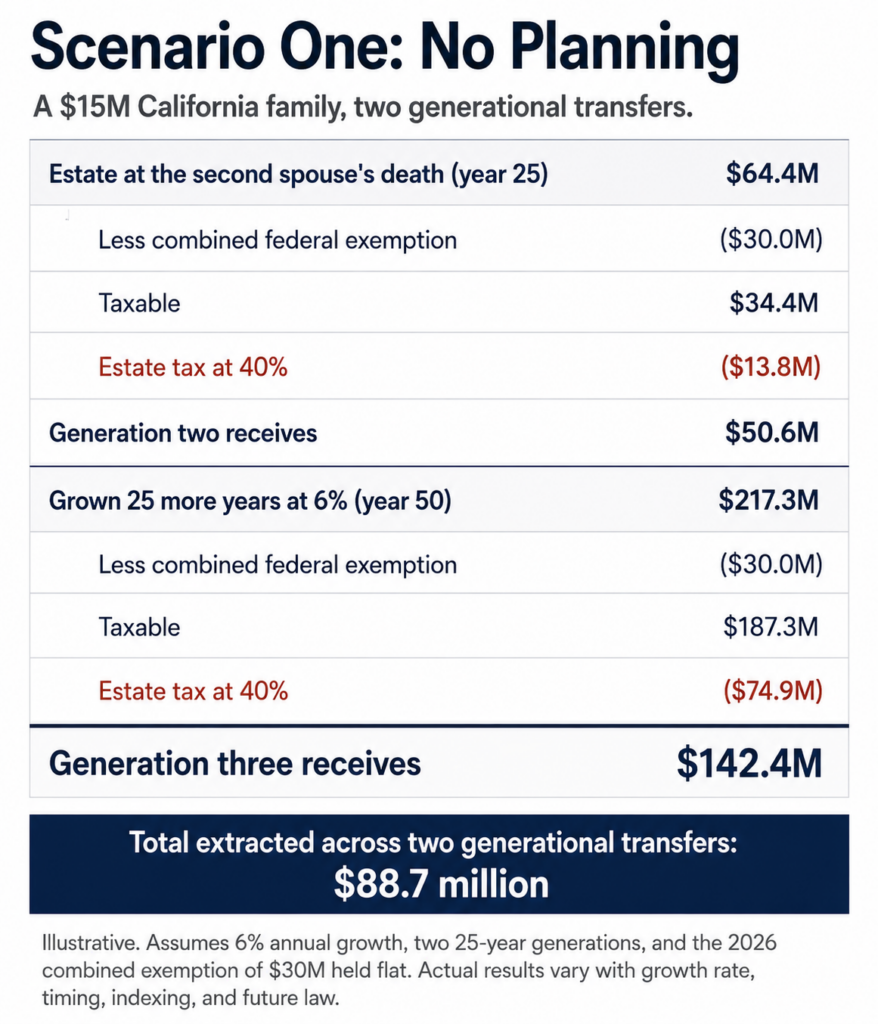
Total extracted across two generational transfers: $88.7 million.
Scenario two — the Dynasty Bridge Trust™
The first transfer is the same. During your life the assets stay in your gross estate — deliberately, because that is what preserves the §1014 step-up — so the exemption applies and the excess is taxed once at the second death.
What changes is everything after.
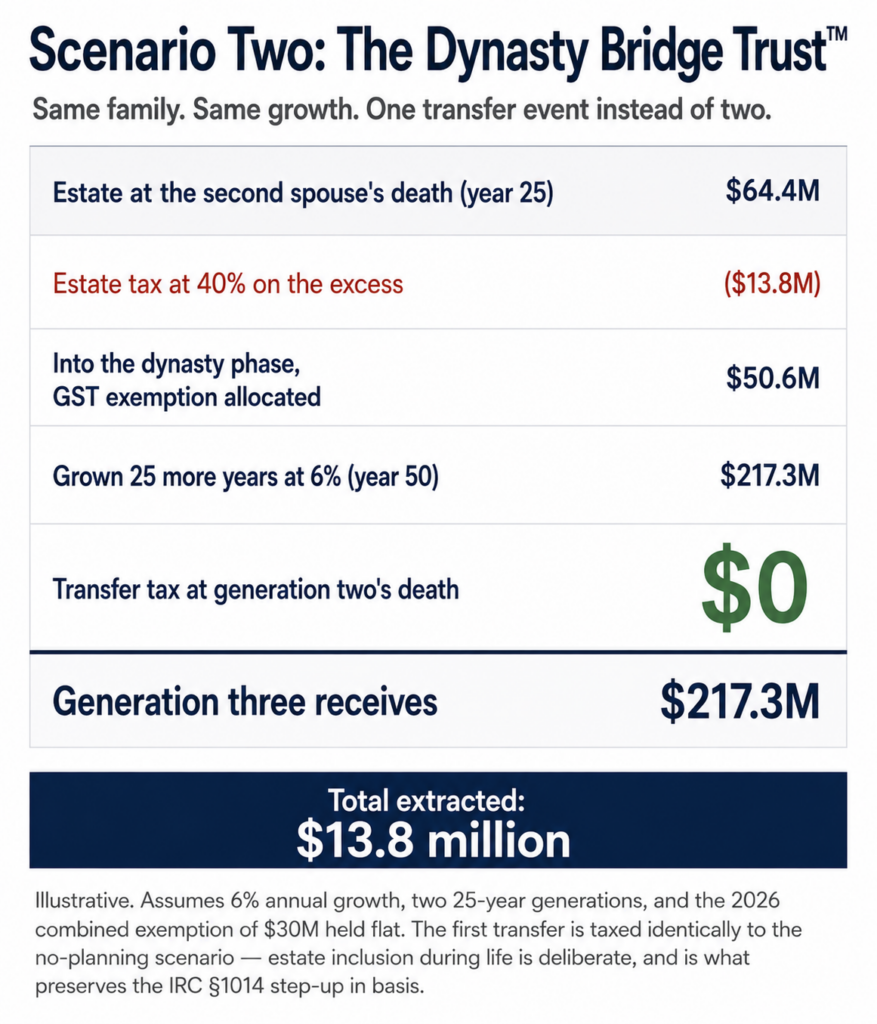
Total extracted: $13.8 million.
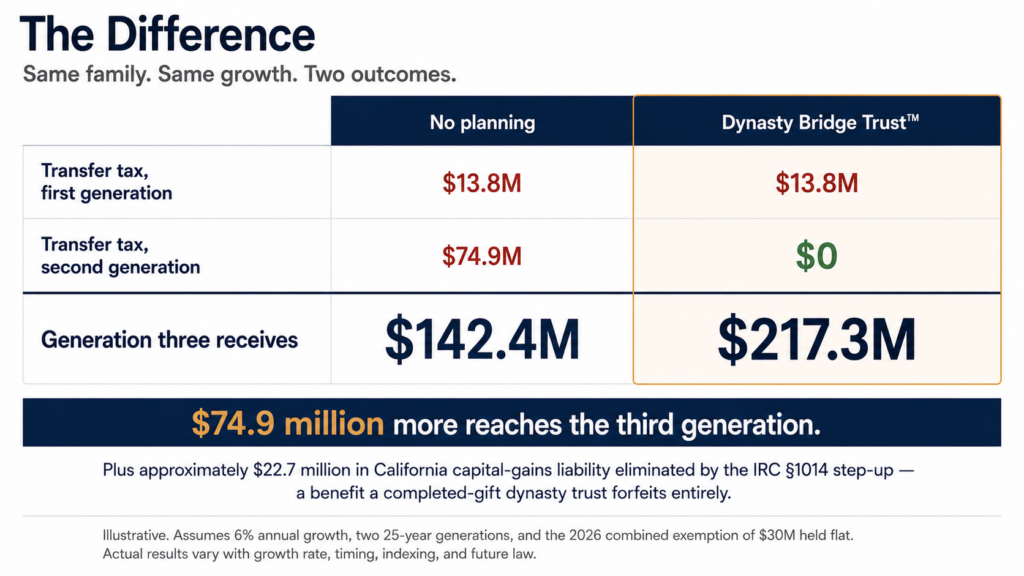
$74.9 million more reaches the third generation — and that is only the transfer-tax side.
Add the step-up
There is a second number most dynasty planning gives away.
Assume the original $15 million carries a $3 million cost basis. Because the assets are in the estate at the second death, IRC §1014 resets the basis to fair market value — wiping out roughly $61.4 million of accumulated gain. At California’s combined long-term rate near 37 percent, that is approximately $22.7 million of capital-gains liability eliminated.
A traditional dynasty trust forfeits this entirely, because funding it is a completed gift that removes the assets from the estate. No estate inclusion, no step-up, and the heirs inherit the original $3 million basis.
Combined, the planning difference in this illustration is roughly $97 million — and unlike a completed-gift structure, you keep full access and control to your assets the entire time.
Why this problem is specific to California
Two things compound it. The same $15 million estate was built on more pre-tax income than the same estate in a no-income-tax state, and the federal 40 percent extraction does not adjust for that. And every year of appreciation compounding inside an unprotected structure is appreciation that cannot be retroactively repositioned.
California has also repeatedly floated wealth-tax and exit-tax proposals. None has been enacted as of 2026, but the political pressure is real, and California already taxes nonresidents on California-source income after they leave.
Why Doesn’t a Nevada Trust Solve This for a California Resident?
Because California has no DAPT statute, voids self-settled spendthrift protection under Prob. Code §15304, and — as Huckaby confirmed in 2026 — applies its own law to creditor access when the asset is California real property, regardless of a Nevada choice-of-law clause.
California Probate Code §15304 is explicit: if a person creates a trust for their own benefit and includes a spendthrift clause, that restraint is ineffective against the settlor’s creditors, and creditors may reach the maximum amount the trustee could pay to or for the benefit of the settlor. There is no ambiguity. The spendthrift clause in a self-settled California trust is void as to the settlor’s own creditors.
What Huckaby held
United States v. Huckaby, No. 2:23-cv-00587-DAD-JDP (E.D. Cal. Mar. 2, 2026). Robert Huckaby and Joyce Tritsch created the Circle H Bar T Trust in 2011 — a self-settled Nevada spendthrift trust — and transferred a South Lake Tahoe, California property into it the same day. Both served as settlors, trustees, and beneficiaries of the same instrument. Following a 2018 federal judgment against Huckaby for failure to honor IRS levies, the United States sued in 2023 to enforce its lien and foreclose his interest.
The court applied the Restatement (Second) of Conflict of Laws in two parts. Under §277, Nevada law governed interpretation of the trust instrument — the defendants were right about that, and the court said so. But under §280, the law of the situs of land governs whether a beneficiary’s interest can be reached by creditors. The property was in California, so California law controlled. Probate Code §15304 applied. The trust was self-settled. The spendthrift clause was void as to those creditors. The federal judgment lien attached under 28 U.S.C. §3201(a) and the court authorized foreclosure of Huckaby’s one-half interest.
The defendants argued §15304 should not apply retroactively to property placed in trust before the lien arose. The court rejected that.
This was a federal district-court order granting partial summary judgment — persuasive and directly on point, not binding appellate precedent.
The lesson is precise: a Nevada choice-of-law clause does not control creditor rights against California real property. A nominally “Nevada DAPT” with no genuine independent trustee, no offshore enforcement layer, and California real estate held directly inside the trust is not an asset protection structure. It is a recorded document with a spendthrift clause California courts will not enforce.
A note on Kilker
Kilker v. Stillman is frequently cited for the proposition that California courts will reach through out-of-state DAPTs on voidable-transfer grounds. That opinion is unpublished and non-citable as authority under California Rule of Court 8.1115. I mention it only as an illustration of judicial attitude, not as precedent, and anyone presenting it to you as established California law is overreaching.
The rule itself does not need Kilker. It rests on California’s Uniform Voidable Transactions Act, on Probate Code §15304, and now on Huckaby‘s situs analysis — all of which are citable.
Why the Bridge Trust® is different
The Bridge Trust® is not a self-settled domestic DAPT. It has a genuine independent Trust Protector, and it is a foreign trust in legal character from inception rather than a domestic trust invoking a sister state’s statute.
On a declaration of an Event of Duress, a set of mandatory effects operates immediately: standing consents are revoked, the grantor’s powers to appoint or remove the Protector and successor trustee are suspended, and distributions are suspended. What follows is discretionary — the independent Protector may shift enforcement control offshore, may change governing law or situs. Those are fiduciary judgments, not a mechanical trigger, which is deliberate: an automatic “lawsuit filed, therefore flee” clause is what a court would characterize as built-in obstruction.
The offshore jurisdiction does not recognize California judgments. It does not recognize any foreign court judgment. That is the structural distinction Huckaby illustrates, and the gap the offshore enforcement layer is designed to fill.
Why Does California’s 90-Year Perpetuities Limit Matter?
Because a multigenerational plan needs more than 90 years of road. California follows the Uniform Statutory Rule Against Perpetuities and permits no perpetual trusts. Nevada allows 365 years — more than four times the horizon.
California has adopted the Uniform Statutory Rule Against Perpetuities: the traditional lives-in-being-plus-21-years formulation alongside a 90-year wait-and-see alternative vesting period. California has not enacted a general dynasty trust statute abolishing or extending that rule.
Ninety years is meaningful. It is not 365.
For a family whose objective is to let wealth compound inside a protected vehicle across three, four, or five generations without triggering transfer tax at each death, the difference is not a technicality. It is the difference between a structure that runs out of road while the plan is still in progress and one that does not.
A California resident can establish a Nevada dynasty trust governed by Nevada law where the trust has a qualified Nevada trustee exercising genuine administrative functions in Nevada — not the settlor, not a family member, not a domestic trust company with no Nevada nexus — a Nevada governing-law provision, Nevada situs, and no California administrative contact beyond the beneficiaries themselves.
For a third-party trust, California courts apply standard conflict-of-laws principles and will generally respect Nevada law for the internal affairs of a properly established and administered trust. The self-settled public-policy concern under §15304 is absent in a properly structured third-party instrument.
Huckaby confirms the same point from the negative direction. A Nevada trust with no genuine Nevada trustee, settlors serving as their own trustees and beneficiaries, and California real estate held directly inside the structure is not a Nevada trust in any meaningful sense. A properly structured Nevada dynasty trust with real nexus and a genuine independent trustee is a different instrument, and California courts treat it differently.
What Does the Four-Layer Structure Look Like for a California Family?
State-matched California LLCs hold the risky assets. Those flow up into an Arizona multi-member limited partnership with statutory charging-order exclusivity. The partnership interest sits inside the Bridge Trust®, which carries the offshore enforcement layer. At the second death, a Nevada dynasty trust carries the wealth forward for 365 years.
Layer one — the LLCs
State-matched California entities holding the risky assets: a professional corporation or medical group for the practice, California LLCs for real estate holdings and operating businesses. Each risky asset compartmentalized from every other asset and from the individual.
Given §17705.03’s express foreclosure authorization and Curci‘s reverse-piercing framework, proper drafting of transfer restrictions, pick-your-partner provisions, and genuine economic separation between the debtor and the entity’s assets is the difference between a wall and a starting point for a collection argument.
Layer two — the Arizona multi-member limited partnership
The LLCs flow up into the partnership, which owns their membership interests.
A.R.S. §29-3503 provides charging-order exclusivity for a limited partner’s interest — in statutory text, with no foreclosure authorization. Unlike California’s statute, which expressly permits foreclosure and does not treat the charging order as exclusive, Arizona has answered the exclusivity question California has not.
A creditor gets the right to wait for a distribution that may never come. No foreclosure. No receivership over the entity. No equitable reverse-piercing argument against a properly structured multi-member partnership with genuine economic separation and multiple independent members.
Layer three — the Bridge Trust®
The partnership interest is held inside the Bridge Trust®.
Because the trust satisfies the court test and control test of Treas. Reg. §301.7701-7 — the two-part test under IRC §7701(a)(30)(E) — it is classified as a domestic trust for tax purposes. Separately, the instrument is drafted to establish and maintain grantor-trust status under IRC §§671–677, so income is reported on your own return and the trust is disregarded for income-tax purposes. Two rules doing two different jobs: one determines domestic-versus-foreign classification, the other determines who reports the income.
No change to the return. No offshore filing exposure in the baseline structure.
But the trust is foreign in legal character, registered offshore from inception — registered in Belize, whose international-trust law provides its firewall from the date of registration, with a pre-committed Cook Islands enforcement layer standing behind it. That layer does not recognize California judgments, or any foreign court judgment. It imposes a fraud burden of proof beyond a reasonable doubt — a criminal standard in a civil setting. It requires a substantial bond to initiate a claim, with fee-shifting if the creditor loses, and strict limitation periods. Its trustees are constrained from complying with foreign court orders compelling distributions.
One thing worth knowing about how the instrument itself is written, because it tells you what this is and is not. The trust contains an express anti-fraud carve-out: it states on its face that it is not intended to defraud legitimate creditors, launder funds, or shield criminal proceeds. That language is in the document. A structure built to hide assets does not write that clause.
Across more than three decades of use, this kind of offshore enforcement layer has repeatedly frustrated creditor collection, and a properly structured and funded trust has not been forced to surrender its assets. That is a track record, not a guarantee. No honest lawyer promises a courtroom outcome.
For California residents specifically — where §15304 voids self-settled domestic trusts, and where Huckaby confirmed in 2026 that California situs law governs creditor access to California real property regardless of Nevada choice-of-law clauses — the offshore enforcement layer is the gap-filler no California-based or Nevada-labeled domestic structure can replicate. It does not depend on California recognizing self-settled spendthrift protection. It does not depend on Nevada choice-of-law language. It operates because offshore law is the governing enforcement law, and offshore law does not take orders from California courts.
Layer four — the dynasty phase
This is where most explanations get it wrong, including some written about this structure.
There is no separate dynasty trust. The Dynasty Bridge Trust™ is one instrument. At the death of the second spouse, the same trust continues into its dynasty phase — carrying
wealth forward through Continuing Beneficiary Trusts under the same master agreement rather than through a newly created vehicle. Every Bridge Trust® already contains this language. A trust established today purely for lawsuit protection can carry into its dynasty phase later.
The governing law is Nevada, with a built-in authorization to migrate to South Dakota or another advantageous jurisdiction if Nevada’s law changes. Nevada permits a 365-year term under NRS 111.1031 — the state abolished the common-law rule against perpetuities. No state income tax on trust income. Directed-trustee statutes separating investment from distribution authority.
Against California’s 90-year ceiling, that is the difference between a plan that runs out of road mid-execution and one that does not.
Here is the sequencing.
During your life, the assets remain in your gross estate. That is deliberate. Estate inclusion is what preserves the §1014 step-up, and for a family below the federal exemption — $15 million per individual, $30 million per couple in 2026, permanent and indexed — the exemption shelters those assets from estate tax anyway. You give up nothing, and you keep full access and control. There is no completed gift.
At the death of the second spouse, three things happen at once: the step-up is captured, GST exemption is allocated, and the trust moves into its dynasty phase.
From that point forward, wealth stays in trust and no fresh 40 percent transfer tax is triggered at each generational death. Your children benefit from the assets without owning them outright, so a creditor suing your son cannot reach what is in trust and a divorcing spouse cannot claim it as marital property. Distributions are discretionary and controlled, never outright.
That is what solves the $89 million problem — not removing assets from your estate during life, but keeping them where the exemption and the step-up both work, and then out of the tax base at every generation after.
When Should GST Exemption Be Allocated?
Allocation timing depends on which path you take, and the two paths are different. A lifetime completed gift allocates at funding. The Dynasty Bridge Trust™ path allocates at the dynasty conversion following the second death. Either way, appreciation that has already occurred inside the taxable estate cannot be retroactively repositioned.
The federal GST exemption is $15 million per individual, set permanently under current law and indexed. Unlike the estate tax exemption, GST exemption is not portable between spouses. Allocate it correctly and in time, or the first spouse’s shelter is simply lost.
Every dollar of appreciation compounding inside a properly structured GST-exempt dynasty trust escapes both federal estate tax and federal GST tax at each generational transfer. Every dollar compounding inside a taxable estate faces the 40 percent stack at each generational death — with no annual state bill to prompt the conversation before it is too late.
For California families with pre-IPO equity, carried interest, or real estate partnership interests growing at rates that can compress the entire appreciation window into a single liquidity event, getting the structure in place before the appreciation event is the highest-leverage decision available. Once appreciation has occurred inside the taxable estate, it cannot be retroactively repositioned.
One point I want your CPA to hear directly, because it is where plans fail. The trust document does not allocate GST exemption. The instrument references GST planning, but the allocation itself happens on a tax return. Tax efficiency across generations depends on that allocation being made correctly and on time — which means this is a coordination question between your attorney and your CPA, not something a well-drafted document handles by itself.
I would rather tell you that now than have you find out from a return that was filed without it.
What Does the Step-Up in Basis Actually Save?
A traditional dynasty trust forfeits the §1014 step-up, because funding it is a completed gift that removes assets from the estate. The Dynasty Bridge Trust™ keeps them in the estate during life, so the basis resets at death — often eliminating seven figures of capital-gains liability the traditional structure hands to the heirs.
Under IRC §1014, when an asset that is part of the decedent’s gross estate at death passes to heirs, its cost basis resets from the original purchase price to fair market value as of the date of death.
A founder who bought $200,000 of company stock that grew to $8 million during her life — holding it inside a structure that keeps the asset in her estate — dies with that stock at an $8 million basis. Her heirs can sell it the next day and pay no federal capital-gains tax. The $7.8 million of appreciation accrued during her life is wiped clean.
A traditional dynasty trust forfeits this entirely. Transferring assets into it is a completed gift that removes them from the grantor’s estate at funding. Because they are not in the estate at death, §1014 does not apply. The heirs inherit the original cost basis — $200,000 in the example — and pay capital-gains tax on the full $7.8 million when they sell. At combined federal and California rates, that is well over $2 million of liability.
The reason the Dynasty Bridge Trust™ captures the step-up is the same reason it protects you during life. The Bridge Trust® is an incomplete-gift grantor trust: the settlor retains enough beneficial enjoyment and control that the assets are a grantor trust for income tax under §§671–677 and remain inside the gross estate. In the estate at death means eligible for the step-up.
The specific mechanism, since a good CPA will ask: the instrument gives the grantor a non-fiduciary power of substitution under IRC §675(4)(C) — the ability to reacquire any trust asset by substituting property of equivalent value. That “swap power” is what maintains grantor-trust status, which is what keeps §1014 alive. The step-up is a function of compliant drafting, not of jurisdiction, and it is not something any trust gets automatically.
A traditional dynasty trust does the opposite — funded as a completed gift that pushes assets out of the estate for transfer-tax purposes, with the step-up going out alongside them.
The Dynasty Bridge Trust™ does not face that trade-off, because it uses each treatment at the right time. During life: assets in the estate, grantor has full access, step-up preserved, offshore barrier defending against creditors. At the second death: step-up captured, GST exemption allocated, wealth transitions into its dynasty phase.
For families below the federal exemption, this is the structural point that decides the choice. The exemption shelters the assets from estate tax, grantor-trust status preserves the step-up, and the dynasty conversion extends the wealth without erosion at each transfer. All three at once, by design.
An advisor who recommends a completed-gift dynasty trust to a family below the exemption is trading away a significant tax benefit for transfer-tax planning the exemption alone already accomplishes.
The Question That Actually Matters for California
Most California families at $10 million or more have a revocable living trust, one or more LLCs, perhaps a bypass trust arrangement, and an estate plan built to avoid probate and distribute assets at death. Some have a Nevada trust their advisor described as an asset protection trust.
For probate, the standard plan works.
For a creditor using §17705.03’s foreclosure authorization, Curci‘s reverse-piercing framework, and California’s full post-judgment toolkit against an LLC with no upstream structure — not protected.
For a creditor reaching through a domestic Nevada trust under §15304, or foreclosing on California real estate under the Huckaby analysis — not protected.
For the generational estate-tax problem compounding at 6 percent over 25 to 50 years, in a state where no bill ever prompts the conversation — not protected.
The Dynasty Bridge Trust™ does not ask you to choose between solving the creditor problem and solving the legacy problem. It solves both inside one integrated structure — designed the same way I used to attack structures from the plaintiff side in Los Angeles and Orange County.
If you are a California physician, technology executive, real estate developer, or business owner with $10 million or more in exposed assets, and you want to understand what your current structure actually protects, that is the conversation to have.
You don’t rise to the level of your income. You fall to the level of your legal structure.
Structure before stress.
📞 For a confidential legal consultation, contact Bradley Legal Corp. at (888) 773-9399, or complete the intake questionnaire at btblegal.com. There is no charge for the consultation.
By: Brian T. Bradley, Esq. — National Asset Protection Attorney
California Dynasty Planning FAQs
Does California have an estate tax? No. California has no state estate tax and no inheritance tax. That is precisely the problem — no bill ever arrives to prompt the planning conversation, while the federal 40% liability compounds.
Does California have a domestic asset protection trust statute? No. California has not enacted one, and Probate Code §15304 voids self-settled spendthrift protection against the settlor’s own creditors.
Can a California resident use a Nevada dynasty trust? Yes, for a properly structured third-party trust with a qualified Nevada trustee exercising genuine administrative functions in Nevada, Nevada governing law, Nevada situs, and no California administrative nexus. The §15304 self-settled concern is absent in a third-party instrument.
Does a Nevada choice-of-law clause protect California real estate? No. Under Restatement (Second) of Conflict of Laws §280, the law of the situs of the land governs whether creditors can reach a beneficiary’s interest. Huckaby applied exactly that analysis in 2026.
How long can a California trust last? California follows the Uniform Statutory Rule Against Perpetuities — lives in being plus 21 years, with a 90-year wait-and-see alternative. California does not permit perpetual trusts. Nevada permits 365 years.
Is an LLC enough protection in California? It is a necessary first layer, not a sufficient last one. Corporations Code §17705.03 expressly authorizes foreclosure of the debtor’s transferable interest, and Curci permits equitable reverse veil-piercing in appropriate cases.
Does the Dynasty Bridge Trust™ remove assets from my estate? Not during your life, and that is deliberate. Estate inclusion is what preserves the §1014 step-up, and the federal exemption shelters the assets from estate tax anyway. At the second death the trust moves into its dynasty phase, and from that point forward no fresh 40% transfer tax is triggered at each generational death.
Is the dynasty trust a separate trust I have to create later? No. It is the same instrument continuing into its dynasty phase, carrying wealth forward through Continuing Beneficiary Trusts under the same agreement. Every Bridge Trust® already contains the language.
Does the trust itself allocate my GST exemption? No. The instrument references GST planning, but allocation happens on a tax return. That is a coordination point between your attorney and your CPA, and it is where generational plans most often fail.
Does this structure reduce my income taxes? No. It is tax-neutral by design. Income is reported on your own return under the grantor-trust rules.