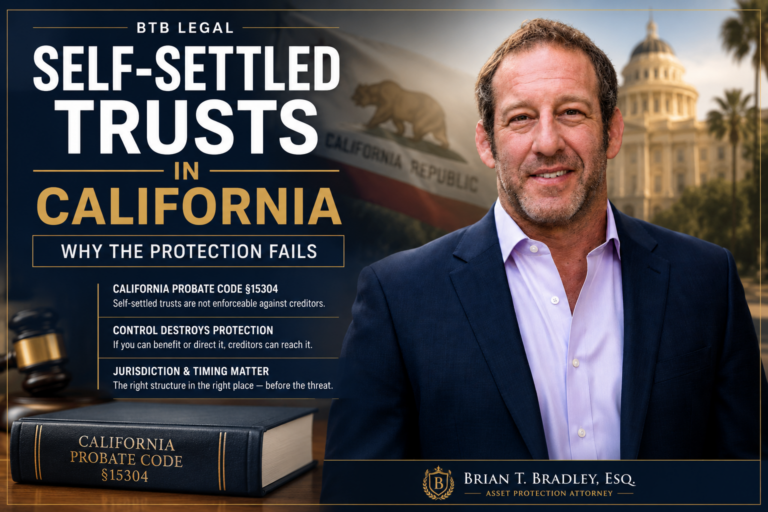


A dynasty trust is an irrevocable trust designed to hold assets across multiple generations without triggering estate or generation-skipping transfer tax at each generational death. It protects your children and grandchildren from their own creditors and divorcing spouses. It does not protect the person who funded it — because under the self-settled trust doctrine, a settlor who can benefit from a trust cannot shield it from their own creditors.
That distinction decides whether the structure works for what you actually need. This page covers the mechanics, the state rules, and where the protection stops.
Key Points
- Irrevocable, always. A dynasty trust cannot be revocable. Estate tax exclusion and creditor protection both depend on giving up the power to revoke.
- Perpetual duration depends on the state. South Dakota and Delaware allow perpetual trusts; Nevada permits 365 years; California and Oregon cap at roughly 90.
- It protects the beneficiary, not the settlor. A child receiving discretionary distributions is protected. The parent who funded it is not.
- Self-settled doctrine applies in every high-litigation state — California §15304, New York EPTL §7-3.1, Florida §736.0505, Texas §112.035, Illinois 760 ILCS 3/505.
- Federal creditors are a separate layer. Tax liens and restitution reach beneficial interests regardless of spendthrift language.
- Assets held directly in the trust are governed by the law where they sit. You cannot move dirt.
What Is a Dynasty Trust?
An irrevocable trust designed to hold and compound family assets across multiple generations without a taxable transfer event at each generational death. In states without a rule against perpetuities it can last indefinitely; elsewhere its term is capped by statute. Also called a perpetual trust, a generation-skipping trust, or informally a family legacy trust.
The core idea is simple. Ordinarily, wealth is taxed each time it passes down — parent to child, child to grandchild — at rates reaching 40 percent federally, plus state estate tax in a dozen or so states. Over three generations, compounding tax can consume more than the compounding growth produces.
A dynasty trust interrupts that cycle. Because the assets stay inside the trust rather than passing into each generation’s taxable estate, the transfer event that triggers the tax never occurs. Beneficiaries receive distributions from the trust; they do not own the underlying assets.
Two things make it work. Generation-skipping transfer tax exemption — currently $15 million per individual — is allocated to the trust, sheltering it and its future appreciation from GST tax at each generational level. And a long or unlimited trust term, which depends entirely on which state’s law governs.
You will see the same structure called an asset preservation trust, a perpetual trust, or a legacy trust. Those are marketing labels, not distinct legal instruments. The operative questions are always the same: who funded it, who can benefit, whose law governs, and how long it can run.
Is a Dynasty Trust Revocable or Irrevocable?
Irrevocable, without exception. If the settlor can revoke the trust, the assets remain in the settlor’s estate for transfer tax purposes and remain fully reachable by the settlor’s creditors. The tax and protection benefits both depend on the settlor giving up the power to take the assets back.
This is the most common beginner question and the answer is not negotiable.
A revocable living trust is a probate-avoidance instrument. You can change it, revoke it, and take assets back at any time. Because you retain that power, the assets are in your taxable estate and your creditors can reach them — a creditor is not required to pretend a power of revocation does not exist.
A dynasty trust must be irrevocable. That is what removes assets from the transfer tax base at each generation and what makes the spendthrift protection real for beneficiaries.
There is a middle case worth knowing about. A trust can be irrevocable for transfer tax purposes while still being a grantor trust for income tax purposes — meaning the settlor pays the income tax on trust earnings. That is a feature, not an accident: paying the trust’s income tax is effectively an additional tax-free gift to the beneficiaries, and it is a standard design choice.
How Does a Dynasty Trust Work?
The settlor funds an irrevocable trust, allocates GST exemption to it, and names an independent trustee. Beneficiaries receive discretionary distributions rather than ownership. Because the assets never enter a beneficiary’s estate, no transfer tax event occurs at their death, and the trust continues to the next generation.
The mechanics, in sequence:
Funding. The settlor transfers assets — cash, securities, closely held business interests, real estate held through entities, life insurance — into the trust. For a completed-gift dynasty trust, this uses gift tax exemption at funding.
GST allocation. Generation-skipping transfer tax exemption is allocated to the trust. This is the step that shelters the trust from GST tax at every generational level, and it is worth stating plainly: the trust document does not allocate GST exemption. The allocation happens on a tax return. That is a coordination point between your attorney and your CPA, and it is where generational plans most often fail.
Administration. An independent trustee holds legal title and administers the trust under the terms of the instrument. Distributions to beneficiaries are discretionary, typically under a health, education, maintenance, and support standard, or under broader discretion vested in the trustee.
Generational continuation. When a beneficiary dies, the assets remain in trust. No transfer tax event occurs because the beneficiary never owned them. The trust continues for the next generation, often through separate sub-trusts for each family line.
Termination. The trust ends when the state’s perpetuities period expires, or never, in a state that has abolished the rule.
What Is Actually In a Dynasty Trust Agreement?
A trustee appointment and succession mechanism, distribution standards, spendthrift provisions, a trust protector role, situs and governing law designations, GST allocation language, and sub-trust provisions for each family line. There is no usable template — the drafting choices are where the protection lives or fails.
People search for dynasty trust samples, templates, and agreements. It is worth being direct: the document is not the value, and a template will not produce a working structure. The Chicago business owner described below had a professionally drafted Nevada dynasty trust with a spendthrift clause, a professional trustee, and a trust protector. It failed anyway, on facts that no template addresses.
The provisions that decide outcomes:
Trustee appointment and removal. Who serves, who can replace them, and whether the settlor or a beneficiary holds removal power. Unrestricted removal power in a beneficiary’s hands is a control problem — that was the drafting lesson from United States v. Grant.
Distribution standards. Purely discretionary distributions are more protective than an ascertainable standard, because a creditor can reach what a trustee could be compelled to distribute.
Spendthrift provisions. Real for third-party beneficiaries; void as to the settlor’s own creditors in every high-litigation state.
Trust protector powers. Whether the protector can change situs, replace trustees, or amend administrative provisions.
Situs and governing law. Which determines the perpetuities period, state income tax treatment, and directed-trustee availability.
Sub-trust provisions. How the trust divides at each generation for separate family lines.
Which States Allow Dynasty Trusts, and For How Long?
States that have abolished the rule against perpetuities allow perpetual dynasty trusts. Others permit fixed long terms by statute — Nevada 365 years, Wyoming 1,000, Florida 360. States following the Uniform Statutory Rule Against Perpetuities cap trusts at roughly 90 years, which is why California and Oregon residents generally site dynasty trusts elsewhere.
| State | Dynasty Trust Duration | Notes |
|---|---|---|
| South Dakota | Perpetual | RAP abolished; no state income tax on trust income |
| Delaware | Perpetual for personal property | 110-year limit on directly held real property. Interests in LLCs, partnerships, and corporations are treated as personal property even when the entity owns real estate — 25 Del. C. §503 |
| New Hampshire | Perpetual | RAP abolished |
| Wyoming | 1,000 years | Wyo. Stat. §34-1-139; directly held real property is treated differently under the statutory regime |
| Alaska | 1,000 years | AS §34.27.051 |
| Utah | 1,000 years | Utah Code §75-2-1203 |
| Florida | 1,000 years | Fla. Stat. §689.225, for trusts created on or after July 1, 2022. Trusts created January 1, 2001 through June 30, 2022 use the prior 360-year period |
| Nevada | 365 years | NRS 111.1031; no state income tax on trust income |
| Tennessee | 360 years | Tenn. Code §66-1-202 |
| Arizona | 500 years | A.R.S. §14-2901 |
| Texas | 300 years | Tex. Prop. Code §112.036; extended from the common-law period in 2021 |
| California | ~90 years* | USRAP — Cal. Prob. Code §21205 |
| Oregon | ~90 years* | USRAP — ORS 105.950 |
| New York | Lives in being + 21 years | EPTL §9-1.1; no dynasty statute |
*California and Oregon apply statutory Rule Against Perpetuities regimes that generally use the traditional lives-in-being-plus-21-years test or a 90-year alternative vesting and termination period. The 90-year figure is the right comparison for dynasty planning, but it is a perpetuities and vesting period rather than a mandatory date on which every trust must terminate.
Two points worth pulling out of the table.
The Delaware entity rule is a planning insight, not a footnote. Delaware’s 110-year cap applies to real property held directly by the trust. An interest in an LLC or partnership is personal property under 25 Del. C. §503 — even when that entity owns real estate — so it falls under the perpetual treatment. That is another reason real property belongs in an entity rather than in the trust’s own name.
Florida changed recently, and older comparison charts have not caught up. The 360-year figure that still appears across most of the internet was correct for trusts created between January 1, 2001 and June 30, 2022. Anything created since July 1, 2022 gets 1,000 years.
[Durations verified against current statutes as of September 2026. Perpetuities periods change by legislation — Florida moved in 2022 and Texas in 2021 — so this table should be re-verified at each annual review.]
Two practical points the table does not show.
Siting a trust in a favorable state requires genuine nexus — a qualified trustee actually administering the trust there, real situs, and no meaningful administrative contact with the settlor’s home state. A Nevada trust with no Nevada trustee is a Nevada trust in name only.
And the perpetuities period governs the trust, not the assets. Real property is governed by the law where it sits regardless of the trust’s situs, which is the rule United States v. Huckaby applied in 2026. You cannot move dirt.
Dynasty Trust vs. Irrevocable Trust vs. Revocable Trust
All dynasty trusts are irrevocable trusts. Not all irrevocable trusts are dynasty trusts. The distinguishing features are GST exemption allocation and a term long enough to span multiple generations.
| Revocable Living Trust | Ordinary Irrevocable Trust | Dynasty Trust | |
|---|---|---|---|
| Can the settlor revoke it? | Yes | No | No |
| In the settlor’s taxable estate? | Yes | Usually no (completed gift) | Depends on design |
| Creditor protection for the settlor | None | None in non-DAPT states | None in non-DAPT states |
| Creditor protection for beneficiaries | None during settlor’s life | Yes, if third-party and spendthrift | Yes, and it continues for generations |
| GST exemption allocated? | No | Sometimes | Yes — that is the defining feature |
| Intended duration | Until death, then distributes | Often one generation | Multiple generations to perpetual |
| Primary purpose | Probate avoidance | Varies — gifting, insurance, charitable | Multigenerational transfer tax elimination |
The row that matters is the third one. None of the three protects the person who funded it in a non-DAPT state, and that is what the rest of this page is about.
What a Dynasty Trust Does Well
A business owner in Chicago had done everything right — or so he believed. His estate planning attorney had drafted an irrevocable dynasty trust, named his children as beneficiaries, and assured him the structure would protect his assets across multiple generations. The trust was sitused in Nevada. It had a spendthrift clause, a professional trustee, and a trust protector. On paper it looked like exactly what a sophisticated plan should look like.
This is a composite illustration drawn from patterns I see in practice, not an actual client.
What it did not have was genuine separation between him and the trust assets. He had retained the right to receive distributions at the trustee’s discretion. The trustee was a close associate. He had funded the trust with assets accumulated when a significant business dispute was already on the horizon.
When the creditor’s attorney finished discovery, none of the structure mattered. The court applied Illinois law. The trust was effectively self-settled. The spendthrift provisions were void as to his creditors under 760 ILCS 3/505. The assets were reachable.
The problem was not the trust. It was a misunderstanding of what a dynasty trust does for the person who funded it.
The benefits are real and substantial. A well-drafted dynasty trust eliminates transfer tax on assets held inside it at each generational transfer. It allows a trustee to sprinkle income to beneficiaries in lower brackets. In a state without income tax on trust income, it can eliminate state tax on accumulated earnings. And through basis planning at death, a trustee or protector can selectively provide step-ups on appreciated assets without triggering step-downs on depreciated ones.
The beneficiary-level protection is genuine. A child receiving a discretionary distribution from a trust funded by a parent is in a fundamentally different legal position than a child who inherits outright. Outright inheritance immediately exposes those assets to the child’s creditors, their divorcing spouse, and any judgment against them. The trust holds that exposure at bay for as long as assets remain inside.
That protection is real, it works, and it is consistent with centuries of trust law.
The confusion arises when the person who funded the trust assumes those same protections apply to them.
Why Doesn’t a Dynasty Trust Protect the Person Who Funded It?
Because of the self-settled trust doctrine. A person cannot place assets into a trust for their own benefit and simultaneously shield those assets from their own creditors. Restatement (Second) of Trusts §156 states the rule, and every high-litigation state applies it.
Where the settlor is also a beneficiary, restraints on alienation are ineffective as to the settlor’s creditors even though the trust itself remains valid. The trust does not disappear. The spendthrift clause does not disappear. But as to the settlor’s own creditors, the protective provisions are void to the extent of the maximum amount the trustee could distribute to the settlor.
Dynasty trusts extend this analysis across generations without changing it. Modern DAPT jurisdictions — Nevada, Alaska, Delaware, South Dakota — created statutory exceptions to the self-settled rule. But those exceptions only apply when the forum court honors the DAPT state’s law, and in high-litigation states that is precisely what courts refuse to do.
The three questions that decide it
Is the settlor a beneficiary? If yes, the self-settled doctrine applies in every high-litigation state, and the settlor’s interest is reachable to the maximum distributable amount regardless of what the document says.
Is the trust sitused entirely within U.S. jurisdiction? If yes, a U.S. court with personal jurisdiction can reach it. The ceiling for any domestic trust is the forum state’s willingness to honor the trust’s chosen law.
Are assets held directly in the trust, or layered through entities? If held directly, the law of the situs of the assets controls creditor rights.
What the Law Says in the Five Highest-Litigation States
California — Probate Code §15304. If the settlor is a beneficiary and the interest is subject to a restraint on transfer, the restraint is invalid as against the settlor’s creditors. Under §15304(b), a creditor may reach the maximum amount the trustee could distribute. AB 1866 (2022), effective January 1, 2023, added §15304(c) clarifying that tax reimbursement does not create a creditor-accessible interest — a tax clarification, not a loophole.
Cutter v. Seror (In re Cutter), 398 B.R. 6 (B.A.P. 9th Cir. 2008), aff’d 468 F. App’x 657 (9th Cir. 2011) held a debtor-settlor’s beneficial interest reachable to the maximum distributable amount regardless of spendthrift language.
United States v. Huckaby, No. 2:23-cv-00587-DAD-JDP (E.D. Cal. Mar. 2, 2026) applied Restatement (Second) of Conflict of Laws §280 to hold that creditor rights against California real property are governed by California law, not the law of the state where the trust was registered. District court, partial summary judgment.
Kilker v. Stillman is often cited alongside it. That opinion is unpublished and non-citable as authority under California Rule of Court 8.1115 — an illustration of judicial attitude, not precedent.
New York — EPTL §7-3.1. A disposition in trust for the use of the creator is void as against existing and subsequent creditors. Unlike California’s provision, which voids only the restraint, New York voids the disposition itself as to creditors — a more aggressive formulation. Federal bankruptcy courts applying Restatement §270 have declined to apply asset-protection-friendly situs law where New York had the dominant relationship to the debtor.
Florida — §736.0505. For an irrevocable trust, a settlor’s creditor may reach the maximum amount distributable to or for the settlor, spendthrift clause notwithstanding. Olmstead v. FTC, 44 So.3d 76 (Fla. 2010) — though focused on a single-member LLC — is consistently cited as evidence of the Florida Supreme Court’s willingness to disregard formalistic structures where the debtor effectively controls the entity.
Texas — Property Code §112.035. Texas enforces third-party spendthrift protection but has no DAPT regime. A Texas settlor who retains a beneficial interest has no statutory basis for claiming protection against their own creditors. Texas turnover and receivership remedies give creditors additional enforcement tools against beneficial interests before distribution.
Illinois — 760 ILCS 3/505. During the settlor’s lifetime, a settlor’s creditor may reach the maximum distributable amount regardless of spendthrift language, as to both existing and future creditors. Rush University Medical Center v. Sessions, 2012 IL 112906 applied the common-law rule to a donor who moved nearly all assets into trusts, including offshore structures, after making a large pledge.
[CONFIRM: several citations on the live page carry no reporter, no court, or an unverified reporter — In re Bogetti (9th Cir. BAP 2023), United States v. Harris, 942 F.3d 1011 (9th Cir. 2019), Menotte v. Brown, 303 F.3d 1261 (11th Cir. 2002), and WC 4th & Colorado, LP v. Texas Capital Bank (2025). Every other rebuilt page now carries court and posture on every citation. Verify these or they should come out.]
The Federal Layer
State law covers private civil creditors. Every dynasty trust faces a separate and more powerful layer from federal enforcement.
Under 26 U.S.C. §6321, the United States obtains a lien on all property and rights to property of a taxpayer once an assessment is made and demand refused. Federal courts determine what constitutes property by reference to state law but apply a broad federal standard once a property right exists. United States v. Craft, 535 U.S. 274 (2002) illustrates the Supreme Court’s willingness to treat state-law interests as property for federal lien purposes even where state law restricted alienation.
In bankruptcy, 11 U.S.C. §541(c)(2) preserves enforceable spendthrift restrictions for valid third-party trusts under applicable nonbankruptcy law. Where the trust is genuinely third-party, that provision can protect the beneficiary’s interest. Where it is self-settled or functionally self-settled, the restriction is not enforceable under forum law and §541(c)(2) does not protect it.
How Dynasty Planning and Asset Protection Fit Together
They answer different questions and can coexist. The dynasty trust handles generational transfer tax and beneficiary protection. A separate layered structure handles the settlor’s own creditor exposure. Neither replaces the other.
A dynasty trust protects your children from their creditors. A Bridge Trust® protects you from your creditors. They do not overlap.
A properly built plan keeps both intact: state-matched LLCs holding individual risk assets, owned by an Arizona limited partnership with charging-order exclusivity under A.R.S. §29-341, owned by a trust with an offshore protection jurisdiction embedded in the governing instrument from formation.
The settlor’s beneficial interest is separated from operational control through a genuine independent Trust Protector. If a serious threat appears, the Protector — an attorney exercising professional judgment, not the settlor — may declare an Event of Duress. That declaration is the trigger, and it is what distinguishes this from automatic designs: nothing fires on the filing of a complaint. Once declared, the instrument operates — standing consents revoked, the grantor’s relevant powers suspended, distributions suspended — and the Protector may appoint the pre-committed offshore Special Successor Trustee in the Cook Islands or a co-equal jurisdiction such as Nevis.
And the real estate — the asset most exposed to the situs rule Huckaby confirmed — never sits directly inside any trust. It sits in a state-matched LLC, owned by the partnership, owned by the trust.
The Dynasty Bridge Trust™
The Dynasty Bridge Trust™ does both jobs inside one instrument.
During your active years, the Bridge Trust® with the partnership and LLCs provides the creditor barrier for your own assets. At the death of the second spouse, the same instrument continues into its dynasty phase, carrying wealth forward through Continuing Beneficiary Trusts under the same master agreement. There is no separate dynasty trust to create later — every Bridge Trust® already contains the language.
Those downstream trusts have genuine third-party separation: the beneficiary did not fund them, does not control them, and has no unfettered access. The spendthrift protection is real, and the multigenerational holding mechanics apply fully.
No gap between the two. No assets passing outright and immediately exposed.
Dynasty Trust FAQs
What is a dynasty trust? An irrevocable trust designed to hold assets across multiple generations without triggering estate or GST tax at each generational death. Beneficiaries receive distributions rather than ownership, so no taxable transfer occurs when they die.
Is a dynasty trust revocable or irrevocable? Irrevocable, always. If the settlor could revoke it, the assets would stay in the settlor’s estate and remain reachable by the settlor’s creditors.
How long can a dynasty trust last? It depends on the governing state. South Dakota, Delaware, and New Hampshire permit perpetual trusts. Wyoming, Alaska, Utah, and Florida allow 1,000 years; Arizona 500; Nevada 365; Tennessee 360; Texas 300. California and Oregon apply a roughly 90-year perpetuities period.
Which states allow dynasty trusts? Any state permits a trust of some duration, but states that have abolished the rule against perpetuities — or extended it by statute — are where dynasty trusts are typically sited. See the table above.
What is the difference between a dynasty trust and an irrevocable trust? All dynasty trusts are irrevocable. What distinguishes a dynasty trust is GST exemption allocation and a term long enough to span multiple generations.
Does a dynasty trust protect my assets from lawsuits? It protects your beneficiaries’ interests from their creditors. It does not protect you from your own creditors if you are also a beneficiary — the self-settled trust doctrine applies in every high-litigation state.
Can I be a beneficiary of my own dynasty trust? You can be named as one, but in California, New York, Florida, Texas, and Illinois that makes the trust self-settled as to you, and your creditors can reach the maximum amount distributable to you.
Who administers a dynasty trust? An independent trustee, often with a trust protector holding powers to replace trustees or change situs. Genuine independence matters — a trustee who is a close associate of the settlor is a control problem a creditor will argue.
Is a “perpetual trust” the same as a dynasty trust? Effectively yes. Perpetual trust, legacy trust, and asset preservation trust are common labels for the same underlying structure. The operative questions are who funded it, who benefits, whose law governs, and how long it can run.
Does a dynasty trust preserve the step-up in basis? Not a traditional one. Funding a traditional dynasty trust is a completed gift removing assets from the estate, so IRC §1014 does not apply and heirs inherit the original basis. A structure designed to keep assets in the estate during life preserves the step-up.
The Bottom Line
Dynasty trusts are exceptional estate planning and tax mitigation instruments. The intergenerational holding, the income shifting flexibility, the basis planning mechanics, and the beneficiary-level creditor protection are all genuine and well-established.
What they are not — in California, New York, Florida, Texas, or Illinois — is a comprehensive asset protection strategy for the person who funded them.
The practitioners who understand both tools build plans that use each for what it does. Dynasty provisions for generational transfer and beneficiary protection. A layered structure for the settlor’s own creditor barrier during their active years.
Understand what each tool does. Use each for what it does well. Build the plan that closes both gaps.
You don’t rise to the level of your income. You fall to the level of your legal structure.
Structure before stress.
📞 For a confidential legal consultation, contact Bradley Legal Corp. at (888) 773-9399, or complete the intake questionnaire at btblegal.com.
By: Brian T. Bradley, Esq. – National Asset Protection Attorney