

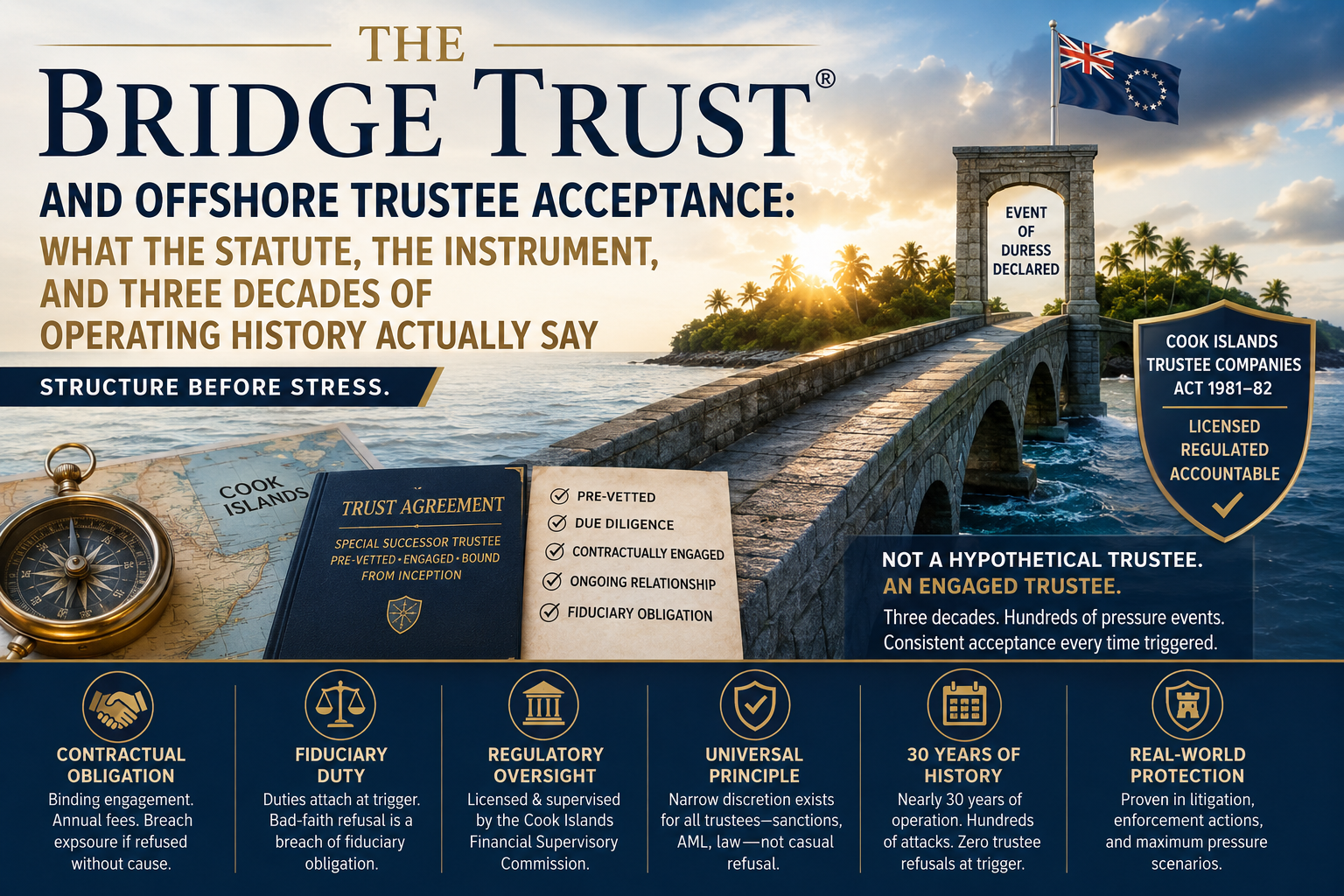
One criticisms aimed at the Bridge Trust® structure is the claim that the offshore Special Successor Trustee may simply refuse to serve when the trust is triggered. The critique is usually framed as if the offshore trustee relationship is hypothetical until the moment a lawsuit appears — that the client will be left scrambling to find a willing trustee mid-litigation, only to be rebuffed.
That framing fundamentally misunderstands how a properly designed and professionally administered Bridge Trust® actually operates. It is also wrong as a matter of trust instrument doctrine, contractual obligation, and Cook Islands regulatory framework.
This article walks through what the structure actually does, what the law actually says, and what the operational record actually shows. For the doctrinal companion piece on why the Bridge Trust® is legally an offshore trust from inception, see The Bridge Trust® Is Not a Domestic Trust. It Never Was.
The Misrepresentation, Distilled
The critique argues, in substance: “Sure, you name an offshore trustee in your trust document. But that trustee is not actually your trustee yet. When the Event of Duress is declared and you need them to step in, they will conduct a new review — and they might simply decline. The whole structure depends on a trustee who has not yet accepted the role.”
The argument has surface appeal because it leverages a real and limited principle of common-law trust doctrine: that a designated successor trustee has not formally accepted the trusteeship until they actually step into the role.
But the argument misstates the operational and contractual reality of how the Bridge Trust® engages its Special Successor Trustee, and it ignores the framework of pre-engagement, due diligence, regulatory licensing, and contractual obligation that exists from the day the trust is funded.
What the Trust Instrument Actually Provides
In a Bridge Trust®, the Special Successor Trustee is not merely “named in a document as a future possibility.” The trust instrument expressly provides that the SST has been pre-vetted, is familiar with the Trust Agreement and the parties to the trust, and is identified as the specific party engaged to assume the trustee role upon a declaration of an Event of Duress. Stated plainly, The Special Successor Trustee has already accepted the role and contractually committed to serve if properly called upon through a triggering declaration of an Event of Duress.
The Special Successor Trustee is identified in the operative trust agreement by name and is bound to the structure through a separate engagement that operates alongside the instrument. The relationship is established at the moment the trust is signed and funded — not later, not after litigation appears, not under duress.
The client and the trust structure have already undergone KYC review, due diligence procedures, compliance verification, and onboarding with the offshore trust company involved. This is not a scenario where a desperate client suddenly contacts an offshore trustee during litigation to ask whether the trustee would like to become involved.
The relationship exists. The engagement exists. The obligation to serve has already been agreed to.
That distinction is not semantic. It is the structural difference between a planning relationship and a crisis solicitation — and it is the difference between asset protection that works and asset protection that fails.
The Contractual and Regulatory Reality
The offshore trustee relationship in a Bridge Trust® is an existing fiduciary and contractual engagement established in advance. Fees are paid annually in support of that ongoing relationship and operational readiness. The trustee is licensed under the Cook Islands Trustee Companies Act 1981–82 and supervised by the Cook Islands Financial Supervisory Commission. The engagement is documented, the relationship is maintained, and the regulatory framework attaches from day one.
If an offshore trustee were to refuse to honor that engagement at trigger without legitimate fiduciary grounds, the issue would not simply evaporate into theory. It would create exposure on three distinct fronts.
Contractual exposure. The engagement is a binding agreement supported by years of paid fees. Walking away at trigger without proper grounds is breach of contract, enforceable through Cook Islands courts and exposing the trustee to damages claims from the trust and beneficiaries.
Fiduciary exposure. The moment fiduciary duty attaches at trigger, the trustee owes duties to the beneficiaries. Bad-faith refusal at the precise moment those duties become operational is itself a fiduciary breach.
Regulatory exposure. Cook Islands trust companies operate under the supervisory authority of the Financial Supervisory Commission. Arbitrarily abandoning client engagements — particularly engagements that have been compensated for years — is the kind of conduct that draws regulatory scrutiny and can put the trustee’s license at risk.
This is the framework the critics ignore. The discretion to “just say no” does not exist in a regulatory vacuum. It exists inside a framework of contractual commitment, fiduciary duty, and licensing oversight that operates against arbitrary refusal, not in favor of it.
The Universal Fiduciary Principle
Every licensed trustee — in every jurisdiction in the world — retains some limited fiduciary discretion. That is universal. Trustees cannot be compelled to violate fiduciary duties, local law, anti-money laundering requirements, sanctions regimes, or other regulatory obligations. No competent practitioner would argue otherwise.
This is true of a Bridge Trust® Special Successor Trustee. It is also true of a primary trustee in a fully foreign trust. It is true of a U.S. corporate trustee at a domestic bank. The narrow discretion to decline actions that violate fiduciary or licensing duty is a feature of fiduciary law generally — not a structure-specific defect of the Bridge Trust®.
What that universal discretion does not permit is casual refusal. It does not permit walking away from a contractual engagement because circumstances have become inconvenient. It does not permit abandoning a fiduciary obligation that was accepted years earlier and compensated continuously.
The criticism conflates two entirely different concepts: a trustee’s narrow right to refuse actions that would violate fiduciary duty, and the false suggestion that offshore trustees casually decide, for the first time during litigation, whether they wish to participate in the structure at all.
Those concepts do not occupy the same legal space.
The Empirical Record
The Bridge Trust® has been in operation for nearly thirty years. Across that period, the Special Successor Trustee acceptance mechanism has functioned consistently every time it has been triggered. The structure has been tested through creditor disputes, litigation threats, enforcement actions, and other pressure events. The criticism that the acceptance feature is theoretical is not supported by decades of operational record.
This matters because the entire critique depends on a failure mode that has not manifested. The “trustee might refuse” argument is presented as if it were an active risk profile when it is, in fact, a theoretical concern that has not been observed in the 30 year operational history of the structure.
When a critique is presented as a fatal flaw but cannot point to a single documented occurrence across three decades of operation, sophisticated audiences should weigh that against the rhetorical confidence of the critique.
The Anderson Case Actually Demonstrates the Opposite
The case most frequently cited in offshore trustee acceptance discussions is FTC v. Affordable Media, 179 F.3d 1228 (9th Cir. 1999) — known as the Anderson case. Critics often invoke it as evidence that offshore trust structures fail under pressure.
That is not what the Anderson case actually shows. For a full breakdown see FTC v. Affordable Media (The Anderson Case): Landmark in Asset Protection & Offshore Trusts.
Anderson involved a fully foreign Cook Islands trust. Not a Bridge Trust®. Yet the trustee mechanism functioned exactly as offshore trustees are designed to function under pressure. The Cook Islands trustee remained in role and refused to comply with the U.S. court’s repatriation order. The trustee did not walk away. The trustee did not decline the position. The trustee held the line.
The Andersons were jailed for civil contempt because the court concluded they retained too much direct practical control over the assets — not because of any failure of the trustee acceptance mechanism. The structural protection at the trustee level functioned exactly as designed.
The leading case cited against pre-engagement structures, when read accurately, demonstrates licensed Cook Islands trustees holding the line under maximum pressure. It supports the operational reality the critique seeks to deny.
Tax Classification Versus Legal Situs
A separate source of confusion in this discussion involves the relationship between IRC § 7701 tax classification and legal situs.
Some critics assume that because a Bridge Trust® qualifies as a domestic trust for U.S. tax purposes under § 7701, it therefore must be purely domestic in legal character. That is incorrect.
Tax classification and legal situs are separate analyses operating on separate tracks. A Bridge Trust® is intentionally structured to satisfy the § 7701 court and control tests for domestic tax treatment during peacetime, while simultaneously existing as a foreign trust under foreign governing law and offshore registration. The structure utilizes multiple offshore jurisdictions and includes formal offshore registration certificates issued at inception.
The fact that a trust is taxed domestically does not strip it of its offshore legal characteristics. The two questions are governed by entirely separate bodies of law. Conflating them — treating “domestic for tax purposes” as if it meant “purely domestic in legal character” — is the foundational misunderstanding underlying most of the critique aimed at the Bridge Trust®.
For the complete statutory walk-through, see The Bridge Trust® Is Not a Domestic Trust. It Never Was..
The Multi-Tool Reality
Sophisticated asset protection planning is not about finding a single magical structure that solves every problem. Different clients present different tax profiles, risk tolerances, reporting concerns, operational realities, banking issues, and control preferences.
A fully foreign Cook Islands trust may be appropriate in some cases. A Bridge Trust® may be more appropriate in others. The Dynasty Bridge Trust™, hybrid structures, domestic asset protection trusts, layered LLC planning, Arizona Multi-Member Limited Partnerships, and other tools each have their place depending on the facts.
The four pillars that govern the analysis are constant: timing, control, jurisdiction, and collectibility. The structure that satisfies them depends on the client profile.
The suggestion that every client should use one identical offshore structure regardless of circumstance reflects a simplistic view of sophisticated planning. The real test of any asset protection practice is not which tool it sells. It is whether the practitioner understands when each tool applies, how to implement it correctly, and how to defend it under pressure.
The Real Distinction
The real distinction in this field is not between one trust document and another. It is between paper structures and operational experience.
There is a meaningful difference between selling a standardized offshore trust document and having decades of practical experience implementing, administering, triggering, and defending complex asset protection structures under real-world legal pressure.
Documents do not protect assets. Operating systems do. Documents that have never been tested under litigation pressure are theoretical instruments. Structures that have been deployed across hundreds of pressure events are operational systems.
When evaluating asset protection commentary, sophisticated clients should weigh source impartiality, operational track record, and the substance of doctrinal argument against marketing claims.
Decades of survived court attacks speak more loudly than recently-formed “credentials.”
Bottom Line
The “trustee acceptance myth” depends on a misreading of three separate things:
The trust instrument — which expressly establishes the SST as pre-vetted, familiar with the trust, and bound to the structure from inception.
The contractual and regulatory framework — which constrains arbitrary refusal through breach exposure, fiduciary duty, and licensing supervision under the Cook Islands Trustee Companies Act 1981–82.
The empirical record — three decades of operation, hundreds of attacks, consistent trustee acceptance every time the structure has been triggered.
Trustee discretion is not the structural vulnerability the critique suggests. It is a universal feature of fiduciary law that exists in every trust everywhere — and the Bridge Trust®’s pre-engagement architecture is specifically designed to satisfy it.
Structure before stress.
Frequently Asked Questions:
1. Does the Special Successor Trustee actually have to accept the role at trigger?
The SST has been pre-vetted, named in the Trust Agreement, and engaged contractually before any duress event. Annual fees support the standing engagement. Refusing to serve at trigger without legitimate fiduciary grounds would create contractual, fiduciary, and regulatory exposure under the Cook Islands Trustee Companies Act 1981–82. The discretion to decline exists only on narrow grounds — sanctions, OFAC, anti-money-laundering, settlor misconduct — not casual refusal.
2. Has the Bridge Trust® ever had a trustee refuse to accept at trigger?
Across nearly thirty years of operation and hundreds of documented pressure events, the Special Successor Trustee acceptance mechanism has functioned consistently every time it has been triggered.
3. Doesn’t FTC v. Affordable Media prove offshore trusts fail?
No. Anderson involved a fully foreign Cook Islands trust — not a Bridge Trust® — and the Cook Islands trustee remained in role and refused the U.S. repatriation order. The structural protection at the trustee level functioned. The grantors were jailed because they retained too much direct practical control over the assets, not because the trustee declined the position.
4. Is the Bridge Trust® “really” a domestic trust because of its § 7701 classification?
No. Tax classification under IRC § 7701 and legal situs are separate analyses operating on separate tracks. The Bridge Trust® qualifies as a domestic trust for U.S. tax purposes during peacetime while existing as a foreign trust under offshore governing law and registration. Both characterizations coexist by design.
4. Why not just use a fully foreign Cook Islands trust from the start?
Different clients present different tax, banking, reporting, and operational profiles. Fully foreign trusts impose ongoing IRS reporting (Form 3520, 3520-A), offshore banking constraints, and reduced direct control. The Bridge Trust® preserves tax simplicity and operational control during peacetime while engaging full offshore protection at trigger.
The right structure depends on the facts — there is no universal answer.
By: Brian T. Bradley, Esq.


