

In FTC v. Affordable Media, LLC, 179 F.3d 1228 (9th Cir. 1999), the Andersons were jailed for civil contempt after refusing to repatriate trust assets — and the assets stayed in the Cook Islands anyway. The contempt attached to control they had retained, not to the offshore structure. When the FTC then pursued the trust in the Cook Islands, it lost there too, and was ordered to pay the trustee’s costs.
I spent years on the plaintiff side of civil litigation — filing suit, running discovery, issuing asset subpoenas, deposing trustees. I know what creditors actually do when they come for someone’s money. This is the case that changed how I think about offshore trust law more than any other, and it is the case most often quoted at half its length.
Key Points
• The trust held. The Cook Islands trustee refused the U.S. repatriation order. The money never came back.
• The people did not. The Andersons were jailed for civil contempt because the court found they retained control.
• The defect was role stacking. They were co-trustees and protectors of their own trust. As protectors, they held the power to certify that no event of duress existed — which would have unwound the freeze.
• The FTC lost in the Cook Islands too. On August 10, 1999 the Cook Islands High Court rejected its attempted takeover of the trust on every point and awarded costs against it.
• Bad facts. This was a Ponzi scheme, the assets were fraud proceeds, and the creditor was a federal agency. Those facts limit how far the case travels.
• The lesson is separation of roles, not that offshore jurisdiction is magic or that it is worthless.
What Was FTC v. Affordable Media About?
The FTC brought an enforcement action against Michael and Denyse Anderson and their Nevada entity, Affordable Media, LLC, over a fraudulent investment program. Three years before the suit, the Andersons had established a Cook Islands trust administered by a licensed local trustee company. The court ordered them to bring the money back.
The underlying business sold media units to investors with a promised 50% return, supposedly funded by profits from late-night television product sales. Not enough product moved to support the promised returns, so earlier investors were paid with later investors’ money. When new investment dried up, it collapsed.
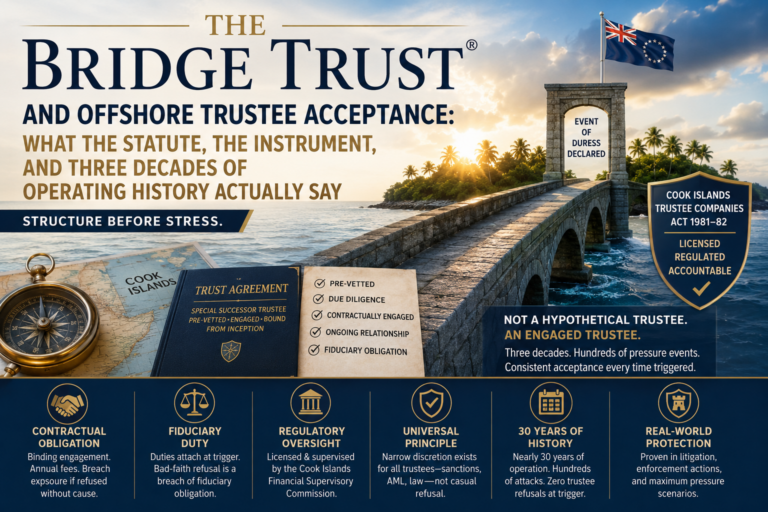
In July 1995, three years before the FTC filed, the Andersons established an irrevocable trust under Cook Islands law. AsiaCiti Trust Limited, a licensed Cook Islands trustee company, served as trustee. The trust deed contained a duress clause: if an event of duress occurred — a foreign court order aimed at the trust assets, for example — the trustee’s authority became controlling and it was constrained from complying.
The Andersons named themselves co-trustees alongside AsiaCiti. They also named themselves trust protectors.
Hold onto that second fact. It is the entire case.
The FTC obtained a temporary restraining order and then a preliminary injunction, both of which required the Andersons to repatriate any assets held for their benefit outside the United States.
What Did the Trust Actually Do When the Court Ordered Repatriation?
It refused. On May 12, 1998 the Andersons instructed the trustee to provide an accounting and return the assets. The trustee treated the U.S. order as an event of duress, removed the Andersons as co-trustees, and declined both requests. When they tried to install their children as trustees, the trustee removed those appointees too.
That second detail matters and it rarely gets quoted. This was not a single refusal that might be explained by a slow response or a confused fiduciary. The Andersons made a further attempt to purge the contempt by appointing their children as trustees, and the trustee removed them as well — because the event of duress was continuing.
The mechanism worked twice, under direct pressure from a federal court, against a party actively trying to satisfy that court.
The district court had no way to compel AsiaCiti. In personam jurisdiction over settlors is not in rem jurisdiction over assets held abroad by an independent fiduciary in a jurisdiction that does not recognize U.S. judgments.
The assets stayed in the Cook Islands.
Why Were the Andersons Held in Contempt If the Trust Worked?
Because they had not actually given up control. Beyond being co-trustees, they remained trust protectors — and as protectors they retained the power to certify that no event of duress had occurred, which would have reversed the trustee’s freeze. The FTC surfaced that fact. The Andersons had not volunteered it.
This is the holding, and it is narrower than it is usually described.
A party asserting impossibility as a defense to contempt bears a heavy burden: they must show, specifically and in detail, why compliance cannot be achieved. The district court found the Andersons had not carried it, and the Ninth Circuit reviewed that finding for clear error and affirmed.
The reasoning was that the inability to comply was the intended result of their own arrangement. They built the barrier, and they kept a key to it.
The Ninth Circuit was also candid about what it could not do. It affirmed contempt against the persons in front of it. It did not, and could not, reach the trustee or the assets.
They went to jail. The money did not come back.
What Happened When the FTC Went to the Cook Islands?
It lost. On August 10, 1999, the Cook Islands High Court ruled against the FTC entity on every point — the documents removing the trustee were an invalid exercise of the protector’s powers, and the attempts to install the FTC entity as protector and remove it from the excluded-persons list were invalid because they would have benefited an excluded person. The court awarded costs against the FTC entity.
This is the half of the case that almost never gets told, and it is the more important half.
Under U.S. judicial compulsion, documents were executed purporting to remove AsiaCiti as trustee and install an FTC-controlled entity in its place, and to amend the trust so that entity was no longer an excluded person. The trustee took the position that acting on documents produced under duress would breach its fiduciary duty to preserve trust assets for the beneficiaries. The matter went to the Cook Islands High Court.
The court held:
1. The documents purporting to remove the existing trustee and appoint the FTC entity were an invalid exercise of the protector’s powers.
2. The amendment purporting to remove the FTC entity from the excluded-persons list was invalid, because it would have benefited an excluded person.
3. The appointment of the FTC entity as protector was invalid for the same reason.
Then the court awarded costs against the FTC entity and in favor of the trustee.
Sit with what that means. A federal agency with effectively unlimited litigation resources went to the Cook Islands holding documents executed under a U.S. court’s compulsion, asked the local court to give it control of the trust, was refused on every ground, and was ordered to pay the trustee’s legal costs.
The matter later resolved by settlement. The terms were never made public.
That outcome — not the contempt order — is why practitioners who actually collect judgments treat Cook Islands trusts the way they do.
Does Anderson Prove Offshore Trusts Fail?
No, and it does not prove they are invincible either. It proves a narrower and more useful thing: the offshore jurisdiction performed exactly as designed under maximum pressure, and the settlors’ retained control is what put them in a cell. Those are two separate results from one case.
Anyone citing Anderson for a clean conclusion in either direction has not read all of it.
Critics stop at the contempt order and call the structure a failure. That framing ignores that the assets were never recovered and that the FTC was turned away in the Cook Islands with a costs award against it.
Promoters stop at the assets and call it a win. That framing ignores that two people sat in federal custody.
Both halves are true. The case is a proof of concept for the jurisdiction and a cautionary tale about drafting.
The Four-Pillar Analysis
Every asset protection case worth studying breaks across four dimensions. Anderson illustrates all four.
Timing was the Andersons’ genuine advantage. The trust was established and funded in 1995, three years before the FTC action. Fraudulent transfer law requires a showing of actual intent to hinder, delay, or defraud a creditor, and where the creditor does not yet exist at the time of the transfer, that argument is far weaker. Pre-litigation structure is not fraud. It is planning.
Control is where the case is most instructive, and where the conventional summary gets it wrong. The usual telling is that the duress clause stripped the Andersons of control. It did not — not completely. The trustee removed them as co-trustees, but they remained protectors, and that role carried the power to certify that no event of duress existed. That residual authority is what defeated the impossibility defense. The lesson is not that duress mechanisms fail. It is that a settlor should never hold a role that lets a court say you could undo this if you chose to.
Jurisdiction performed as advertised. Cook Islands law does not recognize foreign judgments. Its trust statutes constrain trustees from complying with foreign court orders. The burden to challenge a transfer is beyond a reasonable doubt — a criminal standard in a civil setting. Limitation periods are short and filing bonds are substantial. Nevis offers materially comparable protection. Anderson was the live test of that framework against a determined federal plaintiff, in U.S. court and then in Cook Islands court. It passed both times.
Collectibility is where the practical answer lives. The FTC obtained a judgment, obtained contempt, obtained incarceration — and did not obtain the trust assets. It then spent more money losing in a foreign forum and paying the trustee’s costs. That is the calculus every creditor’s attorney eventually runs.
What Anderson Does Not Stand For
Practitioners who cite this case without reading it carefully do their clients a disservice.
It does not stand for the proposition that an offshore trust will protect assets obtained through fraud. The Andersons ran an illegal scheme and the assets were scheme proceeds. It does not stand for the proposition that the settlors stay free — they sat in federal custody while their trust assets remained protected. That is a real trade-off, and any honest practitioner has to name it.
It also arose in a government enforcement action under the FTC Act, not a private civil creditor claim. Federal agencies are, along with the IRS, a category of adversary with resources and persistence that a typical plaintiff does not have. That distinction matters enormously when you are projecting how a case like yours would go.
Legitimate planning with clean money, executed before any legal threat exists, produces a fundamentally different risk profile. The Andersons’ dirty-hands problem is what made their situation extreme.
What Anderson Teaches About Structure Design Today
Four things: separate the roles so the settlor holds no reversal authority, put real power in an independent fiduciary, build the structure before a claim is foreseeable with legitimately sourced assets, and stay fully tax-compliant. Anderson failed on the first. It succeeded on everything else.
The independent trustee must hold actual authority, not nominal authority the settlor can override. The settlor must not occupy a role — protector, co-trustee, or otherwise — that lets a court conclude the freeze is reversible at will. That single design choice is the difference between the Andersons’ outcome and a clean one.
On the mechanism itself, precision matters. In a well-drafted instrument, declaring an event of duress produces a set of mandatory protective effects immediately: standing consents are revoked, the grantor’s powers to appoint or remove the protector and successor trustee are suspended, and distributions are suspended. The settlor does not have to act, and cannot act.
What follows is discretionary. An independent protector may appoint the offshore successor trustee, may change governing law or situs, may move custody. Those are fiduciary judgments, not a mechanical trigger. That distinction is deliberate: an automatic “lawsuit filed, therefore flee” clause is precisely what a court would characterize as built-in obstruction. A discretionary menu exercised by an independent fiduciary is not.
A hybrid structure — offshore in legal character from inception, domestic for tax classification under IRC §7701 while conditions are calm — delivers the jurisdictional protection Anderson validated while carrying domestic-level administration and reporting until a threat actually appears.
What Happens When a Creditor’s Attorney Finds a Trust Like This
I have seen the calculus change in real time.
Enforcement across an international jurisdictional gap, against a trustee with no legal obligation to cooperate, in a forum where the burden of proof is criminal-standard, the filing bond is substantial, contingency fees are prohibited, and costs can be awarded against you, is not a litigation strategy. It is an exercise in spending fees with no return.
The FTC — with the full weight of the federal government behind it — concluded that settlement was more practical than continuing to fight on that terrain.
Most creditors never get that far.
FAQs
Did the Andersons’ Cook Islands trust fail?
No. The trustee refused the U.S. repatriation order and the assets were never recovered. The Andersons were jailed for contempt because they retained control, which is a defect in their drafting, not in the jurisdiction.
Why were they held in contempt if they could not access the assets?
Because they remained trust protectors and retained the power to certify that no event of duress existed, which would have reversed the trustee’s freeze. The court found their inability to comply was self-created.
Did the FTC ever recover the trust assets?
Not through litigation. It lost in the Cook Islands High Court on August 10, 1999 and was ordered to pay the trustee’s costs. The matter later settled on undisclosed terms.
Can a U.S. court order a foreign trustee to hand over assets?
It can order a person within its jurisdiction to act. It has no mechanism to compel a foreign fiduciary holding legal title in a jurisdiction that does not recognize U.S. judgments. That distinction is the entire structural point.
Does Anderson mean I could go to jail for having an offshore trust?
Contempt attaches to refusing to do something you retain the power to do. The Andersons held reversal authority. A structure where the settlor holds no such authority at the moment of the order presents a materially different posture — which is why the roles are separated.
Does this case apply to legitimate assets?
Its facts do not. Anderson involved fraud proceeds and a federal enforcement agency. Legitimately earned wealth, structured before any threat exists, is in a different legal posture.
The Takeaway
Anderson is the most stress-tested proof point in offshore trust law precisely because the structure held under maximum pressure. Federal government plaintiff. Ponzi context. Contempt order. Incarceration. Two attempts to purge. A separate action in the foreign forum. And still the assets were never reached.
It also tells you exactly what to avoid: do not hold a role that lets a court say you could reverse this if you wanted to.
Asset protection is not secrecy or evasion. It is building legal structures that make collection impractical while remaining fully compliant with U.S. tax and disclosure law. No structure guarantees an outcome. What a properly built one changes is the position you negotiate from.
The question is whether you have the right instrument in place before you need it.
Structure before stress.
📞 For a confidential legal consultation, contact Bradley Legal Corp. at (888) 773-9399, or complete the intake questionnaire at btblegal.com. There is no charge for the consultation.
By: Brian T. Bradley, Esq. — National Asset Protection Attorney