

No. The Bridge Trust® is a foreign trust in legal character from the day it is executed and funded. “Domestic” describes only its tax classification under IRC §7701 — a separate statutory question with a separate answer. There is no conversion, because there is nothing to convert.
This is the single most common misunderstanding about the structure, and it is worth resolving precisely, because everything else follows from it.
Key Points:
• Two statutory tracks, not one. Legal situs is governed by offshore trust law. Tax classification is governed by IRC §7701 and Treas. Reg. §301.7701-7. Critics collapse them into one question and get a wrong answer.
• The offshore foundation exists at inception — registered, with a pre-committed offshore trustee already engaged and onboarded, years before any threat.
• Nothing converts. At an Event of Duress the trust does not become foreign. It was always foreign. What changes is the §7701 tax classification and who administers it.
• No transfer occurs at the trigger, which is why the fraudulent-transfer criticism aimed at last-minute offshore moves does not reach this structure.
• The criticism is accurate — about a different structure. A domestic asset-protection trust attempting to go offshore mid-litigation is vulnerable. That is not what this is.
• Roughly 30 years of operating history. History, not a guarantee of any individual outcome.
What Is the Misconception?
The misconception is that the Bridge Trust® is a domestic trust that converts to an offshore trust when a threat appears — or that a separate offshore trust gets created later. Neither is accurate. There is one trust, foreign from inception, and nothing is created or transferred at the trigger.
The claim shows up in online commentary, in competitor marketing, and occasionally in the questions clients bring to a first legal consultation. It comes in two versions:
1. The Bridge Trust® is a domestic trust that converts to an offshore trust when a creditor threat appears.
2. The Bridge Trust® is a domestic trust, and a separate offshore trust gets created later, once a lawsuit arises.
Neither describes this structure.
Is the Criticism Legally Wrong?
No. As applied to a domestic trust attempting a mid-litigation offshore move, the criticism is correct. Courts will block that transfer, apply the forum state’s law, and hold the settlor accountable. The criticism is accurate. It is simply aimed at a structure that is not this one.
I want to be precise here, because these conversations go sideways when a planner waves off a valid principle.
A domestic trust that tries to move assets offshore after a claim appears is exposed on fraudulent-transfer grounds from the moment it moves. Creating an entirely new offshore trust after a threat materializes is worse. Courts see both for what they are.
I agree with that entirely. And it is exactly why this structure does not do it.
The disagreement is not about the law. It is about which structure the law is being applied to.
What Is the Bridge Trust® Actually, on Day One?
From the moment it is executed and funded, the Bridge Trust® is a registered offshore trust in a jurisdiction such as the Cook Islands or Nevis, with a pre-committed offshore trustee already engaged. The offshore relationship is established, maintained, and paid for annually — before any threat exists.
The offshore trustee is not a name in a document it has never seen. It is a signatory party to the trust agreement, alongside the settlors, trustees, and Protector. KYC, compliance, due diligence, and onboarding are completed at inception. The relationship is live and maintained annually.
Not when a lawsuit is filed. Not when an Event of Duress is declared. Not when a creditor starts making noise. On day one.
This is not a strategy implemented under pressure. It is a legal architecture built, registered, and operating offshore before any threat exists. That is the entire point, and it is what makes the timing objection inapplicable.
What Are the Two Statutory Tracks?
Track One is legal situs — governed by offshore trust law, foreign from execution, and unchanged before, during, or after a trigger. Track Two is U.S. tax classification — governed by IRC §7701(a)(30)(E) and Treas. Reg. §301.7701-7. Two questions, two statutes, two answers. Neither controls the other.
Track One — Legal Situs
The trust is an offshore trust in legal character from the day it is executed, registered under the law of an offshore jurisdiction such as the Cook Islands or Nevis. That legal character does not change — not before a trigger, not during, not after.
This is the track a creditor runs into.
Track Two — U.S. Tax Classification
Whether a trust is domestic or foreign for U.S. tax purposes is a separate question, governed by IRC §7701(a)(30)(E) and the two-part test in Treas. Reg. §301.7701-7. It has nothing to do with where the trust is registered or whose law governs it.
This is the track the IRS sees.
Critics conflate these. Once you separate them, the structure stops looking like a contradiction and starts looking like what it is — the precise outcome the statute produces when both tests are satisfied.
How Does the Bridge Trust® Qualify as Domestic Under IRC §7701?
By satisfying both parts of the test in Treas. Reg. §301.7701-7. The court test requires that a U.S. court can exercise primary supervision over administration. The control test requires that U.S. persons control all substantial decisions. The trust is structured to satisfy both during the domestic phase.
For clients who do not live in a self-settled spendthrift state, Nevada is designated as the administrative situs — satisfying the court test. The client serves as active trustee — satisfying the control test, because a U.S. person holds authority over substantial trust decisions.
Both tests met simultaneously produces domestic classification under §7701, even though the trust is foreign in legal character. That is not a contradiction or a marketing shorthand. It is what the statute does when its conditions are met.
Separately, the instrument is drafted to establish and maintain grantor-trust status under IRC §§671–677. The client retains qualifying powers, so income is taxed directly to the grantor on a personal Form 1040 and the trust is disregarded for income-tax purposes. In most cases no separate trust return is required.
Two rules, two jobs. The court and control tests determine domestic-versus-foreign classification. The grantor-trust rules determine who reports the income. One does not produce the other, and conflating them is one of the most common errors in commentary about this structure — including some written by people who otherwise understand this area well.
The result during the domestic phase is a structure that is tax-neutral. It does not reduce, defer, or hide a dollar of tax.
What Happens at an Event of Duress?
Declaring an Event of Duress triggers a set of mandatory protective effects immediately, and separately opens a discretionary menu the Trust Protector may act on. Declaration alone does not change situs, governing law, or trustee. If the Protector appoints the offshore Special Successor Trustee, the §7701 control test fails and tax classification reclassifies from domestic to foreign.
The distinction between mandatory and discretionary matters, and it is worth stating exactly.
Mandatory on declaration. Standing consents are revoked. The grantor’s powers to appoint or remove the Protector, the Special Successor Trustee, and the Investment Advisor are suspended. The trustee may not resign or transfer without Protector consent. Distributions are suspended. These operate automatically — the settlor’s relevant authority is stripped without the settlor having to do anything.
Discretionary thereafter. Nothing else changes on its own. The Protector may appoint a new trustee, including the offshore Special Successor Trustee, removing any grantor-trustee. The Protector may change governing law or situs. The Protector may move title or custody. These are options exercised by an independent fiduciary, not a mechanical switch.
That design is deliberate. A pre-programmed “lawsuit filed, therefore flee” clause is exactly what a court would characterize as built-in obstruction. A discretionary menu exercised by an independent Protector is not.
If the Protector does appoint the offshore trustee, the consequence for Track Two is immediate. The offshore trustee is not a U.S. person, so the control test fails. When one test fails, domestic classification ends. The trust reclassifies from domestic to foreign for tax purposes.
The Track One legal character — offshore, since day one — becomes administratively active. It did not appear. It was always there.
Is the Transition a Fraudulent Transfer?
No, because there is no transfer. No new trust is created, no assets are conveyed, and no decanting occurs. What changes is administration and tax classification. The fraudulent-transfer analysis attaches to funding, which happened years earlier, before any claim was foreseeable.
This is where the “conversion” framing does real damage, because if you believe a conversion occurs, the fraudulent-transfer criticism follows logically.
Nothing crosses a bridge to become offshore. The offshore legal character was present from execution. The domestic tax classification was deliberately maintained through §7701 compliance and deliberately broken through the trustee succession mechanism. The entire architecture was engineered to work this way from the day the documents were signed.
A creditor arguing fraudulent transfer has to point at a transfer. At the trigger, there isn’t one.
Does United States v. Huckaby Prove Hybrid Trusts Fail?
No. Huckaby involved a self-settled Nevada spendthrift trust holding California real property. No offshore element was involved and no offshore move was attempted. It failed because it was self-settled and because California law governed the land. It is a DAPT-fails case and a situs case.
United States v. Huckaby, No. 2:23-cv-00587-DAD-JDP (E.D. Cal. Mar. 2, 2026) is worth reading carefully, because it is frequently cited for propositions it does not support.
The facts: the Circle H Bar T Trust, a self-settled Nevada spendthrift trust, held real property in South Lake Tahoe, California. The United States held a judgment lien.
The reasoning, and this is the citable part:
• Situs governs land. Although the trust designated Nevada law for construction (Restatement (Second) of Conflict of Laws §277), the court held that California law governs whether a creditor can reach a beneficiary’s interest in land — the law of the situs of the property (Restatement (Second) §280). The land sits in California, so California law controls creditor rights.
• Self-settled is fatal. The trust was self-settled because the same people were trustors, settlors, trustees, and beneficiaries. Under Cal. Prob. Code §15304, a settlor of a spendthrift trust cannot also be its beneficiary. The court rejected the retroactivity argument.
• The lien reached. Huckaby held both legal title as trustee and an equitable interest as beneficiary, satisfying enforcement under 28 U.S.C. §3201(a).
This is a district-court order granting partial summary judgment, not appellate authority.
What it teaches is not that hybrid structures fail. It teaches two things this structure was built around: do not let the settlor be trustee and beneficiary, and you cannot move dirt — real estate is governed by the law where it sits, which is why real-estate protection works by structuring and protecting equity, not by relocating property.
Can I Be Held in Contempt? What Anderson Actually Shows
A court can order a person within its jurisdiction to act, and can hold them in contempt for refusing. It cannot compel a foreign trustee. FTC v. Affordable Media proves both halves: the Andersons went to jail, and the assets never came back.
FTC v. Affordable Media, LLC, 179 F.3d 1228 (9th Cir. 1999) is quoted constantly at half its length.
The half critics quote: the Andersons were co-trustees of their own Cook Islands trust. Ordered to repatriate, they said they could not. The Ninth Circuit affirmed the contempt finding, because they had voluntarily created the mechanism that made repatriation impossible. They went to jail.
The half almost nobody finishes: the Cook Islands trustee refused to comply, and the assets stayed offshore. The court had no mechanism to compel a foreign fiduciary. In personam jurisdiction over settlors is not in rem jurisdiction over assets held abroad by an independent trustee in a jurisdiction that does not recognize U.S. judgments. The money never came back.
Anderson is never a clean win and never a clean loss. It is the single best argument in the case bank for separating the roles — because what failed was retained control, not foreign jurisdiction.
That is what this structure does. Once the mandatory duress effects operate and the Protector appoints the offshore trustee, the grantor no longer holds authority to direct trust assets or compel repatriation. The grantor is out of the control loop by design.
United States v. Grant shows the other side: the impossibility defense working where control was genuinely relinquished. Ordered to repatriate, Mrs. Grant tried — she even attempted to replace the trustee — and the independent offshore trustee refused. The court accepted that she could not comply.
The underlying rule is Maggio v. Zeitz, 333 U.S. 56 (1948): civil contempt requires a present ability to comply. But Anderson is the reminder that courts will find self-created impossibility where the settlor built the barrier and kept the keys. The defense holds when authority was relinquished before the order, an independent trustee holds exclusive power, and the settlor stayed tax-compliant and transparent. It does not hold on the strength of a slogan.
Bridge Trust® vs. Domestic Asset Protection Trust
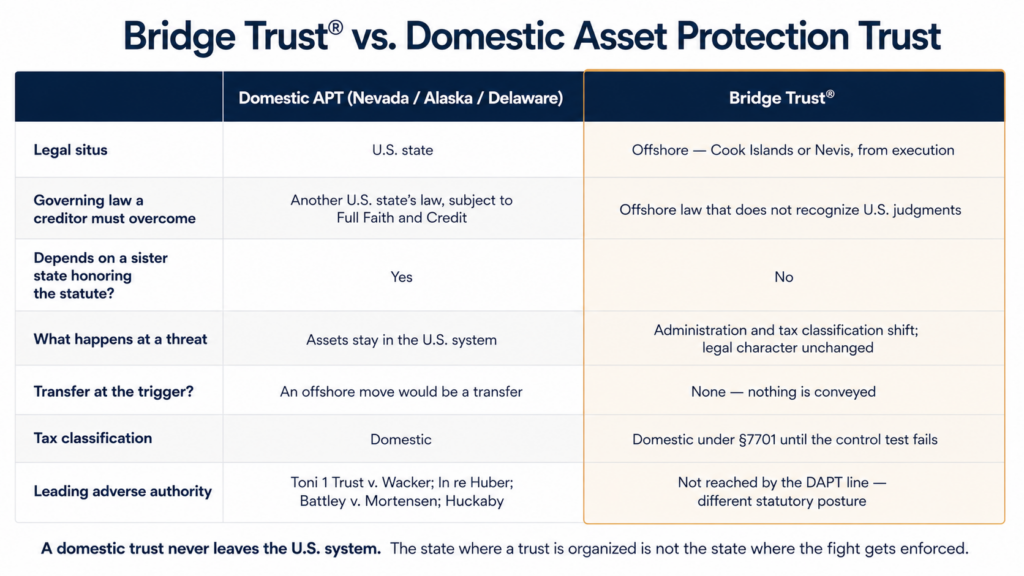
The structural point is one sentence: a domestic trust never leaves the U.S. system, so a determined U.S. court can reach it. The state where a trust is organized is not the state where the fight gets enforced.
What the Critics Are Actually Describing
There is a real structure that does what the criticism describes — a domestic asset-protection trust attempting to move assets offshore after litigation begins. That structure is vulnerable, and courts have correctly identified the vulnerability. A last-minute attempt to establish offshore status under judicial scrutiny is not an offshore trust. It is a domestic trust attempting an escape, and courts block it.
This is not that structure.
The offshore foundation is established at inception, through a registered trustee relationship, before any threat exists. The domestic tax treatment running concurrently is a function of §7701 compliance and grantor-trust drafting — not evidence that the trust is domestic in legal character.
The Bridge Trust® has been in use for roughly three decades. It has been attacked in court over 300 times — roughly four times a year — and no creditor has ever followed a client down to the Cook Islands once the bridge is broken. That is operating history. It is not a promise about any individual matter, and no structure guarantees an outcome. What it changes is the position you negotiate from.
Critics who describe this as a domestic trust that converts to offshore are not describing it. They are describing a different, weaker structure — and then attributing its weaknesses to an architecture built specifically to avoid them.
FAQs
Is the Bridge Trust® a domestic trust?
Not in legal character. It is a foreign trust registered offshore from execution. “Domestic” describes its IRC §7701 tax classification during the pre-trigger phase.
Does the Bridge Trust® convert to an offshore trust?
No. There is nothing to convert. It is offshore in legal character from day one. At a trigger, administration and tax classification change; legal situs does not.
Is the Bridge Trust® a DAPT?
No. It does not rely on any state asset-protection statute, which is why the line of cases defeating domestic asset-protection trusts does not reach it the same way.
Is the transition to offshore administration a fraudulent transfer?
No, because no transfer occurs. No new trust is created and no assets are conveyed. Fraudulent-transfer analysis attaches to funding, which happens before any claim is foreseeable.
Who decides when the trust goes offshore?
An independent Trust Protector, exercising fiduciary judgment. Declaring an Event of Duress triggers mandatory protective effects but does not by itself change situs, law, or trustee.
Does Huckaby apply to the Bridge Trust®?
No. Huckaby involved a self-settled Nevada trust where the same people were settlors, trustees, and beneficiaries, holding California real property. No offshore element was present.
Can I be jailed for contempt over an offshore trust?
A court can hold a person in contempt for refusing to do something they retain the power to do. That is why the roles are separated and why the settlor’s relevant authority is suspended on a duress declaration. Anderson is the case that proves the point in both directions.
Does the Bridge Trust® reduce taxes?
No. It is tax-neutral by design. Income is reported on your own return under the grantor-trust rules.
Structure Before Stress
Asset protection comes down to four questions: timing, control, jurisdiction, and collectibility. I run all four on every plan I build, and I would rather earn a client who showed up skeptical.
If you are putting seven or eight figures behind a legal structure, pressure-test it. Ask who controls the assets. Ask what happens on day one of litigation. Ask what the offshore trustee is actually obligated to do. Ask how the trust is classified for tax, and under which statute. Ask which jurisdiction’s law matters when a creditor tries to collect.
Then ask the same questions of whatever you are being offered instead.
📞 For a confidential legal consultation, contact Bradley Legal Corp. at (888) 773-9399, or complete the intake questionnaire at btblegal.com. There is no charge for the consultation.
By: Brian T. Bradley, Esq. — National Asset Protection Attorney