

Let me tell you about a call I did not enjoy taking.
A business owner — successful, careful, the kind of man who actually reads the fine print — had set up a purely foreign asset protection trust about two years earlier. Not with me. He’d found a promoter online who sold him a single tool: a fully foreign trust, offshore from top to bottom, pitched as the strongest protection money can buy. He wired the funds. He signed the binder. He felt safe.
Then a letter came from the IRS.
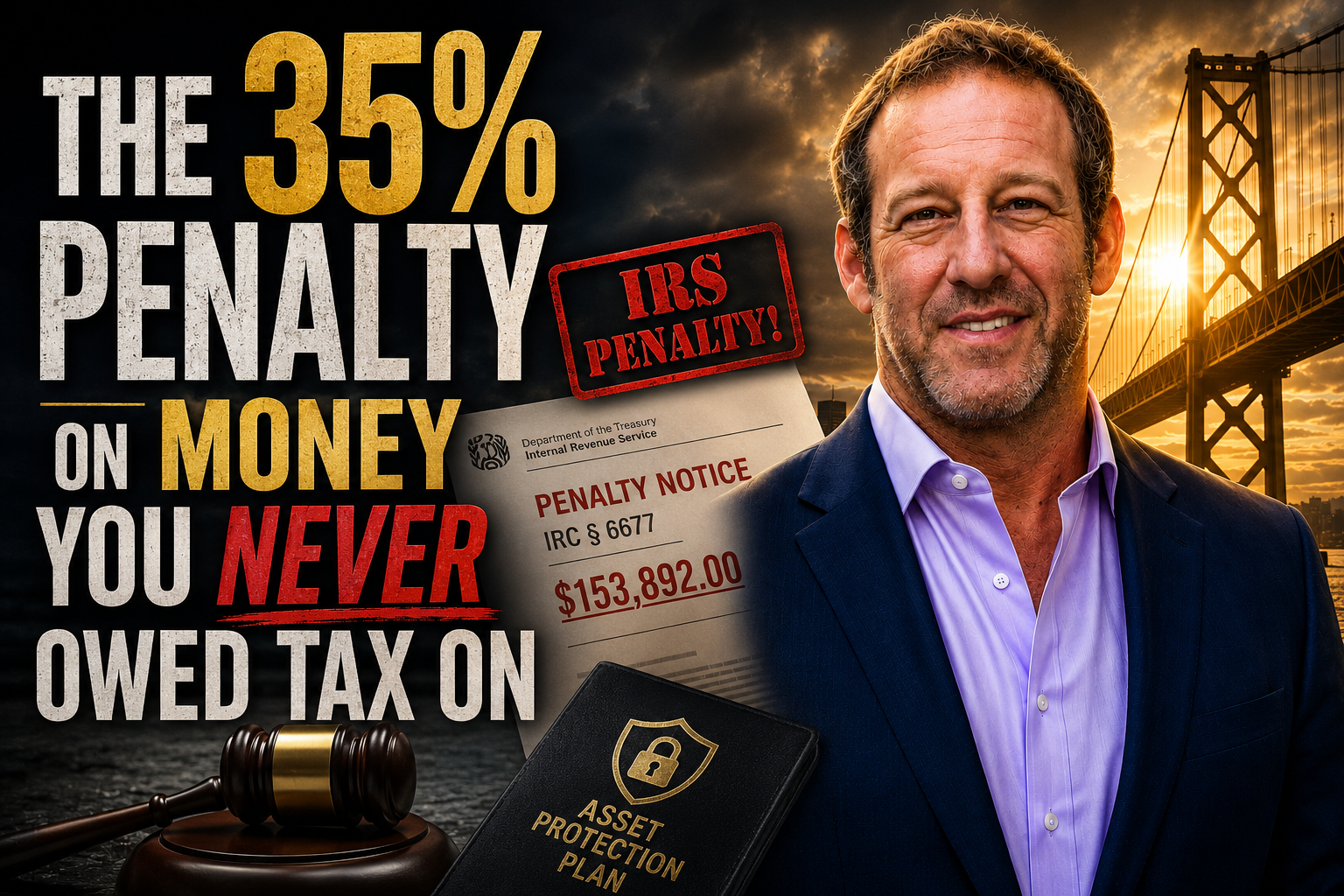
It was not a tax bill. He had paid every dollar of income tax he owed. It was a penalty notice — six figures — tied to a reporting form he did not know was his responsibility, for a transfer into his own trust. No additional tax was due. He was being penalized on the value of what he had moved, not on any tax owed on it.
That is the part of the foreign-trust story the sales page never explains. And it is one of the clearest reasons the Bridge Trust® exists.
What a Fully Foreign Trust Actually Signs You Up For
When you create a foreign trust, you step into one of the most unforgiving reporting regimes in the entire Internal Revenue Code.
The rules live in IRC § 6048. They require a U.S. person to report the creation of the trust, every transfer of property into it, the continuing ownership of it, and every reportable distribution out of it. That reporting is done on two forms: Form 3520, filed by you, and Form 3520-A, filed each year for the trust.
The penalties for getting it wrong live in IRC § 6677. And they are unlike almost anything else in the tax code, because they are not measured by tax. They are measured by the value of your assets.
Miss a reportable transfer or distribution, and the penalty is the greater of $10,000 or 35% of the amount involved. Miss the annual Form 3520-A, and the penalty is 5% of the trust’s assets — every year it happens. You can owe zero additional income tax and still face a penalty measured in hundreds of thousands of dollars.
Here is what most people never grasp until they are living it: filing on time does not make you safe.
Section 6677 penalizes returns that are late, and it penalizes returns that are incomplete, incorrect, or improperly valued. A foreign trust is not a “file it once and forget it” arrangement. Every contribution is a reportable event. Every distribution is a reportable event. Move an LLC interest in, take cash out, forgive a loan, and each one is its own filing with its own valuation and its own way to go wrong.
A trust that runs for twenty years can generate dozens or hundreds of these events — dozens or hundreds of chances for a technical error that carries a six-figure price tag.
The valuations alone are a recurring cost. Publicly traded stock is easy. A closely held business, an LLC interest, real estate, a promissory note, intellectual property, crypto — those often require a professional appraisal, and the burden of proving the number is on you.
Then there is the question of who is even responsible. Contributions are reported by the person who made them. Distributions are reported by the person who received them. The annual Form 3520-A is technically the foreign trustee’s job — but if the trustee fails to file it, the IRS collects the penalty from you, the U.S. owner, not from the trustee overseas who dropped the ball.
A settlor assumes the trustee is handling it. The trustee assumes the CPA is handling it. The beneficiary has no idea that simply receiving a distribution created a filing obligation. And the penalty lands on whoever the code says it lands on, regardless of who actually made the mistake.
In late 2024 the IRS did soften one edge of this. For certain late-filed returns, it stopped assessing the penalty automatically and began reading the taxpayer’s reasonable-cause explanation first. That is real relief — and it is also a tell. You do not build a review process for a problem that is not hitting people. It does nothing for the return that was filed on time but incomplete, filed with the wrong valuation, or the distribution nobody realized was reportable. The statute, and the exposure, is unchanged.
And this is not theoretical. The IRS assesses thousands of these information-return penalties every year, totaling hundreds of millions of dollars, and more than half are later abated. Read that again, because the abatement number is not comforting — it is the warning. “Later abated” means the penalty was assessed first, and the taxpayer then spent months or years, and real money on attorneys and CPAs, proving it should never have been charged. Winning that fight still costs you. Losing it is catastrophic.
None of this makes a foreign trust wrong. In the right case it is a superb tool. It makes the reporting burden a real cost that has to be weighed honestly — and almost never is, because the people selling the loudest have no reason to bring it up.
“Offshore Is Stronger” Answers the Wrong Question
The pitch for a fully foreign trust is always the same: offshore is stronger. And in a pure legal-protection contest, that is often true.
But “stronger” is not the only question.
Better is relative. A Ferrari is better than an SUV on a racetrack and worse than an SUV for a family road trip. The promoters who sell one offshore tool to everyone who calls have decided that offshore is always better, for every client, in every situation. That is not analysis. That is a product line.
The insight they skip is that a trust has two separate identities, and they do not have to match.
One is its legal home — the jurisdiction whose law protects it from creditors. The other is its tax status — whether the IRS treats it as domestic or foreign for reporting. A pure foreign trust is foreign for both. You get offshore protection, and you get the offshore reporting machine that comes bolted to it, from day one, whether or not you are ever actually threatened.
The Bridge Trust® is built to separate those two questions. That is the entire point of a hybrid.
How the Bridge Trust® Is Built Differently
While life is calm, the Bridge Trust® is a domestic grantor trust for U.S. tax purposes. It qualifies under IRC § 7701(a)(30)(E) — a U.S. court has primary supervision, U.S. persons control the substantial decisions.
Because it is domestic for tax purposes there is no Form 3520 and no Form 3520-A to file. You report the trust’s income on your normal 1040, exactly as you do now. The § 1014 step-up in basis is preserved. There is no offshore filing, no annual foreign-trust return, and none of the § 6677 penalty exposure that comes with them.
And yet the protection is real, because the trust’s legal home has been offshore the entire time. It is registered in the Cook Islands and in Belize — jurisdictions built to reject U.S. judgments — from the day it is signed. Nevis sits in that same tier of creditor-hostile jurisdictions. The legal passport is foreign. The tax passport is domestic. Both are held at once.
The foreign-reporting obligations only attach if the trust actually has to cross the bridge — if a genuine creditor threat forces it to become a fully foreign trust for tax as well as law. At that moment, yes, the 3520 and 3520-A obligations begin. But by then you are in an active fight, the protection is doing the job you built it for, and the compliance cost is a price worth paying. You take on that burden when it buys you something — not for years and years while nothing is happening.
That is the difference between paying for protection and paying for exposure. A pure foreign trust charges you the full compliance burden every single year, in exchange for a fight that statistically may never come. The hybrid holds the same protective position without that burden, until the day the burden actually buys you something.
Who This Is Really For
If you are a physician, a business owner, or a real estate investor with serious exposure and serious assets, you should protect yourself — early, before anything is on the horizon. The question is not whether to plan. It is which structure fits your situation.
For most families under roughly $30 million in exposed assets, a fully foreign trust is rarely the right answer. The marginal increase in offshore strength does not justify decades of mandatory reporting, recurring valuation and preparation fees that commonly run several thousand dollars a year, and a penalty regime that can bill you six figures on a year you owed no tax at all.
A hybrid that respects the balance of protection, cost, and compliance is more often the better choice.
If you work with these clients — if you are a CPA, a wealth manager, or a financial advisor — this is the part that protects you as much as your client. When a client walks in with a fully foreign trust, you inherit the 3520 and 3520-A exposure, often without being told it exists. The hybrid keeps your client out of that machine while life is calm and preserves the step-up you would otherwise be planning around.
A few common-sense questions save people from this.
Ask any advisor whether the structure they are selling creates an annual foreign-trust filing obligation, and what the penalty is if it is missed. Insist that your CPA be on the call before anything is signed.
Ask whether the offshore trustee is contractually taking responsibility for filing Form 3520-A — and if not, demand to know why not. Any advisor who resists getting on the phone with your tax team is one to be wary of.
None of this is an argument against offshore protection. It is an argument for matching the tool to the situation, and for counting every cost — including the ones created by the plan itself — before you commit.
Asset protection is supposed to reduce risk. It should not quietly trade a lawsuit that may never happen for a reporting burden that is guaranteed to.
That is the discipline behind the Bridge Trust®. Offshore protection when you need it. Domestic simplicity until you do.
Structure before stress.
By: Brian T. Bradley, Esq.


