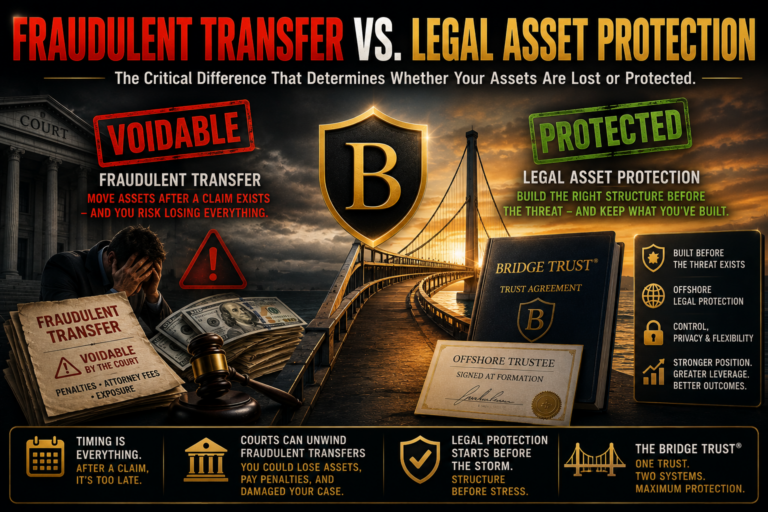


An offshore asset protection trust, sometimes called a foreign asset protection trust, is a trust formed under the law of a creditor-protective jurisdiction such as the Cook Islands, Nevis, or Belize. It places assets under a sovereign legal system that does not recognize U.S. judgments at all. A domestic asset protection trust relies on one state’s statute that another state’s court can decline to apply. The difference is not drafting quality — it is jurisdiction, and courts have been consistent about it: In re Huber, Toni 1 Trust v. Wacker, and United States v. Huckaby.
Only one standard ultimately matters: collectibility. If a creditor cannot collect, the structure worked. If they can, the paperwork never mattered.
If you want offshore protection without handing your assets to a foreign trustee during the years when nothing is happening, there is a hybrid structure — the Bridge Trust® — that holds that protection in reserve. I explain how it is taxed and how it moves offshore in the hybrid section below, and in full in What Is the Bridge Trust®?
Key Points
- Offshore jurisdictions don’t recognize U.S. judgments. A creditor must re-litigate from scratch, locally, against a criminal burden of proof.
- Setup pricing for a fully foreign trust varies widely by firm. Annual maintenance typically runs $5,000 to $20,000, compliance included. My Bridge Trust® with the AMLP is $32,500, and $3,500 a year to maintain.
- It makes sense at roughly $2 million or more in exposed net worth — assets a creditor could actually reach, not retirement accounts or protected home equity.
- Nevis mandates an EC$270,000 creditor bond; the Cook Islands does not. Different architecture, not different strength — and conflating them is a common error.
- The structure has to exist before the threat. Fraudulent-transfer law measures a transfer from the date it was made.
- Every adverse offshore case turned on control or timing — never on the offshore jurisdiction failing.
- In re Rensin is the honest boundary. A Cook Islands trust migrated to Belize: distributions to the settlor-beneficiary were reachable, the corpus held by the offshore trustee was not.
- In Solow the trust held and the person did not. The assets were never reached; the contempt attached to the settlor’s spouse personally.
- In Grant the impossibility defense worked — until a $221,000 undisclosed distribution brought the IRS back. Conduct after the win is its own risk.
- The cases critics cite are all the same case — reactive timing, retained control, home-state law.
- DAPTs fail on jurisdiction, not drafting. Alaska’s own supreme court said so in Toni 1 Trust v. Wacker.
- Federal law overrides state protection. 11 U.S.C. §548(e) gives a bankruptcy trustee a ten-year reach against self-settled trusts.
What Is an Offshore Asset Protection Trust?
An offshore asset protection trust is an irrevocable trust holding your assets with a licensed trustee in a foreign jurisdiction whose law does not recognize U.S. judgments.
Three elements distinguish it from a domestic trust. A foreign trustee — a licensed trust company outside the reach of a U.S. court’s contempt power. A protector — an independent party with defined powers, typically including removal and replacement of the trustee. And a jurisdiction that will not enforce a U.S. judgment, which forces a creditor to re-litigate the underlying claim locally.
That third element is the whole point. A domestic trust sits inside a legal system where a judgment from one state is enforceable in every other. An offshore trust does not.
In normal operation very little changes in your financial life. The trust is a grantor trust for U.S. tax purposes, assets are usually held through an underlying partnership or LLC, and you continue managing the entities. What changes is where the ownership interest sits when someone comes looking.
What Does an Offshore Trust Change?
The forum. Instead of relying on one U.S. state’s statute against another U.S. state’s court, the assets sit under a sovereign legal system that does not recognize U.S. judgments at all. A creditor who wins in California has to start over — in a foreign court, under foreign law, against a foreign trustee.
Which Jurisdiction: Cook Islands, Nevis, or Belize?
The most developed framework is the Cook Islands International Trusts Act 1984, as amended, written specifically to address cross-border creditor enforcement. Nevis and Belize offer co-equal creditor-protective regimes, and a well-built structure is not locked to a single forum.
The core protections:
Non-recognition of foreign judgments. A U.S. judgment cannot be domesticated. The underlying claim must be re-litigated locally from the beginning.
A criminal-level burden of proof. Fraudulent transfer must be established beyond a reasonable doubt. In Nevis, §61(1) of the Limited Liability Company Ordinance (Cap. 7.04) additionally requires proof that the transfer rendered the member insolvent — two burdens, not one.
Short, hard limitation periods. Nevis §61(4) imposes an absolute bar at two years from accrual or one year from the transfer.
A creditor bond — in Nevis, and this is where most comparisons go wrong. §61 of the Nevis International Exempt Trust Ordinance (Cap. 7.03) requires a creditor to deposit EC$270,000 with the Nevis Ministry of Finance before commencing an action against trust property. At the fixed peg of 2.70 XCD to 1.00 USD, that is $100,000 USD, and Nevis courts retain discretion to require more depending on the scale of the litigation. It is a statutory floor, not a ceiling.
The Cook Islands has no equivalent mandatory cash bond. The International Trusts Act 1984 does not impose one. That does not make the Cook Islands weaker — it means the barriers are built differently: non-recognition of foreign judgments forcing de novo local litigation, a criminal burden of proof on fraudulent conveyance, strict limitation periods measured from the transfer or the accrual of the cause of action, and severe costs-shifting against a claimant who loses.
Conflating the Nevis statutory bond with Cook Islands law is one of the most common errors in comparative offshore analysis, and it appears constantly in content written by people who have not opened either statute.
Regulated trustees are legally constrained from honoring foreign orders. An offshore corporate trustee in Nevis, the Cook Islands, or Belize is subject exclusively to its local legal framework. Complying with an order from a foreign court that has no local jurisdiction exposes that trustee to personal legal liability and loss of license. That is not reluctance or discretion — it is a professional consequence that makes cooperation with a U.S. repatriation order untenable for a licensed fiduciary.
That is why a U.S. court’s order against the trustee has no practical effect, and why in Anderson the trustee refused twice under direct federal pressure.
What Does an Offshore Trust Cost?
There is no single number, and anyone who gives you one without asking a question first is guessing.
Firms price fully foreign trusts very differently. Some run lean. Some are very high end. The same structure can carry a wildly different setup fee depending on who builds it, because every firm charges what it decides to charge. That part of the market has no standard.
What drives the difference is scope — the number of entities, the asset types involved, and how much restructuring has to happen before funding. A single brokerage account is a different job from multiple properties across several states, each needing its own LLC.
The annual side is more predictable. Maintenance on a fully foreign trust typically runs $5,000 to $20,000 a year. That figure includes the offshore compliance — the filings and the reporting sit inside it, not stacked on top of it.
My own pricing is simpler, because the Bridge Trust® is a different structure. As of November 2026, I charge $32,500 for the Bridge Trust® with the Asset Management Limited Partnership included, and $3,500 a year to maintain it. The annual number adjusts with inflation from time to time.
It should be weighed against what it protects. The structure makes sense at roughly $2 million or more in exposed net worth. Below that, the arithmetic usually does not work, and I will say so.
The annual figure is not optional. A foreign trust carries trustee fees and U.S. information reporting every year it exists. Anyone quoting you a setup cost without an annual number has given you half the picture.
What Are the Pros and Cons?
The advantages are jurisdictional. The disadvantages are cost, reporting, and the fact that a court can still reach you personally.
What it does well: separation that actually exists, because a foreign trustee is not subject to U.S. process. Non-recognition of U.S. judgments, which forces a creditor to re-litigate at real cost under a heightened standard. And limitation periods running from the transfer, which reward planning done early.
What it costs you: money every year, not once. Information reporting, with substantial penalties for getting it wrong. And less direct control — which is the point, and is also uncomfortable for people used to holding their own assets.
And the one nobody wants to discuss: contempt. A U.S. court with personal jurisdiction over you can order you to act, and can incarcerate you for civil contempt if it concludes you are not complying. That happened in FTC v. Affordable Media and in In re Lawrence. A repatriation order binds the person even where it cannot bind the trustee.
Who Needs One — and Who Doesn’t?
Roughly $2 million or more in exposed net worth, in a profession or asset class where being sued is a question of when rather than whether.
Exposed means reachable — not your 401(k), not ERISA plan assets, not protected home equity. The assets a judgment creditor could actually collect against: brokerage accounts, investment real estate equity, business equity held personally, cash.
That distinction matters more than the number. Someone with $2.5 million concentrated in retirement accounts and a homestead has very little exposed. Someone with $2 million in a brokerage account and two rentals has nearly all of it exposed.
Where it fits: physicians and surgeons in high-litigation specialties, where the risk is a verdict above policy limits. Real estate holders with meaningful equity. Business owners approaching a liquidity event. Professionals whose personal exposure outlasts the engagement.
Where it does not: if adequate insurance covers your realistic worst case, buy the insurance first. If your wealth sits in protected assets, this solves a problem you do not have.
And if a claim is already foreseeable, I will decline the engagement — not as preference, but because building then creates a voidable transfer and a bad fact in your own file. This is not a structure you grow into. It is for people already exposed who know it.
What Does the Offshore Case Law Actually Hold?
That U.S. courts can compel people within their jurisdiction and cannot compel a foreign trustee. Every adverse case in this area turned on retained control or reactive timing. None turned on the offshore jurisdiction failing to hold.
FTC v. Affordable Media — the Anderson case
FTC v. Affordable Media, LLC, 179 F.3d 1228 (9th Cir. 1999) is the most quoted and most half-quoted decision in this field.
The chronology settles the timing question. The trust was established in July 1995. The FTC filed its enforcement action on April 23, 1998, in the District of Nevada — nearly three full years later. The funding was not defective on fraudulent-transfer grounds and was nowhere near a time bar. Timing was not the defect.
Control was. Michael and Denyse Anderson retained positions as co-trustees and trust protectors of their own trust.
When the Nevada federal court ordered repatriation, the Andersons transmitted the instruction to the Cook Islands corporate trustee. The trustee exercised the duress clause, declared an event of duress, removed the Andersons as co-trustees, and refused to distribute. When they attempted to install their children as replacement trustees to purge the contempt, the trustee removed those appointees too, because the duress was continuing.
The mechanism performed exactly as designed — twice, under direct federal pressure, against parties actively trying to satisfy the court.
The Ninth Circuit affirmed contempt anyway, and the reason is the entire lesson. Because the Andersons remained Trust Protectors, they retained the power to override the event of duress or replace the trustee. Holding a live legal control mechanism over the trust meant they could not establish impossibility of compliance, and the court affirmed their incarceration.
What failed was not the offshore jurisdiction. What failed was the domestic side of the structure, because the grantors insisted on keeping protector powers over an offshore entity.
Then the FTC took the fight offshore and lost there too. On August 10, 1999, the Cook Islands High Court ruled against the FTC entity on every point it raised, and awarded costs against it in favor of the trustee. The matter later settled. The assets never came back.
This is why the case gets half-quoted in both directions. Non-specialist writing treats it as proof that offshore trusts do not work, or that the FTC breached a Cook Islands trust. Neither happened. The Cook Islands trustee ignored a U.S. court order and kept the funds. The people who built the trust went to jail because they would not let go of it.
The lesson is separation of roles, not avoidance of the jurisdiction.
United States v. Grant — the Arline Grant case
Mr. Grant established two separate offshore trusts in two separate jurisdictions — one for himself, one for his wife Arline. He then did two things: left the IRS a $36 million debt, and died.
Start with the obvious caveat. A $36 million liability owed to the IRS is not a normal creditor situation, and like Anderson it is a case where the federal government is the plaintiff. Bad facts make bad law, and neither side should treat this as a clean precedent.
Act one: the impossibility defense worked. After the 2005 trial, Mrs. Grant was ordered to request that the trustee repatriate the assets. She complied explicitly — she asked, and when the trustee refused, she attempted to replace the trustee. She was unsuccessful for more than two years.
In 2008 the government moved again, alleging failure to comply. The court refused:
The judge acknowledged more than two years had passed without repatriation, said the failure was not for a lack of effort, and was reluctant to fault Mrs. Grant for her trustees’ denial of her requests. He found she had sufficiently established she was unable to repatriate the funds, and denied the motion.
That is the impossibility defense working, on the record, against the IRS — because control had genuinely been relinquished and the offshore trustee genuinely refused.
Act two: conduct undid it. Having survived that, Mrs. Grant then requested a distribution — and the trustee complied, sending $221,000 to her children’s accounts. She did not inform the court or the government’s counsel.
In January 2012 the IRS moved again. The court’s tone changed completely, finding that her ability to repatriate funds to her children’s accounts while failing to disclose it brazenly flouted the authority of the Court, and that using repatriated funds for anything other than paying down the tax liability ran plainly afoul of its order.
Two lessons, and the first one is a drafting instruction.
The trust gave Mrs. Grant the “non-reviewable, sole and complete discretion to remove and replace the Trustee at any time.” That is the flaw. The fix is a single clause: make that power exercisable only when the beneficiary is not acting under duress — which she plainly was throughout the proceedings. A trust that suspends removal power during duress produces the same protective result without handing a court an argument that the beneficiary retained control.
That drafting point is precisely what this structure does, and it is why the settlor’s power to appoint or remove the Protector and successor trustee is suspended the moment an Event of Duress is declared.
The second lesson is about the creditor. The IRS is not an average adversary. It is plausibly the only creditor with the resources and persistence to pursue a matter this hard for this long, and virtually any private plaintiff would have abandoned it years earlier.
Where it ended up: the money is still not with the IRS. Mrs. Grant cannot freely access it either, under a severe injunction. It looks like a stalemate — but she holds the assets and the IRS does not, and she retains options a debtor with no trust would never have had against a $36 million federal liability.
Doug Lodmell’s test for this case is the right one: if you were Arline Grant, knowing what you know now, would you still have wanted the trust?
SEC v. Solow — the planning worked, the facts did not
This is the case that most rewards careful reading, because two things are true at once and most summaries pick one.
Mrs. Solow set up an offshore trust shortly after her husband received notice of a significant SEC judgment against him arising from his separate business activities. She funded it with their $6 million Florida home, held in tenancy by the entirety — which already insulated it from a creditor of one spouse — and additionally protected by Florida’s unlimited constitutional homestead exemption.
Her stated concern was succession, not creditors: TBE severs on death or divorce, and she wanted the home to pass to the children rather than to her husband unprotected. So she transferred the home into the trust, mortgaged it, moved the proceeds offshore, and did the same with a corporation holding a condominium and with cash accounts.
The trust held. The creditors were not successful in reaching the assets of the trust. On the jurisdictional question, the planning worked exactly as designed.
Mr. Solow did not. The court ordered him to disgorge $3.4 million. When he said he could not pay because the assets sat in his wife’s trust, the court held him in contempt — reasoning that moving TBE assets would have required his consent, and that “such self-created penury does not exempt Mr. Solow from being held in contempt.”
Those are two separate results from one case, and both belong in any honest account of it.
The real lesson is about when not to take the engagement. Had the Solows done nothing, the home was almost certainly exempt already under TBE and the Florida homestead. The condo and cash might have been clawed back, but even those carried a strong TBE argument. Instead, a flurry of financial activity days after the judgment colored every asset in the case — and the creditor was the SEC, which along with the IRS and FTC is a super-creditor with resources and persistence a private plaintiff rarely matches.
The timing was terrible, the conduct was unsympathetic, and the adversary was as strong as they come. On those facts, relying on the protection that already existed would likely have produced a better outcome than building new protection did.
That is the takeaway worth carrying: when a client arrives clearly after the fact, facing a super-creditor, with bad facts — the right answer is often to decline the engagement and say so.
In re Rensin — where offshore stops, and why that is the point
In re Rensin, 600 B.R. 870 (Bankr. S.D. Fla. 2019) is the most useful case in this area precisely because it is not a clean win, and any honest guide has to include it.
Joseph Rensin, a Florida resident, established the Joren Trust under Cook Islands law and later migrated it to Belize — the same two jurisdictions this structure uses. He was both settlor and a discretionary beneficiary, and roughly $8.6 million was distributed to him or for his benefit over time. He filed Chapter 7 in Florida in 2017.
The court applied Florida law to determine what a Florida creditor could reach, notwithstanding the Belize choice-of-law clause — the same domestic-forum public policy that defeats self-settled trusts everywhere else. Distributions payable to Rensin were reachable, and his exemption arguments failed.
But the court could not compel turnover of assets held by the offshore trustee beyond U.S. jurisdiction. Foreign situs drew a hard line around the corpus he did not control.
That is the two-track truth in a single opinion. Offshore situs is necessary — it walled off what the court could not reach. It is not sufficient — a retained beneficial interest plus a pattern of self-directed distributions meant the reachable parts got reached.
Offshore stops at the water’s edge, and that is the point. What sank Rensin was distributions to a settlor-beneficiary he could effectively command. Distribution discretion vested solely in an independent trustee, with the client unable to compel a distribution, is the specific answer to that failure mode.
When a critic waves a case where “a Cook Islands and Belize trust failed,” this is usually the case — and it holds exactly half of what they claim.
Rush University Medical Center v. Sessions — offshore does not move the assets
A Cook Islands trust, and the court still reached the assets — because the assets were in Illinois.
Illinois law applied, the self-settled spendthrift protection was void, and the trust’s foreign governing law did not change where the property sat. This is the same principle Huckaby applied to California real estate from the domestic side.
Offshore governs the trust. It does not govern assets that never left. Placing a foreign wrapper around domestically held property changes the paperwork and not the enforcement forum, which is why the structure has to include the entity layer beneath the trust rather than relying on the trust alone.
Riechers v. Riechers — where a trust held
In Riechers v. Riechers, 679 N.Y.S.2d 233 (N.Y. Sup. Ct. 1998), a physician’s Cook Islands trust — established years earlier in response to general malpractice exposure rather than a specific claim — was not set aside. The court found a legitimate purpose and acknowledged it had no jurisdiction over the offshore corpus.
The honest limit: this arose in a divorce, and the court still made an equitable-distribution award against the husband personally. A trust shields you from creditors. A divorce court with personal jurisdiction over a spouse can still order an offset.
The principle underneath all of it
Maggio v. Zeitz, 333 U.S. 56 (1948): civil contempt requires a present ability to comply. Courts can order people within their jurisdiction to act. They cannot compel an independent foreign trustee operating under foreign law.
Whether a repatriation order succeeds turns on control. If the settlor still holds practical authority, courts treat the failure to comply as self-created and impose sanctions. If control was genuinely relinquished before the threat arose, compliance can become legally impossible — and courts recognize the difference.
Timing. Control. Jurisdiction. Those three, working together.
What Happens When a Domestic Trust Meets a Judgment
A real estate investor in California spent fifteen years building a portfolio worth just over four million dollars. He hired a CPA, worked with a financial planner, and on his estate attorney’s advice formed a Nevada LLC and a Nevada Domestic Asset Protection Trust. He paid the fees, signed the documents, and believed he was protected.
This is a composite illustration drawn from patterns I see in practice, not an actual client.
When a tenant lawsuit escalated into a seven-figure judgment, the legal reality became clear quickly. California courts do not honor Nevada’s asset-protection statutes where doing so conflicts with California’s own public policy against self-settled creditor shields. The structure that looked secure in a binder was exposed where it mattered — in collection.
The key question is never whether a structure looks impressive on paper. It is whether it survives when a creditor’s attorney, a bankruptcy trustee, or a family-court judge tries to enforce a judgment.
⸻
What Does a Domestic Asset Protection Trust Actually Do?
It is a self-settled spendthrift trust formed under one of roughly nineteen state statutes that let a settlor remain a discretionary beneficiary of an irrevocable trust while claiming creditor protection. The protection holds in the state that wrote the statute. It stops being reliable the moment enforcement happens somewhere else.
Alaska enacted the first modern statute in 1997. Nevada, Delaware, South Dakota, and others followed.
The appeal is straightforward: the trust is irrevocable, the settlor can remain a beneficiary, and a favorable state statute purports to shield the assets.
The theory breaks down at the point of enforcement.
Why Do Domestic Asset Protection Trusts Keep Failing?
Because you cannot purchase another state’s laws. A creditor sues where the debtor lives, where the assets sit, or where the claim arose — and that court applies its own law or federal law. Under the Full Faith and Credit Clause, no court is required to enforce another state’s statute when doing so violates its own public policy on creditor rights.
Federal law overrides state protection. In Battley v. Mortensen, 2011 WL 5025288 (Bankr. D. Alaska 2011), a federal bankruptcy court voided an Alaska DAPT under 11 U.S.C. §548(e), which lets a trustee avoid transfers into self-settled trusts made within ten years if made with intent to hinder or delay creditors. The settlor was solvent when he funded it. The Alaska statute did not save the trust.
Courts apply the settlor’s home-state law. In In re Huber, 493 B.R. 798 (Bankr. W.D. Wash. 2013), the court refused to apply Alaska law to an Alaska DAPT created by a Washington resident, applied Washington law instead, and invalidated the trust.
The state that wrote the statute conceded the limit. In Toni 1 Trust v. Wacker, 413 P.3d 1199 (Alaska 2018) — published state supreme court authority, and the cleanest holding in this line — Alaska’s own high court held that its DAPT statute cannot stop other states or federal courts from applying their own fraudulent-transfer law and jurisdiction.
The most recent illustration is on point. In United States v. Huckaby, No. 2:23-cv-00587-DAD-JDP (E.D. Cal. Mar. 2, 2026), a federal district court held that a self-settled Nevada trust could not shield California real property from a federal judgment lien under 28 U.S.C. §3201(a). Under Restatement (Second) of Conflict of Laws §280, California law governed creditor access to land located in California, and because the same individuals were trustors, trustees, and beneficiaries, the trust was self-settled and reachable under Cal. Prob. Code §15304. District-court order granting partial summary judgment — persuasive, not appellate.
Kilker v. Stillman is often cited alongside these. That opinion is unpublished and non-citable as authority under California Rule of Court 8.1115 — an illustration of judicial attitude, not precedent. The rule does not depend on it.
Other creditor-friendly jurisdictions reach the same result by statute. New York EPTL §7-3.1 provides that a disposition in trust for the use of the creator is void as against existing and subsequent creditors.
The pattern is consistent — and worth naming. The cases critics cite against asset protection are, functionally, all the same case. Huber, Battley, Kilker, Dahl, Huckaby: reactive timing, retained control, home-state law applied over the trust’s chosen law. Not one of them turns on a defect that pre-litigation structure with genuine separation of control shares.
The internal affairs doctrine governs how a trust or entity is managed. It does not govern creditor enforcement. If the settlor lives in a state that rejects self-settled protection, that state’s law typically controls — and that is a jurisdiction problem, not a drafting problem. It cannot be fixed by choosing a friendlier domestic state.
What Is the Hybrid, and How Is It Taxed?
A trust created as foreign in legal character from inception — registered offshore in Belize and governed by Nevada law — that satisfies the IRS tests for domestic classification during the years no threat exists. It carries offshore protection without offshore administration or offshore filing until it is actually needed.
A traditional offshore trust gives strong jurisdictional protection but requires a foreign trustee to hold the assets at all times. Most clients want that protection without surrendering day-to-day control during the years when nothing is happening.
Two independent tax rules do two different jobs, and conflating them is the most common error in commentary on this structure.
Because the instrument satisfies the court test and control test of Treas. Reg. §301.7701-7 — the two-part test under IRC §7701(a)(30)(E) — the IRS classifies the trust as domestic. Separately, it is drafted to establish and maintain grantor-trust status under IRC §§671–677, so income is reported on the settlor’s own return and the trust is disregarded for income-tax purposes.
One rule determines domestic-versus-foreign classification. The other determines who reports the income. Neither produces the other.
Because the assets remain includible in the settlor’s estate, the §1014 step-up in basis is preserved — maintained through a non-fiduciary power of substitution under IRC §675(4)(C).
During the domestic phase: income flows through to the settlor, no Forms 3520 or 3520-A are required, and the trust operates with the tax simplicity of a domestic grantor trust. The offshore protection is engineered in from the start and dormant.
What Happens at an Event of Duress?
An independent Trust Protector — an attorney exercising professional judgment, not the settlor — declares duress in writing. That declaration is the trigger. Nothing fires automatically on the filing of a complaint, which is precisely what makes it defensible.
On declaration, the instrument operates: standing consents are revoked, the grantor’s powers to appoint or remove the Protector and successor trustee are suspended, distributions are suspended, and no further amendments may be made. The settlor does not have to act, and cannot act.
That is the Anderson fix. The Andersons stayed in the loop and kept the power to certify the duress away. Here the settlor’s relevant authority is stripped the moment an independent professional declares, leaving nothing for a court to order the settlor to exercise.
The Protector may then appoint the pre-committed Special Successor Trustee — a licensed fiduciary in a creditor-protective jurisdiction such as the Cook Islands, Nevis, or Belize, and a signatory party to the trust agreement from formation, with KYC, due diligence, and onboarding completed years in advance.
No new trust is created. No assets are transferred. The structure moves from its domestic operating phase to its offshore enforcement phase. Because the trust existed before the threat arose, the jurisdictional firewall was already in place — which is why the fraudulent-transfer argument aimed at last-minute offshore moves does not reach it.
The distinction between a declared trigger and an automatic one matters. A clause that fires mechanically on a litigation event reads to a court as pre-programmed obstruction. A documented fiduciary decision by an independent party does not — and it puts a witness on the record who can testify to a reasoned judgment.
Where Does the Partnership Layer Fit?
The Asset Management Limited Partnership is the ownership and control layer — typically an Arizona limited partnership, where A.R.S. §29-341 makes the charging order the exclusive remedy against a limited partner’s interest, with no foreclosure authorization in the statutory text.
The partnership holds the economic interests in the operating assets. State-matched LLCs sit beneath it, containing operational liability at the property or business level and aligning each entity’s governing law with the law of the asset’s situs — the Huckaby problem, solved at the entity layer. The trust holds the majority limited-partner interest while management authority stays with the general partner.
You cannot move dirt. Real estate is governed by the law where it sits, which is why it belongs in a state-matched LLC rather than directly in any trust.
DAPT vs. Offshore vs. Hybrid: The Decision Framework
| Domestic APT | Fully Offshore Trust | Hybrid | |
|---|---|---|---|
| What a creditor must overcome | Another U.S. state’s statute, subject to Full Faith and Credit | Foreign law that does not recognize U.S. judgments | Foreign law, held in reserve |
| Depends on a sister state honoring the statute? | Yes | No | No |
| Offshore filings (3520 / 3520-A / FBAR) | None | From day one | Only if it transitions |
| Ongoing cost | Low to moderate | High | Domestic-level while calm |
| §1014 step-up | Depends on drafting | Depends on drafting | Preserved by design |
| Leading adverse authority | Toni 1, Huber, Battley, Huckaby | Control and timing cases only | Not reached by the DAPT line |
| Best fit | Lower exposure in a favorable forum | Already facing a sustained, well-resourced adversary | Planning ahead of a threat |
Whatever structure is used, one principle governs every plan that works: the structure must exist before the threat arises.
Fraudulent-transfer law — the UVTA and Bankruptcy Code §548, including the ten-year reach of §548(e) for self-settled trusts — measures a transfer against the date it was made, not the date litigation begins. Once a claim is foreseeable, the window closes quickly.
FAQs
Are offshore asset protection trusts legal for U.S. citizens? Yes, when funded before a claim is foreseeable and fully reported. They do not reduce U.S. tax and they do not exempt anyone from disclosure.
Why do domestic asset protection trusts fail? On jurisdiction, not drafting. A DAPT relies on one state’s statute, and the state where you get sued applies its own law. Alaska’s own supreme court confirmed the limit in Toni 1 Trust v. Wacker.
Can a U.S. court force my offshore trustee to return assets? It can order a person within its jurisdiction to act. It has no mechanism to compel a foreign fiduciary in a jurisdiction that does not recognize U.S. judgments — which Anderson demonstrated twice.
Does an offshore trust protect U.S. real estate? Not by holding it. Land is governed by the law where it sits. Real estate goes in a state-matched LLC inside the ownership chain.
What is the impossibility defense? The argument that compliance is genuinely impossible because an independent trustee holds exclusive authority. It works where control was relinquished before the order, as in Grant. It fails where the settlor built the barrier and kept a key, as in Anderson.
Is a hybrid weaker than a fully offshore trust? Different, not weaker. It is foreign in legal character from inception; what is domestic is the tax classification and administration while no threat exists. The trade is offshore filing burden versus domestic simplicity.
How far back can a creditor reach? Four years under the UVTA in most states, and ten years under 11 U.S.C. §548(e) for transfers to a self-settled trust in bankruptcy.
What if I’ve already been sued? For that claim, the window has largely closed, and a transfer now is voidable. For claims that do not yet exist, fraudulent-transfer analysis is creditor-specific and forward planning remains available.
The Question That Decides Everything
I spent the early part of my career on the plaintiff’s side of civil litigation — running discovery, taking structures apart, finding the seam where “protection” gave way. What failed, failed for the same few reasons every time. The settlor kept control he should have given up, or he waited until the claim was already in view.
The structure that holds is the one built before either of those is true.
No structure guarantees an outcome, and no honest lawyer promises a courtroom result. What a properly built and properly timed structure changes is the position you negotiate from.
You don’t rise to the level of your income. You fall to the level of your legal structure.
Structure before stress.
📞 For a confidential legal consultation, contact Bradley Legal Corp. at (888) 773-9399, or complete the intake questionnaire at btblegal.com.
By Brian T. Bradley, Esq. – National Asset Protection Attorney
Not ready to talk yet?
Take my 2-minute Lawsuit Exposure Test
Answer yes or no. You get an exposure score and see where your risk actually comes from.
Take the Lawsuit Exposure Test