
Most people who call my office already have a trust. That’s not the problem.
The problem is that they believe having a trust means they’re protected — and those are two entirely different things. A trust is a legal arrangement. Protection is a legal outcome. The gap between them depends entirely on which trust you have, what it actually does, and what it cannot do under the law of the jurisdiction where a creditor decides to come after you.
This article is a comparative guide to the four trust structures that come up most often in asset protection planning: the revocable living trust, the land trust, the gift trust, and the irrevocable asset protection trust. Each serves a distinct legal purpose. Each fails at something the others do well. Understanding where each one stops is as important as understanding what it starts.
What a Trust Actually Is
At its core, a trust is a three-party legal relationship. A grantor transfers assets to a trustee — an individual or institution — who holds and manages those assets for the benefit of one or more beneficiaries. The trust document governs what the trustee can and cannot do, when beneficiaries receive distributions, and what happens to the assets over time.
That structure sounds protective. But the legal protection a trust provides — or doesn’t — is determined entirely by one question: who controls the assets?
Under both common law and the Restatement (Third) of Trusts, assets you still control are assets a creditor can still reach. Revocability is control. The moment you can revoke a trust and take the assets back, a court can step into your shoes and do the same thing — because creditors are subrogated to your rights. This principle is not theoretical. It is the enforcement reality that drives every recommendation I make.
The Revocable Living Trust: Probate Avoidance, Nothing More
A revocable living trust — often called an RLT — is the most commonly drafted trust in the country, and the most commonly misunderstood.
What it does: it allows your estate to transfer to your beneficiaries outside of probate. In California, Oregon, and Washington, probate is slow, expensive, and public. An RLT bypasses that process entirely. Assets held in the trust at your death pass directly to named beneficiaries without court intervention, without the public record of a probate filing, and without the 9-to-18-month timeline a typical probate administration requires in those states.
What it does not do: protect anything.
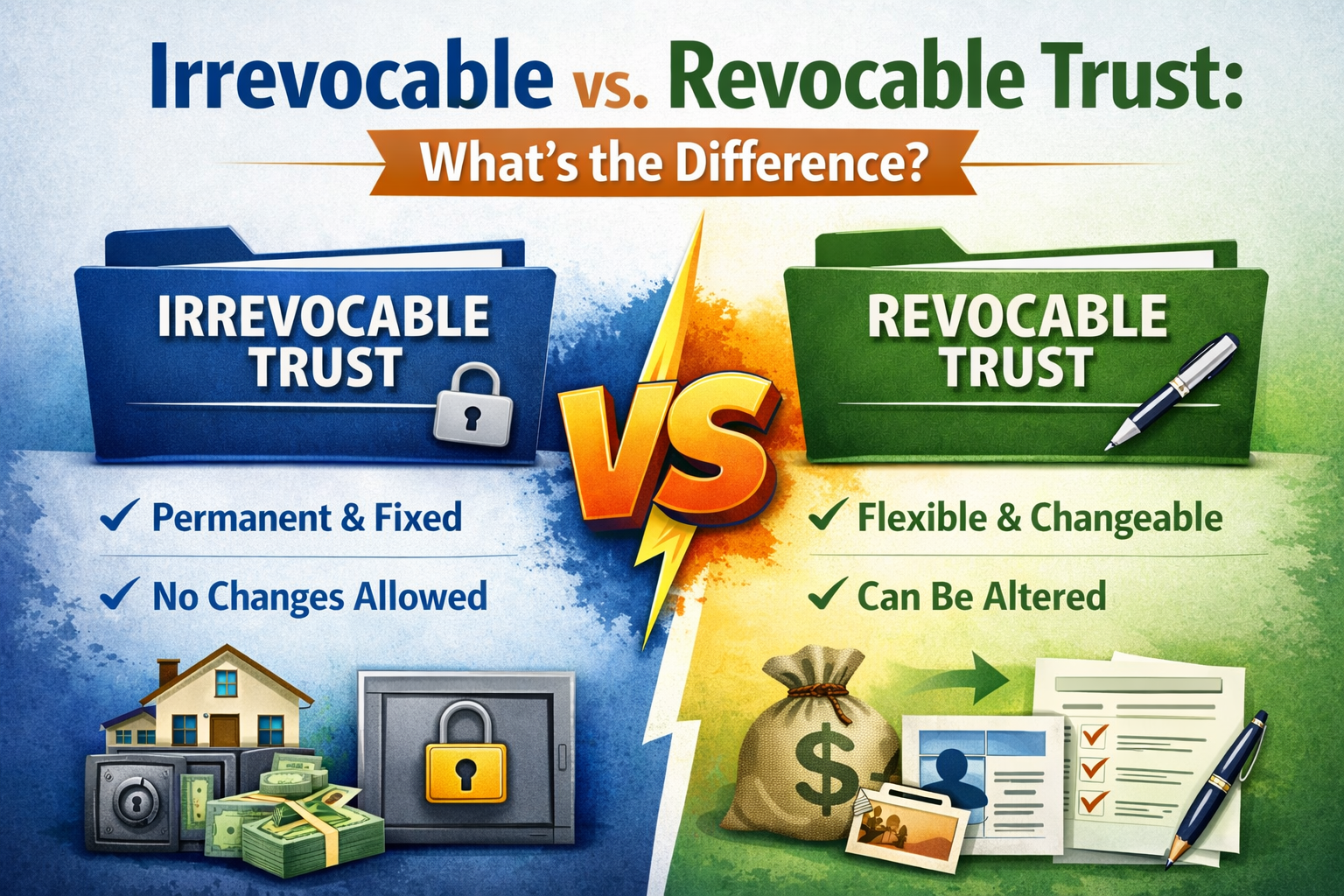
Because an RLT is revocable, you retain full legal control. You are still treated as the owner of the assets for purposes of creditor collection, civil judgment enforcement, and — critically — Medi-Cal and Medicaid eligibility. A plaintiff who wins a judgment against you can execute on assets inside your revocable trust exactly as if the trust did not exist. The trust wrapper is legally invisible to creditors.
An RLT is an essential estate planning tool. It is not an asset protection tool. If your attorney presented it as both, that is the gap you need to close.
The Land Trust: Privacy Without Protection
A land trust is a specific-purpose trust designed to hold title to real property — primarily for two purposes: privacy and probate avoidance.
When real estate is held in a land trust, the beneficiary’s name does not appear on recorded title documents. Ownership is attributed to the trust. For investors with multiple properties, contractors, landlords, or anyone who prefers that litigation adversaries not be able to identify their holdings through a simple county recorder search, that anonymity has real value. It makes you a harder target.
But here is the enforcement reality: a land trust is not a shield. If a creditor identifies you as the beneficial interest holder — which discovery makes straightforward — they can execute on that beneficial interest. The trust form does not restructure the asset. It just obscures the name on the deed.
Land trusts are most useful when paired with a holding LLC that owns the beneficial interest, creating a two-layer structure: the land trust holds title for privacy, the LLC holds the beneficial interest for charging-order protection, and neither layer alone is sufficient. But if creditor protection is the primary goal, you are better served by moving directly to a properly structured irrevocable trust from the start.
The Gift Trust: Estate Tax Mitigation Across Two Timelines
A gift trust is an irrevocable trust used to transfer wealth to beneficiaries while removing the gifted assets from your taxable estate. The mechanics are straightforward: you make a completed gift into the trust, the assets are no longer legally yours, and they no longer count toward your estate at death.
The gift trust becomes tactically important in a specific planning context — and that context shifted significantly on January 1, 2026.
The One Big Beautiful Budget Act permanently set the federal estate, gift, and GST tax exemption at $15 million per individual and $30 million per married couple. The threat of a 2026 sunset back to the pre-TCJA threshold is gone. For most clients, federal estate tax is now a non-issue. If you have a net worth $10 MM or more, a Dynasty Bridge Trust might be for you.
But state estate taxes are a different calculation entirely.
Washington imposes an estate tax with a $2.193 million exemption — one of the lowest in the country. Oregon’s exemption sits at $1 million. Neither state conforms to the federal exemption. A Washington resident with a $12 million estate owes nothing to the IRS at death but faces a substantial Washington estate tax liability on assets above $2.193 million, with marginal rates reaching 20 percent.
For clients in Washington and Oregon, gift trusts — structured as irrevocable trusts with appropriate trustee controls — remain an active and necessary planning tool even now that the federal conversation has quieted. The arbitrage is not between now and a federal sunset. It is between the value of the asset today and the compounded value a creditor or taxing authority could reach a decade from now.
Gift trusts are tax mitigation vehicles. They are not, by themselves, asset protection structures — though when properly integrated with an irrevocable asset protection trust, the two can operate in tandem.
The Irrevocable Asset Protection Trust: The Only Structure That Protects
An irrevocable asset protection trust — the APT — is the only trust type on this list specifically engineered to interrupt a creditor’s ability to reach your assets. The distinction is structural, not cosmetic.
When you transfer assets into a properly drafted irrevocable APT, you are no longer the legal owner. You cannot revoke the trust. You cannot unilaterally demand the assets back. A court cannot step into your shoes and do what you cannot do yourself. This is the enforcement principle that matters: United States v. Craft, 535 U.S. 274 (2002), and its progeny confirm that federal tax liens and creditor claims attach to property rights — and a properly structured APT transfers those rights out of your hands.
That said, not all irrevocable APTs are equal.
Domestic Asset Protection Trusts, or DAPTs, are created under U.S. state law — Nevada, Delaware, and South Dakota are the most commonly used jurisdictions — and offer meaningful protection within their statutory frameworks. Nevada’s DAPT statute under NRS 166 allows a settlor to remain a discretionary beneficiary with a two-year fraudulent transfer limitations period for most creditor claims. The structural vulnerability of a domestic DAPT is straightforward: U.S. courts can reach U.S. trustees. A federal court can issue orders directly to a domestic trustee. If that trustee complies to avoid contempt, the structure collapses under enforcement pressure.
Offshore Asset Protection Trusts operate under the law of a foreign jurisdiction — the Cook Islands and Nevis are the most litigated and most defensible — and are not subject to U.S. court orders directed at the foreign trustee. The Cook Islands enacted the International Trusts Act in 1984, and its provisions have withstood direct U.S. legal challenges in landmark cases including FTC v. Affordable Media, 179 F.3d 1228 (9th Cir. 1999). The offshore trustee is not in contempt of a U.S. court by declining to comply with a U.S. order. That is the structural advantage: enforcement is extraterritorial, and U.S. courts have no mechanism to compel it.
Riechers v. Riechers, 679 N.Y.S.2d 233 (Sup. Ct. Westchester Cty. 1998) is one of the most important judicial validations of the offshore trust structure in U.S. case law — and it is frequently misread. Dr. Riechers, a physician with a history of malpractice exposure, established a Cook Islands self-settled spendthrift trust to protect family assets. When divorce proceedings followed, the New York court examined the structure and explicitly found that the trust had been created “for the legitimate purpose of protecting family assets.” The court then confirmed it had no in rem jurisdiction over the Cook Islands trust corpus — meaning it could not reach the assets directly.
What the court addressed instead was a marital property claim — and that is a critical distinction. A spouse asserting equitable distribution rights in a divorce is not a creditor. She holds a marital property interest that arises entirely outside the framework of creditor-debtor law. The offshore trust did exactly what it was designed to do: it held against every form of legal pressure a creditor can bring. The divorce outcome was not a failure of the structure — it was a separate body of law, governing a separate legal relationship, operating on its own track.
The lesson of Riechers is not that offshore trusts lose in divorce court. The lesson is that a court openly looking for a way to reach Cook Islands trust assets confirmed it could not — and that the trust was legitimate.
The tradeoff of offshore structures is complexity. Offshore trusts require FBAR and Form 3520 reporting under 31 U.S.C. § 5314 and IRC § 6048. They require an independent foreign trustee and a foreign trust protector. They require ongoing administration. For clients with $5 million or more in exposed assets, that complexity is justified by the protection it delivers.
The Bridge Trust®: When You Need Both
The structure I implement most often for high-net-worth clients is the Bridge Trust® — a hybrid irrevocable trust that begins domestic and becomes offshore only when legally necessary.
In its domestic posture, the Bridge Trust® operates like a Nevada or South Dakota DAPT. It files domestically, the trustee is U.S.-based, and daily administration is straightforward. If a creditor files suit and the threat crosses a defined threshold, the trust crosses the bridge — the assets move to the offshore trust jurisdiction and the foreign trustee assumes control. The domestic trustee steps aside. The U.S. court can issue whatever orders it wants. There is no one in its jurisdiction to comply.
The Bridge Trust® is not a theory. It has been tested across 30-plus years of litigation and challenged in multiple courts. The structural principle has held because the offshore component is not triggered speculatively — it is triggered by specific legal events that cross the threshold of enforcement risk.
For clients whose planning horizon extends to the next generation — and whose estate exceeds the threshold where GST planning becomes relevant — the Dynasty Bridge Trust™ layers a Nevada Dynasty Trust above the Bridge Trust® structure, creating a four-layer architecture that addresses creditor exposure across both the client’s lifetime and multi-generational wealth transfer. That is a separate conversation, but it begins with the same foundational question: is the trust you have built to protect you, or merely built to avoid probate?
The Decision Framework
The four structures map onto four distinct problems.
Probate avoidance is the domain of the revocable living trust. Privacy for real estate is the domain of the land trust. State estate tax mitigation — particularly in Washington and Oregon — is the domain of the gift trust. Creditor protection is the exclusive domain of the irrevocable asset protection trust, and within that category, the hybrid Bridge Trust® addresses the enforcement gap that domestic-only structures leave open.
Most clients who call me already have the first structure. Very few have the fourth. The ones who need the fourth but only have the first are the most exposed people in my practice — because they believe the problem is solved.
Schedule a Legal Consultation
Estate planning documents are not asset protection structures. If your wealth is exposed — through your profession, your business, your real estate, or the size of your estate — the question is not whether you have a trust. It is whether the trust you have can withstand enforcement.
I offer private legal consultations. Call (888) 773-9399 or schedule directly online.
Structure before stress.
By: Brian T. Bradley, Esq.