

New York is where wealth concentrates.
Finance. Real estate. Medicine. Law. Private equity. The highest density of high-net-worth individuals on the East Coast — many of them sitting on $15 million, $25 million, $50 million or more in exposed assets, with estates growing every year through equity compensation, carried interest, Manhattan real estate appreciation, and professional income that compounds without a state income tax drag.
And New York is where that wealth gets extracted — at a rate and through a mechanism that most advisors are not showing their clients clearly enough.
New York has its own state estate tax.
It has a cliff provision that is uniquely punishing — one that can cost a family over $1 million in state tax on a single dollar of appreciation above the threshold. It has no domestic asset protection trust statute. It has LLC creditor remedies that are among the weakest in the country. And it has a rule against perpetuities that limits multigenerational planning to a fraction of what Nevada law allows.
For a New York family at $15 million or more, the question is not whether these problems exist. The question is whether your current plan is actually solving them — or whether it is solving probate while leaving the real exposure untouched.
The Dynasty Bridge Trust™ is built for exactly this environment.
The New York Creditor Environment Is the Most Aggressive in the Country
New York is objectively one of the most plaintiff-friendly litigation environments in the United States — and for the client profiles that need the Dynasty Bridge Trust™, the exposure is structural.
For New York physicians, malpractice payouts and premiums are significantly above national averages. New Yorkers pay insurance premiums approximately 15% higher than the national average, reflecting a claim frequency and severity profile that makes liability exposure a permanent feature of medical practice in this state — not a theoretical risk.
For finance professionals, the exposure comes from fiduciary claims, FINRA arbitration, advisory malpractice, and the derivative business liability that flows from managing other people’s money in a high-dispute environment. For real estate investors and developers in New York, personal guarantees on construction financing, landlord-tenant disputes, and contract enforcement actions are routine — and New York courts are comfortable deploying aggressive collection tools when a judgment is obtained.
What makes New York particularly dangerous from a planning standpoint is not just the frequency of claims. It is what happens after a judgment.
The Second Circuit confirmed in 245 Park Member LLC v. HNA Group that New York law does not limit creditors to charging orders for LLC membership interests. Under CPLR 5225 and 5228, a New York creditor can obtain a turnover order compelling the assignment of the LLC interest itself — not just a lien on future distributions. Courts can appoint receivers over the debtor’s membership interests and distribution rights. The LLC interest is treated as general property subject to New York judgment enforcement, and the foreign LLC statute does not control the remedies available in a New York court.
This means that for New York residents, an LLC is a tax and governance vehicle. It is not a high-grade asset protection structure — regardless of whether it is single-member or multi-member, regardless of what the operating agreement says, and regardless of which state the LLC is organized in.
New York’s LLC statute under Section 607 of the Limited Liability Company Law authorizes charging orders but does not treat them as the exclusive remedy. Courts have expressly held that this does not displace turnover under CPLR 5225. The result is that every level of LLC-based planning a New York resident relies on for creditor protection is built on a foundation the Second Circuit has confirmed is not exclusive.
The LLC is a necessary first layer. In New York, it is further from a sufficient last layer than almost anywhere else in the country.
The New York Estate Tax Cliff — And Why It Changes the Math
Every state-specific estate planning conversation in New York has to begin here. Because the cliff provision is uniquely punishing in a way that California, Texas, and Florida residents never face — and it is not explained clearly enough.
The New York state estate tax exemption in 2026 is approximately $7.35 million per person. New York has no gift tax and no GST tax at the state level — but it has a three-year add-back provision that pulls certain lifetime gifts back into the taxable estate for state purposes.
Here is where the cliff triggers:
If a New York taxable estate exceeds 105% of the exemption — approximately $7.72 million in 2026 — the estate loses the entire state exclusion. Not just the excess above the exemption. The entire $7.35 million exclusion disappears. The full estate is then taxed at graduated rates up to 16%.
The math of that is alarming.
An estate worth $7.5 million — within the 105% band — owes New York estate tax only on the approximately $150,000 above the exemption. At lower graduated rates, the tax is measured in tens of thousands of dollars. The effective rate on the full $7.5 million is negligible because the exclusion is intact.
An estate worth $8 million — past the 105% threshold — loses the entire $7.35 million exclusion. The full $8 million is taxed at graduated New York rates that can approach the mid-teens. The tax easily reaches $900,000 to $1 million or more on that $8 million estate.
The marginal cost of the extra $500,000 — from $7.5 million to $8 million — can be several hundred percent of the incremental value when the cliff triggers. A family that does nothing to plan around the cliff can pay close to $1 million in New York estate tax on a difference that would have been tens of thousands of dollars if the estate had stayed within the band.
Now layer the federal exposure on top.
The federal estate and gift tax exemption in 2026 is $15 million per individual — $30 million per married couple — set permanently under current law at a 40% rate above the threshold. For a New York family between $7.35 million and $15 million, there is typically no federal estate tax — but the full force of the New York cliff applies. For a New York family above $15 million, both taxes stack.
At $30 million, the combined effective marginal rate on dollars above both exemptions — federal at 40% plus New York at up to 16%, with only partial federal deduction for state death taxes paid — can push into the 50% to 60% range on the exposed dollars.
Across two generations, without planning, a New York family that simply accumulates in personal name and New York-situs entities, makes no significant lifetime gifts, and fails to use GST or dynasty trust structures faces a compounded outcome that can consume well over half of the second-generation value to combined federal and New York transfer taxes.
This is the problem most New York estate plans are not designed to solve. They are designed to organize assets and avoid probate. Not to eliminate the generational extraction that compounds in the background every year the family does nothing.
New York Has No DAPT Statute — And Its Self-Settled Trust Rule Is the Strictest in the Country
New York Estates, Powers and Trusts Law Section 7-3.1(a) is explicit: a disposition in trust for the use of the creator is void as against the existing or subsequent creditors of the creator.
Not limited. Not restricted. Void.
This is not a gray area in New York law. It is a clear statutory rule and a clear public policy — a New York resident who creates a trust and retains any beneficial enjoyment of income or principal has provided no protection against creditors. Both existing creditors and creditors who arise after the trust is created can reach the assets.
In bankruptcy, the trustee steps into the shoes of a judgment creditor and reaches self-settled trust assets under the same authority. New York commentary and bar materials are consistent: New York does not permit self-settled asset protection trusts. Full stop.
For third-party spendthrift trusts — trusts created by someone other than the beneficiary — New York generally recognizes and enforces the spendthrift provisions. But even there, creditors can execute on a portion of income payments through income execution proceedings, and under EPTL Section 7-3.4, a creditor can bring a plenary action to reach surplus income — any income not necessary for the beneficiary’s education and support.
New York courts can reach surplus income of a beneficiary in a third-party trust, attack out-of-state trusts as fraudulent transfers or alter-ego structures, and issue orders against settlors and beneficiaries personally in connection with offshore or out-of-state arrangements where the creditor and debtor have strong New York contacts.
The practical consequence for New York HNW planning is the same as in Florida: the domestic planning tools available under New York law are insufficient for the client profile the Dynasty Bridge Trust™ is designed to serve. The offshore jurisdictional layer of the Bridge Trust® is not a supplement to New York planning — it is the gap-filler that New York law cannot provide.
New York’s Rule Against Perpetuities Limits Your Dynasty Horizon
New York Estates, Powers and Trusts Law Section 9-1.1 codifies the traditional rule against perpetuities — no interest may suspend the absolute power of alienation for longer than lives in being at the time of creation plus 21 years.
This is not a dynasty planning statute. It is a restriction that effectively limits multigenerational trust planning in New York to the duration of living beneficiaries plus two decades. For a family thinking in terms of 50, 100, or 200 years of compounding — the kind of planning the Dynasty Bridge Trust™ is built for — New York law simply cannot provide the vehicle.
The Four-Layer Answer for New York
The Dynasty Bridge Trust™ is built from the ground up — and for New York residents, each layer addresses a specific vulnerability in the New York legal and tax environment.
Layer one is the LLCs. State-matched entities holding the risky assets — structured to compartmentalize liability at the asset level. In New York, where 245 Park Member LLC confirmed that charging orders are not exclusive and turnover orders can reach the membership interest itself, the LLC cannot be the primary protection vehicle. It is an organizational tool. Its job is to separate the risky asset from everything else and get it out of personal name. It is a necessary first layer — and in New York, it is further from a sufficient last layer than anywhere else in this analysis.
Layer two is the Arizona Multi-Member Limited Partnership. The LLCs flow up into the AMLP, which owns their membership interests. Arizona Revised Statutes Section 29-3503 provides charging order exclusivity for multi-member entities — and Arizona courts have consistently enforced it. The NextGear Capital v. Owens decision in 2023 reaffirmed that a charging order is the exclusive remedy. Unlike New York, where the statute is silent on exclusivity and courts have filled that silence with turnover authority, Arizona’s statute is explicit. A creditor gets the right to wait for a distribution that will never come.
They cannot compel a sale, step into management, or obtain a turnover order against the AMLP interest the way a New York creditor could against a New York LLC interest. The AMLP gives a New York creditor a wall in a jurisdiction that has not adopted New York’s aggressive enforcement posture.
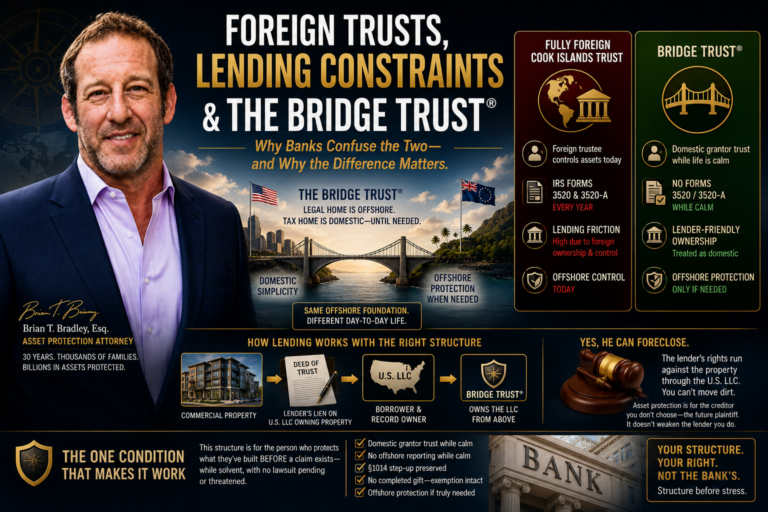
Layer three is the Bridge Trust® — and this is where EPTL 7-3.1 is directly addressed. The AMLP interest is held inside the Bridge Trust®, which operates as a domestic grantor trust under IRC Sections 671 through 677 for tax purposes. No change to your return. No FBAR exposure in the baseline structure. But the governing instrument contains the Emergency Override Declaration under Sections 51 through 54 — a foreign enforcement mechanism that shifts jurisdiction to the Cook Islands without a court order if a creditor moves to execute against trust assets.
Cook Islands law does not recognize New York judgments. It does not recognize any foreign court judgment. It imposes a fraud burden of proof beyond reasonable doubt — one of the highest standards in international trust law. It imposes strict limitation periods, prohibits local trustees from complying with foreign court orders compelling distributions, and requires a creditor to post a bond of approximately $50,000 just to initiate a claim — with fee-shifting if they lose. Over 300 court challenges across 30-plus years. None have successfully reached the assets through that offshore layer.
For New York residents specifically — where EPTL 7-3.1 makes self-settled domestic trusts void as to creditors, and where New York courts have shown willingness to apply New York public policy to out-of-state arrangements — the Cook Islands enforcement mechanism is the layer that New York law cannot reach and New York courts cannot simply override.
Layer four is the Dynasty Trust. Downstream of the Bridge Trust® sits the generational planning layer. When you pass, the Bridge Trust convert into a dynasty trust.
Assets inside this structure are not in your taxable estate. They are not in your children’s taxable estates — and critically for New York planning, they are not subject to the New York estate tax cliff at each generational transfer, because there is no transfer. The assets remain inside the trust vehicle. Successive generations are named as beneficiaries, not owners. The 40% federal rate and the 16% New York rate are not triggered because the taxable estate event never occurs.
For a Manhattan family with a $15 million estate today, growing at 6% annually, the difference between the New York cliff hitting twice across two generations and the Dynasty Bridge Trust™ absorbing that growth inside a protected vehicle is not a planning preference. It is a measurable, compounding, irreversible financial outcome that gets larger every year the structure is not in place.
The GST Allocation Window New York Families Are Missing
The GST exemption of $15 million per individual is set permanently under current law. But the allocation you lock in at funding is protected under Treasury Regulation Section 20.2010-1(c) regardless of what Congress does next.
For New York families, the GST allocation is more urgent than for clients in states without a state estate tax — because New York will tax each estate at death, subject to the cliff and graduated brackets, in addition to whatever federal exposure exists. Assets that remain inside a properly structured GST-exempt dynasty trust are subject to transfer tax exactly once — at funding, to the extent they exceed the exemption — and then compound for up to 365 years without another transfer tax event at the federal or state level.
Assets that remain outside that structure compound inside the New York taxable estate, get hit by the cliff at each generational death, and face both federal and New York exposure every time the baton passes to the next generation.
The window that cannot be recovered is not the exemption amount. It is the appreciation that builds inside the unprotected estate every year before the structure is in place. That compounding cannot be reversed. And the New York cliff does not care whether the appreciation was intentional or incidental — it applies to the full estate value at the moment of death.
The Step-Up in Basis Advantage Traditional Dynasty Trusts Forfeit
The Dynasty Bridge Trust™ captures a tax benefit that traditional dynasty planning eliminates entirely. The mechanism is the step-up in basis at death under IRC § 1014, and the math difference between the two approaches is large enough to fundamentally alter the after-tax result for the next generation.
Under IRC § 1014, when an asset that is part of the decedent’s gross estate at death passes to heirs, its cost basis resets from the original purchase price to fair market value as of the date of death. A founder who purchased $200,000 of company stock that grew to $8 million during her lifetime — holding it inside a structure that keeps the asset in her estate — dies with that stock at an $8 million basis. Her heirs can sell that stock the next day and pay zero federal capital gains tax. The $7.8 million of appreciation that accrued during her life is wiped clean.
A traditional dynasty trust forfeits this benefit entirely. When assets are transferred into a traditional dynasty trust, the transfer is treated as a completed gift. The assets are removed from the grantor’s estate at funding. Because they are not in the estate at death, IRC § 1014 does not apply. The heirs inherit the original cost basis — $200,000 in the example above — and pay capital gains tax on the full $7.8 million of appreciation when the assets are eventually sold. At combined federal and state rates that often exceed 30%, that produces more than $2.3 million of capital gains liability that the Dynasty Bridge Trust™ structure eliminates by design.
The reason the Dynasty Bridge Trust™ captures the step-up is the same reason it provides creditor protection during your lifetime: the Bridge Trust® component operates as a U.S. domestic grantor trust during the settlor’s life, classified under IRC §§ 671–677 and § 7701. Assets held inside the trust are treated as owned by the grantor for income tax and estate tax purposes. They are part of the grantor’s estate. They qualify for the step-up at death.
A traditional dynasty trust must give up grantor trust status — and the estate inclusion that comes with it — in order to remove assets from the estate for transfer tax purposes. The Dynasty Bridge Trust™ does not face this trade-off because it is designed to use both treatments at the right time. During the settlor’s life, the trust is in the estate, the grantor has full access, the step-up is preserved, and the Cook Islands jurisdictional barrier defends against creditor claims. At the death of the second spouse, the step-up is captured under § 1014, the GST exemption is allocated to the converted trust at that time, and the trust transitions into its dynasty phase to hold and compound family wealth across generations without estate tax triggered at each transfer.
For families below the federal estate tax exemption — currently $15 million per individual, $30 million per couple — this is the structural advantage that defines the choice. The estate tax exemption fully shelters the assets from federal estate tax. The grantor trust status preserves the step-up at death. The dynasty conversion at second death extends the wealth multi-generationally without erosion at each transfer. All three benefits accrue simultaneously, by design, in a single integrated structure.
The advisor who recommends a traditional dynasty trust to a family below the exemption is recommending the elimination of a significant tax benefit in exchange for transfer tax planning that the exemption alone already accomplishes.
The Question That Actually Matters for New York
Most New York families at $15 million or more have a revocable living trust, one or more LLCs, a standard A/B structure, and an estate plan designed to avoid probate and make orderly distributions at death. They have been told they are in good shape.
For probate — they are.
For a creditor who obtains a New York judgment and uses CPLR 5225 to demand turnover of the LLC membership interest — they are not.
For the New York estate tax cliff that can cost $1 million in state tax on a single dollar of appreciation above the 105% threshold — they are not.
And for the generational tax problem that stacks federal and New York estate tax across two transfers and compounds every year the family does nothing — they are not.
The Dynasty Bridge Trust™ does not ask you to choose between solving the creditor problem and solving the legacy problem.
It solves both.
Simultaneously.
Inside one integrated structure built from the ground up — with the offshore enforcement layer that EPTL 7-3.1 cannot reach and the dynasty framework that New York’s rule against perpetuities cannot provide.
If you are a New York physician, finance professional, real estate developer, or business owner with $15 million or more in exposed assets and you want to understand what your current structure actually protects — that is the conversation to have.
Structure before stress.
For a confidential legal consultation with an Asset Protection Attorney, contact Bradley Legal Corp. at (888) 773-9399
By: Brian T. Bradley, Esq. – National Asset Protection Attorney