
The 35% Penalty on Money You Never Owed Tax On
When you create a foreign trust, you step into one of the most unforgiving reporting regimes in the entire Internal Revenue Code. The rules live in IRC § 6048.

When you create a foreign trust, you step into one of the most unforgiving reporting regimes in the entire Internal Revenue Code. The rules live in IRC § 6048.

The “trustee might refuse” critique of the Bridge Trust® collapses under the statutory framework, contractual reality, and 30 years of operating history.
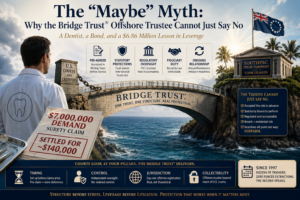
The biggest criticism of the Bridge Trust® is that the offshore trustee can simply “say no” during duress. That critique misunderstands how the structure actually works. This article explains why the Special Successor Trustee’s commitment is made at formation — not at trigger — and why the same “maybe” argument applies equally to fully foreign Cook Islands trusts. Includes real-world case analysis, trustee mechanics, Cook Islands law, and the four pillars courts actually evaluate: timing, control, jurisdiction, and collectibility.

Is the Bridge Trust® Really a Domestic Trust? No. The Bridge Trust® is a foreign trust in legal character from the day it is executed. “Domestic” is its IRC §7701 tax classification, not its legal situs. Two statutory tracks, explained.
Most asset protection structures fail for one reason — the client never actually lost control. Here’s the control doctrine courts apply and why most attorneys build plans that collapse under it.
Most offshore trusts don’t activate when you actually need them. Here’s what the activation mechanism should say in your governing instrument — and where critics of hybrid structures get the analysis wrong

United States v. Huckaby (2026): What the Case Actually Held. United States v. Huckaby, No. 2:23-cv-00587-DAD-JDP (E.D. Cal. Mar. 2, 2026), is a federal collection case in which a self-settled Nevada spendthrift trust failed to protect California real property from a federal judgment lien under 28 U.S.C. §3201(a). The court applied California law to the creditor question — not Nevada’s — because the property sits in California. Under California law the trust was void as a self-settled shield, because the same people were its settlors, trustees, and beneficiaries.
What Critics of the Bridge Trust® Get Wrong. The published critiques attack a trustee-resignation mechanism the Bridge Trust® doesn't use, and cite a case involving a different product. The attack is accurate. The target is wrong.

The best asset protection plans never appear in court records — because they work before litigation begins. Here’s why the absence of case law is actually proof of concept, not a weakness

The Indiana Investors Trust cases are among the most misused in asset protection debates. Here’s what the courts actually decided about asset freezes, offshore planning, and what proper Bridge Trust design prevents