

A tech founder in his mid-fifties called me with a question his estate planning attorney had not been able to answer.
He had built a successful software company that had recently been acquired in part. He held $6 million of acquirer stock with a cost basis under $200,000. His wife was a practicing cardiologist. Their combined net worth — the acquirer stock, a brokerage account, two homes, and retirement accounts — was approximately $14 million.
His estate planning attorney had recommended transferring the acquirer stock into a Dynasty Trust. The reasoning was straightforward. The stock would likely appreciate further over the rest of his life. Getting it out of his estate now would lock in his gift tax exemption against future estate tax exposure. Move it to the next generation. Insulate it from probate.
The attorney’s recommendation was not wrong as a matter of estate tax planning. But it was incomplete.
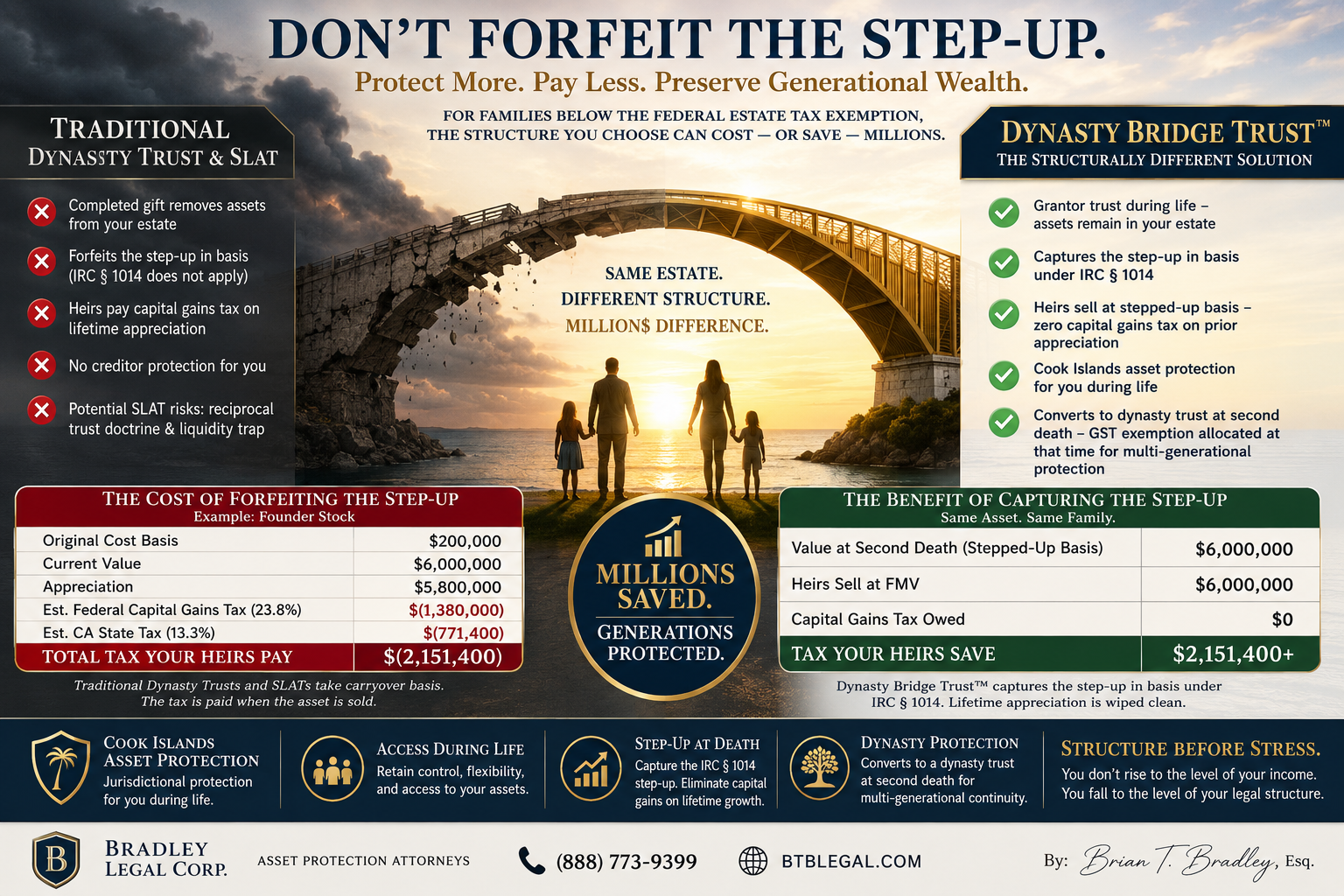
What the attorney did not explain — and what most estate planning attorneys do not explain to clients in this exact band of net worth — was that funding a traditional Dynasty Trust with that stock would cost his children approximately $1.85 million in unnecessary federal capital gains tax when they eventually sold the position. And he did not have an estate tax problem to solve in the first place.
He had a different problem.
He had a planning advisor solving for transfer tax exposure he did not face, by sacrificing a tax benefit he could not afford to forfeit.
The benefit being forfeited was the step-up in basis at death under IRC § 1014. This article explains exactly what that benefit is, why traditional Dynasty Trusts must give it up by design, and why the Dynasty Bridge Trust™ preserves it.
⸻
The Estate Tax Exemption Reality Most Advisors Don’t Explain
The federal estate tax exemption in 2026 is $15 million per individual and $30 million per married couple. The vast majority of families who are advised to fund a traditional Dynasty Trust have a combined net worth well below that threshold.
For these families, the federal estate tax is not actually a problem. The exemption shelters the entire estate. There is no estate tax owed at the first death because of the unlimited marital deduction. There is no estate tax owed at the second death because the estate falls under the doubled exemption.
A handful of states impose their own estate taxes with lower exemptions — New York at $7.16 million in 2026, Massachusetts at $2 million, Oregon at $1 million, Washington at $2.193 million, Connecticut at $13.99 million. State exposure matters and should be addressed where it exists. But for clients in non-estate-tax states, or for families well below the federal exemption, the traditional Dynasty Trust is being recommended to solve a problem the exemption alone already solves.
Removing assets from the estate at funding — which is what a traditional Dynasty Trust requires — only matters if the assets being removed would otherwise trigger estate tax above the exemption. For a $14 million couple in a non-estate-tax state, the exemption is the protection. There is nothing additional that needs to be solved.
The cost of that unnecessary planning is what nobody is calculating.
⸻
What the Step-Up in Basis Actually Is
IRC § 1014 governs the cost basis of property acquired from a decedent. The rule is direct. When an asset is part of the decedent’s gross estate at death and passes to heirs, the heir’s cost basis in that asset is the fair market value as of the date of death.
The original purchase price is wiped out for tax purposes. The appreciation that occurred during the decedent’s lifetime — sometimes decades of growth — is not taxed.
Consider a founder who purchased $200,000 of company stock that grew to $8 million over twenty years. If she sells the stock during her lifetime, she pays capital gains tax on the $7.8 million of appreciation. At the federal long-term capital gains rate of 20% plus the 3.8% net investment income tax, that is approximately $1.86 million in federal tax, before any state income tax.
If she dies holding that stock, and the stock is part of her gross estate at death, her heirs receive a stepped-up basis equal to the $8 million fair market value. They can sell the stock the next day and owe zero federal capital gains tax. The $7.8 million of appreciation is permanently wiped clean.
The step-up in basis is, for most families, the single largest tax benefit available in the entire Internal Revenue Code. It can eliminate decades of accumulated capital gains liability in one event. And it is available only when the asset is part of the decedent’s gross estate at death.
That qualifying condition — part of the gross estate at death — is exactly what a traditional Dynasty Trust is designed to defeat.
⸻
Why Traditional Dynasty Trusts Forfeit the Step-Up by Design
A traditional Dynasty Trust is funded through a completed gift. The grantor transfers assets into the trust. The transfer is treated, for federal transfer tax purposes, as a permanent gift to the trust. The grantor relinquishes ownership and control of the assets. The trust becomes the new owner.
This treatment is the entire point of a traditional Dynasty Trust. By making the gift complete at funding, the grantor accomplishes two things. First, the grantor uses up federal lifetime gift tax exemption equal to the value of the gift. Second — and this is the central design feature — the assets are removed from the grantor’s estate for federal estate tax purposes. They are no longer part of the gross estate at death.
That removal is what generates the estate tax savings the trust is supposed to deliver. If the assets continue to appreciate inside the trust over the rest of the grantor’s life, that appreciation accrues outside the estate and is therefore not subject to the 40% federal estate tax rate that applies above the exemption.
But the same removal that generates the estate tax savings also forfeits the step-up in basis at death. IRC § 1014 applies only to assets that are part of the decedent’s gross estate. Assets in a properly structured traditional Dynasty Trust are, by design, not in the gross estate. § 1014 does not apply to them. There is no step-up.
The Dynasty Trust takes carryover basis instead. The original cost basis the grantor had at the time of funding — $200,000 in the example above — carries over to the trust and remains the basis when the trust eventually sells the asset or distributes it to a beneficiary.
When the heirs (or the trust on their behalf) sell the appreciated stock at $8 million, the trust pays capital gains tax on the full $7.8 million of appreciation. At combined federal rates of 23.8%, that is approximately $1.86 million in federal capital gains tax. In a high-tax state like California, the combined federal and state rate exceeds 37%, producing federal and state capital gains liability above $2.85 million.
That tax is the cost of the traditional Dynasty Trust structure. It is the price of removing the assets from the estate at funding. For families above the federal estate tax exemption, the cost is justified — the 40% estate tax saved on appreciation outside the estate exceeds the capital gains tax paid because the step-up was forfeited.
For families below the exemption, the cost is paid for nothing. The estate tax that would have been owed without the trust is zero. The capital gains tax owed because of the trust is real and substantial. It is a multi-million dollar payment to the federal government in exchange for transfer tax planning that was not necessary in the first place.
⸻
Why the Dynasty Bridge Trust™ Preserves the Step-Up
The Dynasty Bridge Trust™ is structured to deliver dynasty-style multi-generational protection without forfeiting the step-up at death. The mechanism that makes this possible is the trust’s classification as a U.S. domestic grantor trust during the settlor’s lifetime.
The Bridge Trust® component of the Dynasty Bridge Trust™ is established as a Cook Islands trust under the Cook Islands International Trusts Act, registered in Belize for zero-day statute of limitations protection, and classified as a U.S. domestic grantor trust under IRC § 7701 for federal income tax purposes. During the settlor’s lifetime, the trust meets the grantor trust rules under IRC §§ 671 through 677. The settlor is treated as the owner of the trust assets for federal income tax purposes — and, critically, for federal estate tax purposes.
Because the settlor is treated as the owner of the trust assets for estate tax purposes, those assets remain part of the settlor’s gross estate at death. The qualifying condition for the IRC § 1014 step-up is satisfied. At death, the assets receive a stepped-up basis to fair market value.
There is no transfer tax cost to this treatment for families below the federal exemption. The estate is sheltered by the $30 million couple exemption. There is no estate tax to avoid in the first place. Keeping the assets in the estate costs nothing in transfer tax exposure and captures the full step-up benefit.
After the step-up is captured at the death of the second spouse, the trust transitions into its dynasty phase. The GST exemption is allocated to the converted dynasty trust at that time. The trust takes over under Nevada law, which has eliminated the Rule Against Perpetuities, and continues to hold and compound family wealth across generations without estate tax triggered at each transfer.
The Dynasty Bridge Trust™ does not face the trade-off that traditional dynasty planning imposes. It is designed to use grantor trust treatment when grantor trust treatment is beneficial — during life, for asset protection, access, and step-up preservation — and to convert to dynasty treatment at the moment when dynasty treatment becomes beneficial, which is at the death of the second spouse.
The same structure that defends against creditor claims during the settlor’s lifetime captures the step-up at death and extends the protection across multiple generations. All three benefits accrue simultaneously, by design, in a single integrated structure.
____
A Note on SLATs: The Same Forfeit With Additional Failure Modes
Wealth managers and estate planning attorneys frequently recommend the Spousal Lifetime Access Trust — the SLAT — as a solution to the access-versus-estate-tax tension that traditional Dynasty Trusts create. The SLAT promises to remove assets from one spouse’s estate while preserving indirect access through the beneficiary spouse. On paper, the structure addresses the access problem. In practice, it fails for the same fundamental reason traditional Dynasty Trusts fail, and it adds three additional failure modes the family did not need to introduce.
A SLAT is funded by completed gift. The grantor spouse transfers assets into an irrevocable trust for the benefit of the other spouse and, typically, the children. The completed gift removes the assets from the grantor spouse’s gross estate. The transfer uses lifetime gift tax exemption equal to the value of the gift.
Because the gift is complete, the same step-up forfeit applies. IRC § 1014 does not reach assets that are not in the decedent’s gross estate. The SLAT takes carryover basis at funding and preserves carryover basis until the assets are eventually sold. The federal capital gains tax owed by the trust on appreciated assets — appreciation that would have been wiped out under § 1014 had the assets remained in the estate — can run into the millions of dollars per family.
For $12 million to $30 million families below the federal exemption, the SLAT introduces this capital gains tax cost in exchange for solving a transfer tax problem the exemption already solves. The math is the same as the traditional Dynasty Trust math. The forfeit is the same forfeit.
What makes the SLAT worse, not better, is what it adds on top of the step-up forfeit.
The Reciprocal Trust Doctrine. The most common SLAT structure is the mirrored pair — the husband funds a SLAT for the wife and children, the wife funds a SLAT for the husband and children, both trusts with identical terms and opposite beneficiaries. The intent is that each spouse retains indirect access to the trust assets through the other spouse.
The reciprocal trust doctrine, established in United States v. Estate of Grace, 395 U.S. 316 (1969), permits courts to uncross the trusts and treat them as if each spouse had funded a trust for their own benefit. When the doctrine applies, the gift treatment collapses, the assets are pulled back into both spouses’ gross estates, and the SLATs deliver none of the transfer tax planning they were designed to provide. Modern courts have applied the doctrine with increasing aggressiveness. To survive scrutiny, mirrored SLATs must have meaningfully different purposes, different mechanics, and different timing — a drafting standard most SLAT structures do not meet.
No Creditor Protection. A SLAT solves only the estate tax problem. It does not protect against creditors, lawsuits, divorce, or judgment enforcement against the beneficiary spouse. The assets are reachable by anyone with a claim against the beneficiary spouse. The indirect-access mechanism that makes SLATs attractive is the same mechanism that exposes the assets to the beneficiary spouse’s litigation risk, divorce risk, or bankruptcy risk.
For physicians, real estate investors, business owners, and other high-liability professionals — exactly the demographic SLATs are most often pitched to — the SLAT introduces no creditor protection and may amplify exposure if the higher-liability spouse is the beneficiary.
The Liquidity Trap. The indirect-access mechanism collapses entirely under any of three predictable life events. If the beneficiary spouse predeceases the grantor spouse, the access path closes — the trust continues for the children, and the surviving grantor has no remaining indirect path to the funded assets. If the spouses divorce, the access path closes for the same structural reason. If the beneficiary spouse simply makes independent decisions about distributions during the marriage, the access path was never reliable in the first place.
For a couple in their early sixties planning across what may be thirty or forty years of post-funding life, the liquidity loss from a SLAT is a real and underappreciated cost. The “access” the SLAT promises is contingent on circumstances that frequently change.
The Dynasty Bridge Trust™ Solves All Four Problems Without the Trade-Offs. The Dynasty Bridge Trust™ does not require a completed gift, which eliminates the step-up forfeit at the foundation. There is no reciprocal trust doctrine risk because there is no mirrored pair — the structure operates as a single integrated trust. The grantor retains operational control during life, eliminating the liquidity trap. And the structure delivers Cook Islands creditor protection that no version of a SLAT provides.
For the $12 million to $30 million family considering a SLAT recommendation, the analysis is the same as the analysis for a traditional Dynasty Trust. The structure is solving for transfer tax exposure the family does not face, while introducing failure modes the family did not need to accept.
⸻
Side-by-Side: The Math on a $14 Million Estate
Return to the founder couple introduced at the opening. Their combined net worth is $14 million. The estate sits below the federal exemption. They have $6 million of company stock with a $200,000 cost basis.
Under a traditional Dynasty Trust:
The $6 million of stock is transferred into the trust at funding. The transfer uses $6 million of federal lifetime gift tax exemption. The assets are removed from the grantor’s estate. The trust takes carryover basis of $200,000. At the eventual sale — whether by the trustee for distribution or by the beneficiaries after distribution — the trust pays federal capital gains tax on the appreciation. At a current FMV of $6 million, the capital gains liability is approximately $1.38 million federal. If the stock continues to appreciate to $10 million by the time of sale, the capital gains liability grows to approximately $2.33 million federal.
The estate tax saved by removing the assets is zero, because the estate fell below the exemption regardless.
The net cost of the traditional Dynasty Trust to this family is approximately $1.38 million to $2.33 million in federal capital gains tax that would not have been paid had the assets remained in the estate at death. Plus state capital gains tax in any state with an income tax.
Under the Dynasty Bridge Trust™:
The $6 million of stock is transferred into the Bridge Trust® component, which is funded during life without a completed gift because the trust is a grantor trust as to the settlor. No gift tax exemption is used at funding. The assets remain in the settlor’s estate, which is fine because the estate is below the exemption.
At the death of the second spouse, IRC § 1014 applies. The basis is stepped up from $200,000 to the then-current fair market value of the stock. The trust converts into the dynasty phase. The GST exemption is allocated to the converted dynasty trust at that time. Heirs (or the trust on their behalf) can sell the stock at the stepped-up basis with zero capital gains tax owed on the lifetime appreciation.
The estate tax owed at the second death is zero, because the estate is below the exemption.
The net tax cost is zero. The dynasty protection is captured. The creditor protection during life is captured. The step-up is captured.
The Dynasty Bridge Trust™ delivers everything the traditional Dynasty Trust delivers, plus the step-up, plus access during life, for a family in this band of net worth.
⸻
When a Traditional Dynasty Trust Still Makes Sense
The traditional Dynasty Trust is not a wrong tool. It is a tool designed for a specific situation. That situation is families with net worth meaningfully above the federal estate tax exemption who face real exposure to the 40% estate tax rate on assets above the exemption.
For these families, the math reverses. The estate tax saved on appreciation outside the estate over a multi-decade lifetime exceeds the capital gains tax paid because the step-up was forfeited. The trade-off is justified by the size of the estate.
Even for above-exemption families, the analysis is rarely binary. Many ultra-high-net-worth structures use a traditional Dynasty Trust for the portion of the estate above the exemption and preserve other appreciated assets in the estate for step-up at death. This is the kind of planning that fits within sophisticated multi-tool architectures, not within the one-size-fits-all Dynasty Trust recommendation.
There are also specific use cases where a traditional Dynasty Trust is correct regardless of estate size. Charitable lead trusts, grantor retained annuity trusts, and intentionally defective grantor trusts each have their own design logic that may or may not include the step-up question.
But for the broad band of $12 million to $30 million families being advised to fund a traditional Dynasty Trust as a general matter of estate planning — those families are paying a tax cost that is not justified by the planning benefit they receive.
⸻
The Decision Framework
The choice between a traditional Dynasty Trust and the Dynasty Bridge Trust™ for a family in the $12 million to $30 million range comes down to four questions.
First, do you have an actual federal estate tax problem? If your combined estate is below the $30 million couple exemption — and most $12M to $30M families are — the answer is no.
Second, do you have appreciated assets where step-up matters? If you hold concentrated positions, founder stock, real estate purchased decades ago, or any other assets with significant accumulated capital gains, the step-up benefit is large and concrete.
Third, do you want to retain access to the assets during your lifetime? Traditional Dynasty Trusts require completed gifts, which means the assets are no longer accessible to you. The Dynasty Bridge Trust™ preserves access during life because the trust remains in your estate as a grantor trust.
Fourth, do you face creditor exposure during your lifetime? Physicians, real estate investors, business owners, and other high-liability professionals do. Traditional Dynasty Trusts provide no creditor protection for the settlor. The Dynasty Bridge Trust™ provides Cook Islands-grade jurisdictional protection during the settlor’s life.
For families below the federal estate tax exemption with appreciated assets, who want lifetime access, and who face creditor exposure — which describes the typical $12M to $30M client — the Dynasty Bridge Trust™ is the structurally correct answer. The traditional Dynasty Trust forfeits benefits this family does not need to forfeit, in exchange for transfer tax planning this family does not need.
⸻
Bridge Trust® FAQs on Step-Up in Basis
What is the step-up in basis?
The step-up in basis is the rule under IRC § 1014 that resets the cost basis of assets in a decedent’s gross estate to fair market value at the date of death. Heirs who sell the assets after inheriting them owe capital gains tax only on appreciation that occurs after the date of death. The appreciation that accrued during the decedent’s lifetime is permanently wiped clean for tax purposes.
Why does a traditional Dynasty Trust forfeit the step-up?
A traditional Dynasty Trust requires a completed gift at funding, which removes the assets from the grantor’s estate. IRC § 1014 applies only to assets that are part of the decedent’s gross estate at death. Because the assets are no longer in the estate, they do not qualify for the step-up. The trust takes carryover basis instead, and the heirs eventually pay capital gains tax on the lifetime appreciation when the assets are sold.
Why does the Dynasty Bridge Trust™ preserve the step-up?
The Dynasty Bridge Trust™ operates as a grantor trust under IRC §§ 671–677 during the settlor’s lifetime. Assets held by a grantor trust are treated as owned by the grantor for federal estate tax purposes and remain part of the gross estate at death. § 1014 applies and the step-up is captured. The trust then transitions into the dynasty phase at the death of the second spouse.
Is the step-up benefit worth the loss of estate tax planning?
For families below the federal estate tax exemption — currently $30 million per couple — there is no estate tax planning benefit being lost, because the exemption already shelters the estate. The step-up benefit is captured, and the estate tax exposure is zero either way. For families above the exemption, the analysis becomes more nuanced and depends on the size of the estate, the composition of assets, and the relative magnitude of the step-up versus estate tax savings.
Does the Dynasty Bridge Trust™ work for families above the federal exemption?
Yes, but it is typically used as one component of a broader multi-tool architecture. Above-exemption families often combine the Dynasty Bridge Trust™ for assets where step-up preservation is most valuable with traditional dynasty or other transfer tax tools for assets where estate tax savings outweigh the step-up benefit.
When is the step-up captured in the Dynasty Bridge Trust™?
The step-up is captured at the death of the settlor — for couples, at the death of the second spouse, when the trust converts from its lifetime Bridge Trust® phase into its dynasty phase. The GST exemption is allocated to the converted dynasty trust at that time, and the dynasty phase continues without estate tax triggered at each generational transfer thereafter.
Are SLATs better than traditional Dynasty Trusts for the step-up problem?
No. Both structures rely on completed gifts at funding, and both forfeit the IRC § 1014 step-up by design. SLATs add the reciprocal trust doctrine risk, the absence of creditor protection, and the liquidity trap to the same step-up forfeit that traditional Dynasty Trusts impose. For families below the federal exemption, the SLAT is a more complex version of the same structurally wrong answer.
What is the reciprocal trust doctrine?
The reciprocal trust doctrine, established in United States v. Estate of Grace, 395 U.S. 316 (1969), permits courts to disregard mirrored SLAT structures and treat the assets as if each spouse had funded a trust for their own benefit. When the doctrine applies, the gift treatment collapses, the assets are returned to both spouses’ gross estates, and the planning fails. Modern courts apply the doctrine with increasing aggressiveness.
Can I avoid the reciprocal trust doctrine by making my SLATs different from each other?
To survive scrutiny under Estate of Grace and its progeny, mirrored SLATs must have meaningfully different purposes, different mechanics, and different timing. The drafting standard is high and rarely met by SLAT structures pitched to families in the $12 million to $30 million range. The Dynasty Bridge Trust™ avoids the issue entirely by operating as a single integrated trust rather than a mirrored pair.
⸻
The Bottom Line
The Dynasty Bridge Trust™ is not a refinement of the traditional Dynasty Trust. It is a structurally different answer to the same planning question, designed specifically for families whose estate sits below the federal estate tax exemption but who still want multi-generational wealth protection.
For these families — the $12 million to $30 million range that defines most of our client base — Traditional completed-gift planning — whether a Dynasty Trust, a SLAT, or a paired SLAT arrangement — is solving for transfer tax exposure these families do not face, at the cost of forfeiting a step-up in basis benefit they cannot afford to lose. SLATs compound the forfeit with reciprocal trust doctrine risk, the absence of creditor protection, and a liquidity trap that closes the moment the beneficiary spouse predeceases or divorces. The Dynasty Bridge Trust™ delivers the multi-generational protection without the forfeiture, captures the step-up at death by design, and adds Cook Islands creditor protection during the settlor’s lifetime as a separate structural benefit.
If your estate planning advisor has recommended a traditional Dynasty Trust without explaining the step-up forfeit, ask the question directly. If the answer does not include a clear analysis of the capital gains tax cost to your heirs, the recommendation is incomplete.
Structure before stress. You don’t rise to the level of your income. You fall to the level of your legal structure.
📞 For a confidential legal consultation with an Asset Protection Attorney, contact Bradley Legal Corp. at (888) 773-9399 or visit btblegal.com.
By: Brian T. Bradley, Esq.