

Most high-net-worth clients have two planning conversations running in parallel — one with their advisor about growth, one with their estate attorney about transfer. Neither answers the third question: if a judgment is entered tomorrow, what can a creditor actually collect? That is a collectability question, and for most clients above $5–10 million it has never been asked.
This article is for the advisors and CPAs who are closest to that gap and best positioned to see it.
Key Points
- A revocable trust is fully reachable during the client’s lifetime. Cal. Prob. Code §18200 says so directly.
- The gap sits between three professionals, which is why nobody owns it.
- AUM does not move. Custody, strategy, and the advisor relationship stay where they are.
- The dynasty layer is not automatic — GST exemption has to be allocated on a return, and the deadline is the first spouse’s death.
- Five questions surface the gap without requiring you to explain any structure.
- This is additive to your role, not a substitute for it.
The Call That Prompted This
A financial advisor in Newport Beach had worked with a cardiothoracic surgeon for eleven years.
He managed the surgeon’s retirement accounts, investment portfolio, and family trust distributions. He knew his goals, his risk tolerance, his family.
The plan was comprehensive. Until it wasn’t.
Eighteen months ago a malpractice claim came in above policy limits. Discovery mapped every asset. The revocable living trust — assumed to be protective — was not. Under California Probate Code §18200, trust property remains subject to the settlor’s creditors to the extent of the power of revocation during the settlor’s lifetime.
The portfolio was exposed. The real estate equity was exposed. Everything was visible.
The advisor called me after the settlement.
Not to understand what went wrong. To understand what he needed to do differently for the forty-three other clients in his book who looked exactly like this one.
Why This Gap Exists
Because it sits between three professionals, and none of them owns it. The CPA handles tax. The estate attorney handles transfer. The advisor handles growth. Nobody is asked what happens when a judgment arrives.
Most high-net-worth clients have two conversations happening in parallel.
With you: investment strategy, retirement planning, portfolio growth, distribution modeling.
With their estate attorney: revocable trust, A/B structure, beneficiary designations, transfer at death.
Both are necessary. Neither answers this question:
If a judgment is entered against your client tomorrow, what can a creditor actually collect?
That is not an investment question. It is not an estate planning question. It is a collectability question, and it falls in the space between the professionals who each have a piece of the client’s picture.
That is also why it goes unaddressed for years. Not because anyone is doing their job badly, but because it is not anyone’s job.
What the Gap Costs — for the Client and for the Practice
Consider a client with $20 million: revocable trust, several LLCs, a managed portfolio, standard insurance.
A tenant claim comes in at $8 million. Insurance covers $3 million. The rest comes from the balance sheet.
The trust provides no barrier. The entities provide limited resistance. The assets are reachable.
What follows: forced liquidation of managed assets, capital gains triggered on sale, portfolio strategy disrupted, real estate refinanced or sold, retirement projections reset.
And this is not only a client problem. A $4 million loss in client assets is a direct reduction in AUM, a reduction in recurring revenue, a disruption to long-term planning, and in some cases a damaged relationship built over a decade.
It is also almost always preventable — if the structure existed before the claim.
What This Structure Actually Addresses
Two exposures most plans leave open: what happens while the client is alive, and what happens to the wealth after it transfers.
Lifetime exposure
A lawsuit does not just create liability. It creates enforcement risk.
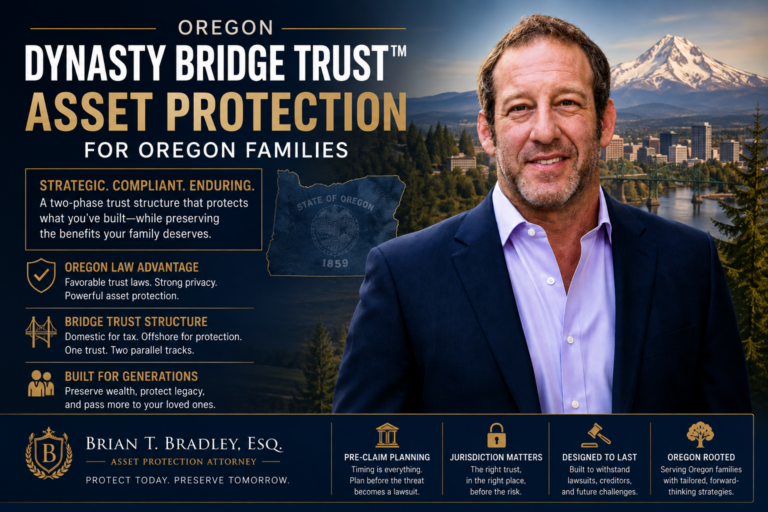
The Bridge Trust® component introduces a jurisdictional barrier. It does not eliminate liability. It changes collectability — and it is not about hiding anything. Nothing in the structure depends on a creditor failing to find something.
During normal operation, two independent tax rules apply. The instrument satisfies the court test and control test of Treas. Reg. §301.7701-7 under IRC §7701(a)(30)(E), so the IRS classifies it as domestic. Separately, it maintains grantor-trust status under IRC §§671–677, so income is reported on the client’s own return.
Your client remains in control within the structure. You continue managing the assets. No offshore reporting applies while the trust operates domestically.
The trust agreement is governed by Nevada law and registered offshore from inception, in both Belize and the Cook Islands. The Belize registration starts the offshore limitation period at day one; the Cook Islands recognizes the trust as of that original filing date and supplies the pre-committed successor trustee.
If a credible threat arises, an independent Trust Protector — an attorney exercising professional judgment, not the client — may declare an Event of Duress. Nothing fires automatically on the filing of a complaint. Administration then shifts to a jurisdiction that does not recognize U.S. judgments, and a licensed offshore trustee that honored a foreign order lacking local jurisdiction would face personal liability and loss of license.
Generational exposure
Standard estate plans transfer wealth. They do not protect it after transfer.
The dynasty layer changes what a beneficiary actually receives. When a beneficiary becomes entitled to a distribution, the trustee makes a good faith inquiry asking whether they want their share held in trust rather than distributed outright. If they do, the trustee may establish a Continuing Beneficiary Trust for that beneficiary and their descendants.
Which means the protection is per-beneficiary and decided when the facts are known — one child can take a distribution while another’s share stays protected, based on their circumstances at the time rather than assumptions made decades earlier.
Held that way, principal is substantially harder for a beneficiary’s creditors or a divorcing spouse to reach than an outright inheritance, because the beneficiary does not own it.
One thing to be precise about, because it is where most dynasty planning quietly fails.
The tax benefit is not automatic. A dynasty structure avoids generation-skipping transfer tax only to the extent GST exemption has been allocated to it — and that allocation happens on Form 709 or Form 706, not in the trust document.
And the GST exemption is not portable between spouses. There is no DSUE equivalent. If the first spouse dies without allocating theirs, that exemption is permanently gone.
A $15 million estate growing at 6% over 40 years reaches roughly $155 million. Whether that compounds inside a GST-exempt structure or gets taxed at each generational transfer depends on a filing — which is your CPA’s work, coordinated with counsel, and it has a deadline nobody controls.
What This Means for Your AUM
Nothing operationally. Everything legally.
Advisors ask one question first, and it deserves a direct answer.
“Do the assets leave my management?”
No.
Accounts remain where they are. Custody does not change. Investment strategy does not change. You remain the advisor.
The only thing that changes is the legal ownership layer. The trust becomes the account holder, and the instrument provides for an investment advisor role through which the client continues to direct strategy.
Operationally, nothing changes. Legally, everything does.
And a Word About the Relationship
The AUM question is usually the stated concern. The unstated one is whether you lose the client.
You do not, and the reason is structural rather than reassuring.
I do not manage money. I am not a CPA. I am not an estate planning attorney. Your client’s tax filings stay with their CPA. Their portfolio stays with you. Their estate plan stays with the attorney who drafted it, and the dynasty layer supplements it rather than replacing it.
What I do is the legal architecture underneath all three. That is a piece nobody else on the team is positioned to build, and it makes the rest of the plan hold up under pressure it was not designed for.
Managing a client’s wealth is a team activity. This is one seat at that table, and it is currently empty on most plans.
Five Questions for Your Next Review
You do not need to explain the structure. You need to identify the gap.
1. What are the most realistic ways someone could sue you today?
2. If a $10 million judgment hit tomorrow, which assets do you believe are protected?
3. Have you ever spoken with an asset protection attorney — not just an estate planner?
4. If your child went through a divorce, how protected would their inheritance be?
5. Do you have any personal guarantees or large contingent liabilities?
If there is hesitation in any answer, the planning is incomplete.
How the Referral Works
Position it as a planning gap, not a product.
“I work with an attorney who focuses specifically on protecting high-net-worth clients from exactly this type of exposure. It’s a legal consultation, not a sales call, and everything is privileged. I’d like to connect you.”
From there:
The legal analysis happens independently. Your client’s financial data stays with you. You remain the primary relationship. The structure is implemented without disrupting AUM.
You are not replacing your role. You are closing a gap in it.
What Your CPA Needs to Know
During normal operations: the trust is treated as a domestic grantor trust, income is reported on the client’s personal return, and no foreign reporting — Forms 3520, 3520-A, or FBAR — applies unless the structure is triggered.
If the structure activates: foreign reporting requirements apply. These are informational filings, not additional tax liability, and coordination handles them.
On the dynasty side: GST exemption allocation is the CPA’s work, on Form 709 or Form 706. The trust instrument creates the vessel. The allocation is what makes it tax-efficient, and the first spouse’s death is the deadline.
Most CPA concerns come down to unfamiliarity rather than complexity. A short call resolves it, and I am happy to be on it.
The Clients in Your Book Who Need This
You already know who they are.
The physician with growing malpractice exposure. The real estate investor with concentrated equity across multiple states. The entrepreneur approaching a liquidity event. The executive with concentrated stock and real estate tax exposure. The practice owner who signed a personal guarantee and has not thought about it since.
These clients trust you to see what they do not. And most of them have never been asked what happens if a judgment exceeds their coverage, or what happens when their children inherit outright.
FAQs
Does the client’s revocable trust provide creditor protection? No. Under Cal. Prob. Code §18200 and equivalent provisions elsewhere, trust property remains subject to the settlor’s creditors to the extent of the power of revocation during the settlor’s lifetime.
Do assets leave my management? No. Custody, strategy, and the advisor relationship stay in place. What changes is the legal ownership layer.
Am I at risk of losing the client relationship? No. This is a legal structuring engagement, not wealth management, tax preparation, or estate planning. Those stay with the professionals already handling them.
What does the CPA need to do? During normal operation, nothing beyond the client’s usual return. On the dynasty side, GST exemption allocation on Form 709 or Form 706 — which is where the tax benefit actually comes from.
Is the dynasty tax benefit automatic? No. A dynasty structure avoids generation-skipping tax only to the extent GST exemption has been allocated to it, and that exemption is not portable between spouses. Unallocated at the first death, it is lost.
What size client does this fit? It depends on exposure rather than a threshold. A surgeon with $4 million exposed and a real estate investor with $20 million face different problems, and the state the client lives in changes the analysis — state estate tax thresholds are frequently far below federal.
Can this be done after a claim arises? No. Transfers made once a claim is foreseeable are voidable and typically make the client’s position worse. This is pre-claim planning by definition.
How do I raise it without alarming the client? Ask the five questions above. You are not selling a structure; you are identifying whether one question in their plan has an answer.
The Question That Protects Both of You
You have built the plan. You have grown the assets. You have structured the investments.
If a major claim hits tomorrow, does the structure hold?
And if it does not — are you going to find that out now, or when it shows up in a settlement statement?
Structure before stress.
📞 For a confidential legal consultation, contact Bradley Legal Corp. at (888) 773-9399, or complete the intake questionnaire at btblegal.com.
By: Brian T. Bradley, Esq. – National Asset Protection Attorney