

Most families, business owners, and professionals are told they’re protected because they have a living trust. They’re not.
Estate-planning attorneys design revocable trusts to transfer assets when you die — not to defend them while you’re alive. That distinction is more consequential than most people realize. A lawsuit filed on a Tuesday afternoon doesn’t care whether you have a beautifully drafted trust with your name on it. What matters is whether the law considers you to still own those assets. In a revocable trust, you do.
True asset protection begins where traditional estate planning ends — with irrevocable, court-defensible structures that separate ownership from control without triggering IRS reporting problems or fraudulent-transfer exposure.
Understanding the Two Foundations
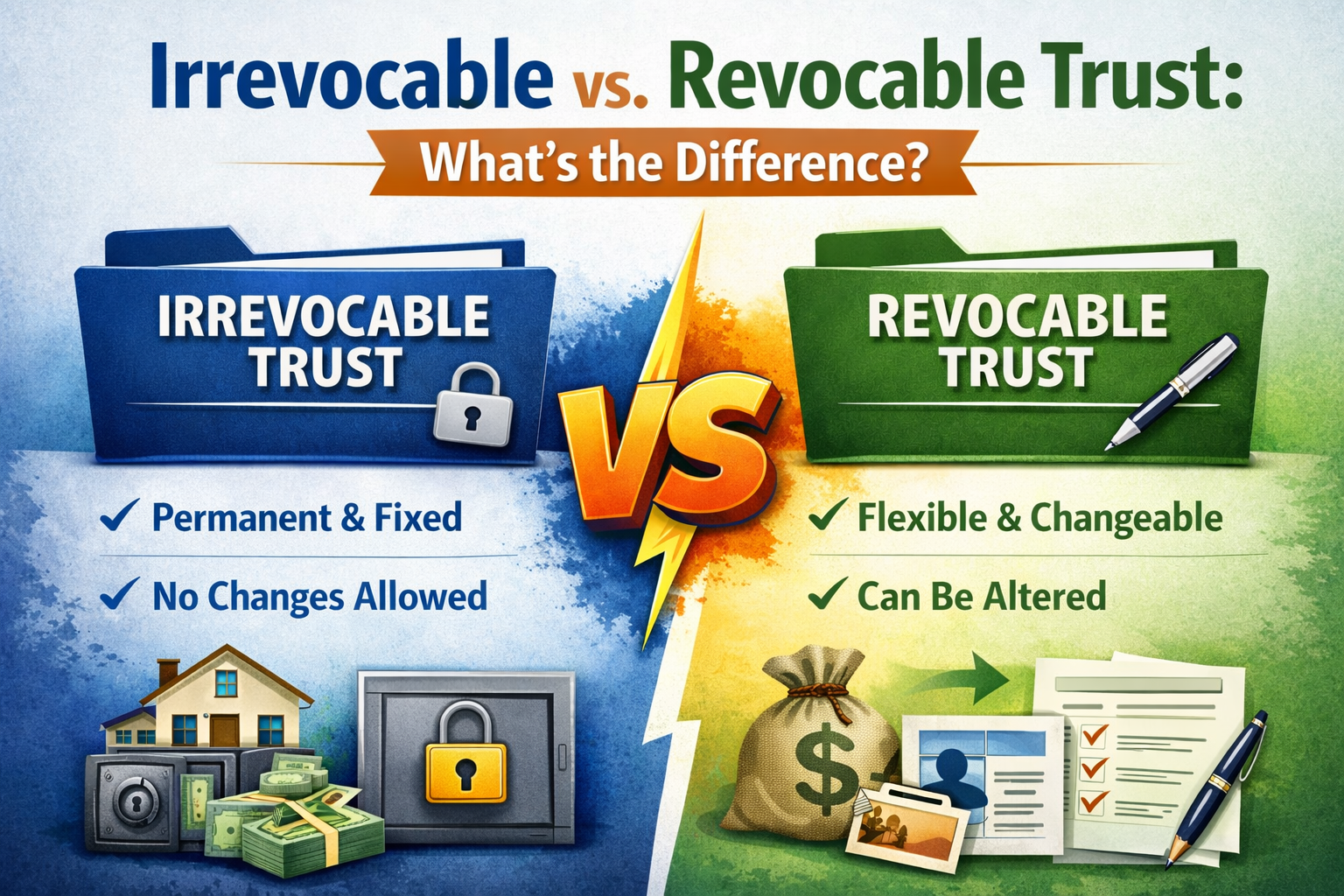
A revocable trust — commonly called a living trust — is an estate-planning tool, not a shield. The grantor retains full control: you can add or remove beneficiaries, move assets in and out, and revoke the trust entirely. That flexibility is the point. It lets your estate bypass the probate process after death, preserves privacy, and ensures cleaner transfers to heirs.
But that same flexibility is the fatal flaw for asset protection purposes. Because you retain control, the law treats those assets as still yours — personally and completely. A creditor who wins a judgment against you can reach everything inside a revocable trust just as easily as everything held in your individual name. Courts don’t look at the wrapper. They look at who really controls the asset.
An irrevocable trust operates differently. When properly structured, it removes assets from your personal ownership and transfers authority to an independent trustee. That legal separation — ownership in one legal entity, control in another — is what creates protection. A creditor can’t easily reach assets you no longer legally own. They must overcome the independent legal structure itself.
The protection comes with trade-offs. Once established, an irrevocable trust is difficult or impossible to modify. It typically requires its own tax identification number and a separate annual return (Form 1041). And if the trust, trustee, and assets all remain within the United States, the jurisdictional advantage is limited — a domestic judge can compel a domestic trustee to cooperate, order assets turned over, and evaluate transfers for fraudulent intent under state law.
The core rule is simple: control equals ownership, and ownership equals exposure. Irrevocability removes that exposure — but it often does so at the cost of flexibility you may need when circumstances change.
Why Domestic Irrevocable Trusts Fail Under Pressure
The promise of domestic asset protection trusts — DAPTs offered in states like Nevada, South Dakota, Alaska, and Delaware — is that you can create an irrevocable trust for your own benefit and still receive protection from future creditors. In theory, this sounds like exactly what you want. In practice, courts have declined to honor that promise with uncomfortable frequency.
In In re Mortensen (Bankr. D. Alaska 2011), a bankruptcy trustee successfully voided an Alaska self-settled trust, finding the transfer was made with intent to delay creditors — Alaska’s own protective statute couldn’t immunize it. In In re Huber, 493 B.R. 798 (Bankr. W.D. Wash. 2013), a Washington bankruptcy court held that Alaska’s DAPT statute didn’t protect trust assets from a bankruptcy trustee at all, because federal bankruptcy law preempted the state-level protection scheme entirely. In Kilker v. Stillman, 233 Cal. App. 4th 320 (Cal. Ct. App. 2014), the California Court of Appeal found that a grantor’s retained control over a domestic irrevocable trust was sufficient to expose those assets to creditor claims — the irrevocability of the instrument was beside the point when operational control remained with the grantor. In Toni 1 Trust v. Wacker, 413 P.3d 1199 (Alaska 2018), the Alaska Supreme Court invalidated a domestic self-settled trust under fraudulent transfer analysis, reinforcing that even Alaska’s protective statutory framework has no answer when a court finds the transfer was made to defeat a creditor. In Dahl v. Dahl (Utah 2015), the Utah Supreme Court included trust assets in the marital estate because the grantor had retained sufficient control to render the trust a personal resource rather than a genuinely independent structure. And just this year, in United States v. Huckaby, 2026 WL 587784 (E.D. Cal. Mar. 3, 2026), a federal district court allowed the IRS to foreclose on California real property held inside a Nevada DAPT — applying California law rather than Nevada’s protective statute because the asset was physically located in California. Since Huckaby served as both trustee and beneficiary, he retained sufficient legal and equitable interest for a federal tax lien to attach. A Nevada trust instrument held no weight against California’s rule that a settlor cannot shield assets from creditors while remaining a beneficiary.
The lesson across all six cases is the same: domestic trusts fail when a court — state or federal — decides to look past the wrapper. Location of the asset, identity of the trustee, and degree of retained control are the variables that determine outcome under real enforcement pressure. The label on the trust instrument is not.
The Bridge Trust® — Jurisdictional Insulation Without Offshore Complexity
The Bridge Trust® was developed nearly 30 years ago to solve the jurisdictional problem that domestic irrevocable trusts cannot solve on their own. It begins as a domestic grantor trust — fully compliant under IRC §§ 671–677 and classified as domestic under the court and control tests of IRC § 7701(a)(30)(E). During its domestic phase, the trust is completely tax-transparent. Income flows directly to your individual return. No Form 3520. No offshore reporting obligations. No PFIC exposure. The structure is invisible to the IRS in the same way any domestic grantor trust is invisible — because that is precisely what it is.
What makes the Bridge Trust® structurally different is its pre-engineered offshore activation mechanism. When activation occurs and a licensed Cook Islands trustee assumes control of substantial trust decisions, § 7701’s control test is no longer satisfied. The trust reclassifies as foreign, and jurisdiction shifts beyond the reach of any U.S. court order — without requiring you to re-title assets, create new entities, or file emergency motions.
The Cook Islands offers something no U.S. jurisdiction can match: a legal environment designed from the ground up to be hostile to creditor attacks on properly established trusts. Foreign court judgments are unenforceable there. Creditors who want to challenge a transfer must re-litigate the entire claim under Cook Islands law — bearing the burden of proving fraudulent transfer beyond a reasonable doubt, the highest evidentiary standard available in any jurisdiction. They face a strict statute of limitations running from the date of transfer. And they must retain Cook Islands counsel and litigate in a Cook Islands court, with no procedural assistance from any U.S. judgment they already hold.
This is why the Bridge Trust® carries a 30-year track record and has withstood more than 300 legal challenges without a single forced distribution. The structure isn’t theoretical. It has been tested in real adversarial proceedings — exactly the condition under which most estate planning tools quietly fail.
Comparing What These Structures Actually Do
A revocable trust is a probate-avoidance tool. It keeps your estate out of the public probate record, simplifies transfers to heirs, and provides administrative convenience during incapacity. It does not protect you from creditors, plaintiffs, or judgments — not even slightly.
A traditional irrevocable trust provides protection through ownership separation. Removing assets from your personal estate makes them harder to reach. But the limitation is jurisdictional: a domestic trustee operating under a domestic court’s authority can be compelled. The independence of the structure is real in theory. In enforcement, it is more fragile than the documents suggest — as six decades of case law have now confirmed.
The Bridge Trust® combines the accessibility of a domestic structure’s day-to-day operation with the jurisdictional strength of a properly established offshore trust. During calm periods, you function as your own managing trustee. Your assets remain available to you as a discretionary beneficiary. No offshore reporting is triggered. When genuine threat appears, the structure activates — moving beyond U.S. jurisdiction through a mechanism that is already embedded in the governing instrument from day one.
The practical translation is straightforward. Revocable trusts manage inheritance. Domestic irrevocable trusts primarily manage estate-tax exposure and Medicaid positioning. The Bridge Trust® defends your wealth against the threat that neither of those tools was built to address — the plaintiff attorney with a contingency-fee retainer, the IRS with a tax lien, and the bankruptcy trustee who knows exactly which statutes to invoke.
Why Timing Is Not Optional
Asset protection law across all U.S. jurisdictions — and under the Uniform Voidable Transactions Act, which the majority of states have now adopted — treats transfers made after a claim arises as presumptively fraudulent. The analysis turns on two questions: whether you were insolvent at the time of transfer, and whether the transfer was made with intent to hinder, delay, or defraud a creditor. A structure built in the weeks before a judgment is entered will be attacked and likely unwound. A structure established years earlier, before any dispute existed, carries a completely different legal posture.
This is not a technical footnote. It is the single most important practical constraint on legitimate asset protection planning. The structure has to exist before the threat — before the dispute, the lawsuit, the investigation, or the deal that goes sideways. Once that clock starts, your planning window has closed.
Conclusion
Revocable trusts are for estate transfer. Traditional irrevocable trusts create ownership separation, with the jurisdictional limitations that come with domestic courts and domestic trustees. The Bridge Trust® was engineered specifically to deliver the flexibility of a domestic structure and the enforcement resistance of an offshore one — tax-neutral, fully compliant with U.S. law, and pre-tested against real legal attacks over three decades.
If your exposure is real — business liability, professional risk, substantial real property, a concentrated investment position, or a liquidity event on the horizon — the question isn’t whether you need a structure. The question is whether the one you have would survive a serious challenge.
You don’t rise to the level of your income. You fall to the level of your legal structure.
Schedule a legal consultation at (888) 773-9399.
By: Brian T. Bradley, Esq.


