

Physicians protect assets in layers, built before a claim exists. The order matters: malpractice coverage first, then the assets already protected by statute — qualified retirement plans, homestead, state exemptions — then entity separation for practice and investment risk, and only then an asset protection trust structure for what remains genuinely exposed. Anything built after a claim is foreseeable is a voidable transfer.
Most physician asset protection content skips the first three layers and sells the fourth. That is backwards, and it usually costs the client money on protection they already had.
Key Points
- Insurance pays the claim. It does not protect your wealth. A verdict above policy limits becomes a personal judgment.
- Claim frequency is falling; severity is rising. 28.7% of physicians sued career-to-date, but average payouts near $463,000 and premiums up seven straight years.
- Practice owners carry more risk — 40.4% of solo practitioners have been sued, against roughly 30% of employed physicians.
- Start with what is already exempt. Qualified plans under ERISA, IRAs to state limits, and homestead equity are frequently a large share of a physician’s net worth.
- A professional entity does not shield you from your own malpractice. It addresses business liability, not personal negligence.
- A domestic asset protection trust fails for an out-of-state settlor — Alaska’s own supreme court said so in Toni 1 Trust v. Wacker.
- If you own the practice, tail coverage is the gap nobody checks. A departing associate without it leaves exposure behind.
- Timing is the only variable that cannot be fixed later.
- Ask any attorney to walk you through the attack, step by step, with statutes. That request separates analysis from sales.
What Happens When a Verdict Exceeds Policy Limits
The following is a composite illustration drawn from patterns in practice. It is not an actual client.
Dr. Andrew spent fifteen years building an orthopedic surgery practice. A knee-replacement patient sued for $3 million alleging negligence. His malpractice policy capped at $1 million.
The remaining $2 million was his problem.
He learned what physicians usually learn too late: malpractice insurance pays claims. It does not protect wealth. His home, savings, and brokerage accounts were suddenly on the table — not because he did anything wrong afterward, but because there was nothing between the judgment and his personal balance sheet.
Physicians are targeted for reasons that have nothing to do with the medicine. Perceived wealth. High policy limits that invite large filings. Juries that see a doctor rather than a person. And a defense that costs real money and takes years even when you win.
What the current data actually shows
The honest version is more useful than the alarming version, and it cuts in an unexpected direction.
Claim frequency is falling. Per the AMA’s April 2026 Policy Research Perspectives report, drawing on the Physician Practice Benchmark Survey for 2016–2024, 28.7% of physicians had been sued at some point in their careers as of 2024 — down from 34% in 2016. In any given year, 1.8% of physicians reported being sued, against a 1991–2005 average of 7.4%.
But risk concentrates sharply by specialty and by years in practice.
- 45.2% of physicians aged 55 and over have been sued, against 11% of physicians under 45
- 59.6% of obstetricians and gynecologists have been sued at least once
- 53.1% of general surgeons have been sued at least once
- Among OB/GYNs and general surgeons aged 55 and over, nearly three in four have been sued
And practice owners carry more of it. The same AMA research finds 40.4% of solo practitioners have been sued, compared with roughly 30% of physicians employed in hospitals or working in multi-specialty groups. Ownership adds exposure.
Severity is moving the other way. Per National Practitioner Data Bank figures, the average paid malpractice claim was roughly $463,000 in 2025, up from about $439,000 in 2024 — a figure that has roughly doubled since 2000. And medical liability premiums have risen nationally for seven consecutive years, the longest sustained increase since the early 2000s.
One honest caveat on the averages. The median payment is far lower than the mean — roughly $97,500 — because most payments fall between $10,000 and $250,000 and a small number of very large verdicts pull the average up. The average is the right number for thinking about tail risk. It is the wrong number for thinking about a typical claim.
And most claims go nowhere. The AMA reports that 65% of claims against physicians were dropped, dismissed, or withdrawn between 2016 and 2018. Being sued is not evidence of error.
Why that pattern argues for planning rather than against it
Fewer claims, larger payouts, rising premiums. That combination is worse for a physician’s balance sheet than the reverse would be, because the risk you cannot insure your way out of is the tail — the verdict that exceeds your limits — and the tail is what is growing.
Add years in practice and a surgical specialty and you are looking at a career-long probability approaching three in four.
State environment compounds it. New York, Florida, New Jersey, Pennsylvania, and California are the most difficult. New York has no cap on malpractice damages, and its homestead exemption under CPLR §5206 is modest — the statutory figures run $150,000 in the downstate counties, $125,000 in a middle tier, and $75,000 elsewhere, adjusted every three years by the Department of Financial Services under a CPI formula. Whatever the current adjusted figure, equity above it is exposed, and it will not cover a physician’s home downstate.
California’s MICRA noneconomic damages cap is real but limited. Under Assembly Bill 35, the non-death cap began at $350,000 in 2023 and rises $40,000 annually through 2032 — roughly $470,000 in 2026, on its way to $750,000. It caps noneconomic damages only. Economic damages, including future medical costs and lost earnings, are uncapped, which is where a catastrophic verdict actually comes from.
Florida and Texas offer strong homestead protection, but that protection stops at the front door. Investment property, brokerage accounts, and practice equity remain fully exposed.
Layer One: Get the Insurance Position Right
Before anything structural, confirm what your coverage actually does. Limits, claims-made versus occurrence, tail coverage, defense-inside-limits, consent-to-settle, and exclusions. Most physicians have never read the policy that is supposed to be their first line of defense.
Specific things to check:
Policy limits against your specialty’s actual verdict range. A $1 million per-claim limit in a high-exposure specialty is a gap, not a plan.
Claims-made versus occurrence, and whether you have tail coverage. A claims-made policy without tail leaves you exposed for work already performed once you leave the practice.
Whether defense costs erode the limit. If they do, a long defense reduces what is available to pay a verdict.
Consent-to-settle provisions, which determine whether the carrier can settle over your objection.
Non-professional exposure, which malpractice coverage does not touch: employment claims, premises liability, auto, cyber, and the personal umbrella that covers none of your professional risk.
This layer is cheap relative to what it covers, and it is the layer most often left unexamined.
Layer Two: Identify What Is Already Protected
A meaningful share of most physicians’ net worth is already exempt from creditors by statute. Qualified retirement plans, IRAs to state limits, homestead equity, and certain insurance products. Knowing what is already protected changes what actually needs a structure — and it is the step most planning skips.
Qualified retirement plans. ERISA-governed plans carry strong anti-alienation protection, subject to exceptions such as qualified domestic relations orders and federal tax claims. For a mid-career physician with a well-funded 401(k), profit-sharing plan, or defined benefit plan, this can be the largest single protected block on the balance sheet.
IRAs and non-ERISA plans. Protection varies by state and is often narrower. California’s CCP §704.115 protects private retirement plans, and protection for IRAs and self-employed plans can depend on what is reasonably necessary for retirement support — a fact-specific standard rather than a bright line.
Homestead. Enormously variable. Florida and Texas offer effectively unlimited homestead protection for a primary residence. New York’s exemption is modest and will not cover the equity in a physician’s home. California’s exemption is indexed and covers a real but limited amount of equity.
Certain insurance and annuity products, where state law provides creditor exemptions for cash value or death benefit.
Why this layer comes before any structure: if $800,000 of a $2 million net worth sits in a qualified plan and another $700,000 is protected homestead equity, the genuinely exposed amount is $500,000 — and the right structure for $500,000 exposed is not the same as the right structure for $2 million exposed.
An attorney who recommends a trust before running this analysis has not done the work.
Layer Three: Separate the Practice From Everything Else
A professional corporation or PLLC addresses business liability. It does not protect you from liability for your own malpractice. Investment real estate and unrelated businesses belong in their own state-matched entities, separate from the practice.
This distinction matters and it is frequently misunderstood.
Your professional entity does not shield you from your own negligence. If you personally commit malpractice, the patient sues you. The entity may address vicarious liability for employees, contract claims, and premises exposure at the practice — real value, but not the thing physicians usually think they are buying.
Investment assets belong outside the practice. The office building in a separate LLC that leases to the practice. Rental properties in state-matched LLCs formed where each property sits, because real property is governed by the law of the place it occupies. You cannot move dirt.
Single-member LLCs are the weakest position on the charging-order axis. In Florida, Fla. Stat. §605.0503(4) authorizes foreclosure against a single-member interest. In California, Corp. Code §17705.03(b)(3) authorizes foreclosure inside what the statute calls the exclusive remedy. Structure matters more than formation.
What If I Own the Practice? Partner and Associate Exposure
A different and larger problem. As an owner, you carry your own malpractice risk plus vicarious exposure for everyone you employ, joint obligations with co-owners, and claims that arrive years after an associate has left. Most of that is managed through entity design, insurance requirements, and contract terms rather than trusts.
If you employ associates or share ownership, the analysis above is only half of it.
Vicarious liability is the exposure people underestimate. A properly formed professional corporation or PLLC generally means owners are not personally liable for malpractice committed by a co-owner or an employed associate. The entity is. That is one of the primary reasons the entity exists, and it is separate from the fact that it does not shield you from your own negligence.
Avoid a general partnership entirely. Partners share joint and several liability for each other’s acts. In a practice with associates, that structure means one physician’s mistake reaches every partner’s personal balance sheet directly.
Separate the operating practice from the assets. The entity that employs physicians and treats patients is the risky one. Real estate, high-value equipment, and intellectual property belong in separate holding entities that lease back to the practice. When a claim hits the operating entity, the building and the equipment are not sitting inside it.
The tail coverage problem
This is the exposure I see missed most often, and it is entirely avoidable.
If an associate leaves on a claims-made policy and does not purchase tail coverage, claims arising from their prior work at your practice can reach the practice and the remaining owners. The associate is gone. The exposure is not.
Employment and partnership agreements should obligate a departing physician to purchase an extended reporting endorsement, specify who pays for it, and address what happens if they do not. Many agreements are silent, and the silence is discovered years later when a claim arrives from a doctor who left in 2019.
Check yours. It is a contract term, it costs nothing to add going forward, and it closes a gap that no trust structure addresses.
Contract terms that do real work
Indemnification provisions requiring a negligent associate and their insurer to hold the practice and non-negligent owners harmless for damages arising from that associate’s own conduct.
Buy-sell triggers on loss of license, severe regulatory action, exclusion from federal programs, or becoming uninsurable — so that a partner whose career ends does not remain a co-owner of a practice that has to keep operating.
Individual coverage minimums in every employment agreement, with the practice verifying that policies are actually in force rather than assuming.
Entity coverage endorsements addressing corporate vicarious liability, which is a different question from whether the individual physician is covered.
One correction to standard advice
Tenancy by the entirety is frequently recommended to physicians, and it is the worst fit for a practice owner.
TBE protects against a creditor of one spouse. It fails against joint liability, federal tax claims, and bankruptcy in many circuits, and it terminates on death or divorce.
For a practice owner, the likely exposures are joint. Co-owned entities. A jointly signed office lease. Personal guarantees on equipment financing that both spouses signed because the lender required it. Those are precisely the claims TBE does not reach.
A physician who owns a practice, signed a guarantee, and holds the house as tenants by the entirety has a structure that fails against the most probable claim. That is not a small distinction, and it is why the recommendation deserves more scrutiny than it usually gets.
Where this leaves the trust layer
Entity design, insurance requirements, and contract terms handle partner and associate exposure. They do not handle a judgment against you personally that exceeds everything above.
That is what the trust layer is for, and the analysis is the same one in Layer Four — with the addition that a practice owner has more to lose and usually more guarantees outstanding than an employed physician does.
Layer Four: The Trust — and Why Most Domestic Options Fail
For what remains genuinely exposed, a trust can help — but only certain kinds. A revocable living trust provides no lifetime creditor protection at all, and a domestic asset protection trust generally fails for a settlor who lives elsewhere.
A revocable living trust does nothing here. Because you can revoke it, a court is not required to pretend that power does not exist. It is a probate instrument.
A domestic asset protection trust depends on another state’s court honoring the statute you chose. That is where it breaks:
Toni 1 Trust v. Wacker, 413 P.3d 1199 (Alaska 2018) — Alaska’s own supreme court held its DAPT statute cannot stop other states or federal courts from applying their own law and jurisdiction.
In re Huber, 493 B.R. 798 (Bankr. W.D. Wash. 2013) — a court applied the settlor’s home-state law rather than the trust’s chosen Alaska law.
Battley v. Mortensen, 2011 WL 5025288 (Bankr. D. Alaska 2011) — an Alaska DAPT voided under 11 U.S.C. §548(e), the ten-year bankruptcy reach against self-settled trusts, even though the settlor was solvent at funding.
United States v. Huckaby, No. 2:23-cv-00587-DAD-JDP (E.D. Cal. Mar. 2, 2026) — a self-settled Nevada trust could not shield California real property, because California law governed creditor access to land sitting in California.
And in the states where most physicians practice, it is settled by statute: Cal. Prob. Code §15304, N.Y. EPTL §7-3.1, Fla. Stat. §736.0505, Tex. Prop. Code §112.035, and 760 ILCS 3/505 each let a settlor’s creditors reach a self-settled trust regardless of spendthrift language.
A third-party irrevocable trust — where you genuinely give assets away to family — provides strong protection, because you are not the settlor-beneficiary. The trade is that you have actually given the assets away.
An offshore or hybrid structure places assets under a legal system that does not recognize U.S. judgments, so a creditor must re-litigate abroad under a criminal-standard burden of proof, within short limitation periods, subject to costs-shifting. That changes the collection math substantially. It does not make anyone judgment-proof, and a U.S. court retains authority over the person regardless of where the assets sit.
How a Creditor Actually Attacks Each Layer
This is the question worth asking any attorney, and the answer separates analysis from sales: if I take a $5 million judgment five years from now, walk me through exactly how the creditor attacks this structure. Here is that walkthrough.
I spent the early part of my career on the plaintiff’s side of civil litigation — running post-judgment discovery, tracing assets, and taking structures apart. This is the sequence.
Step one: the debtor’s examination. You sit for a sworn deposition and answer questions about every entity you own or control, every account, every asset. Anonymity is irrelevant here — you are being asked directly, under oath. Incomplete answers create contempt and perjury exposure that is far worse than the underlying judgment.
Step two: third-party subpoenas. Banks, title companies, accountants, registered agents. Your bank knows the beneficial owner because federal regulation requires it to. This is where entity privacy ends.
Step three: the exempt-asset analysis. A competent creditor’s attorney identifies what is already protected and stops spending money there. Qualified plans and protected homestead equity get set aside quickly. This is why layer two matters — it shrinks the target before anyone starts.
Step four: personal guarantees. If you signed one, the creditor has a direct claim against you and the entity structure is beside the point. Physicians with practice debt or commercial leases frequently have these and forget about them.
Step five: the entity attack. A charging order against LLC and partnership interests, then whatever the forum state allows beyond that — receivership, foreclosure of the interest, turnover orders. This is where the difference between statutes decides outcomes. A charging-order-exclusive jurisdiction stops the sequence here. One that authorizes foreclosure does not.
Step six: the trust attack. If it is self-settled and domestic, the statutes above apply and the analysis is short. If it is offshore, the creditor faces re-litigation abroad and usually runs the economics and stops.
Step seven: contempt. Where an offshore structure holds, the last move is against the person rather than the assets — an order to repatriate, and contempt if you do not comply. Whether that works depends entirely on whether you retained the power to comply. In FTC v. Affordable Media the settlors kept protector powers over their own trust, so the court found their inability self-created and affirmed their incarceration. In United States v. Grant, control had genuinely been relinquished, the trustee refused, and the court accepted that the settlor could not comply.
The step where most physician plans fail is step five, because the entity layer was formed without regard to which state’s enforcement law would apply.
The Timing Rule
Every layer above assumes one thing: it exists before a claim is foreseeable.
Under the Uniform Voidable Transactions Act, a court can unwind a transfer made with intent to hinder or delay creditors — and separately unwind one made without reasonably equivalent value while insolvent, with no intent required at all. In bankruptcy, §548(e) reaches ten years for transfers to a self-settled trust.
For a physician, foreseeability often starts earlier than expected. Not at service of the complaint. At the adverse outcome. At the incident report. At the notice of intent.
A structure funded after that point is not protection. It is a transfer a creditor will attack, and it makes your position in the underlying case worse, because it hands the other attorney a story about your character to use for the rest of the litigation.
What the Layered Structure Looks Like
For a physician with meaningful exposed assets after layers one through three:
State-matched LLCs hold investment properties and unrelated business interests, formed where each asset sits.
An asset management limited partnership holds those LLC interests. Under A.R.S. §29-341, a charging order is the exclusive remedy against a limited partner’s interest, with no foreclosure authorization in the statutory text. You serve as general partner and keep management authority.
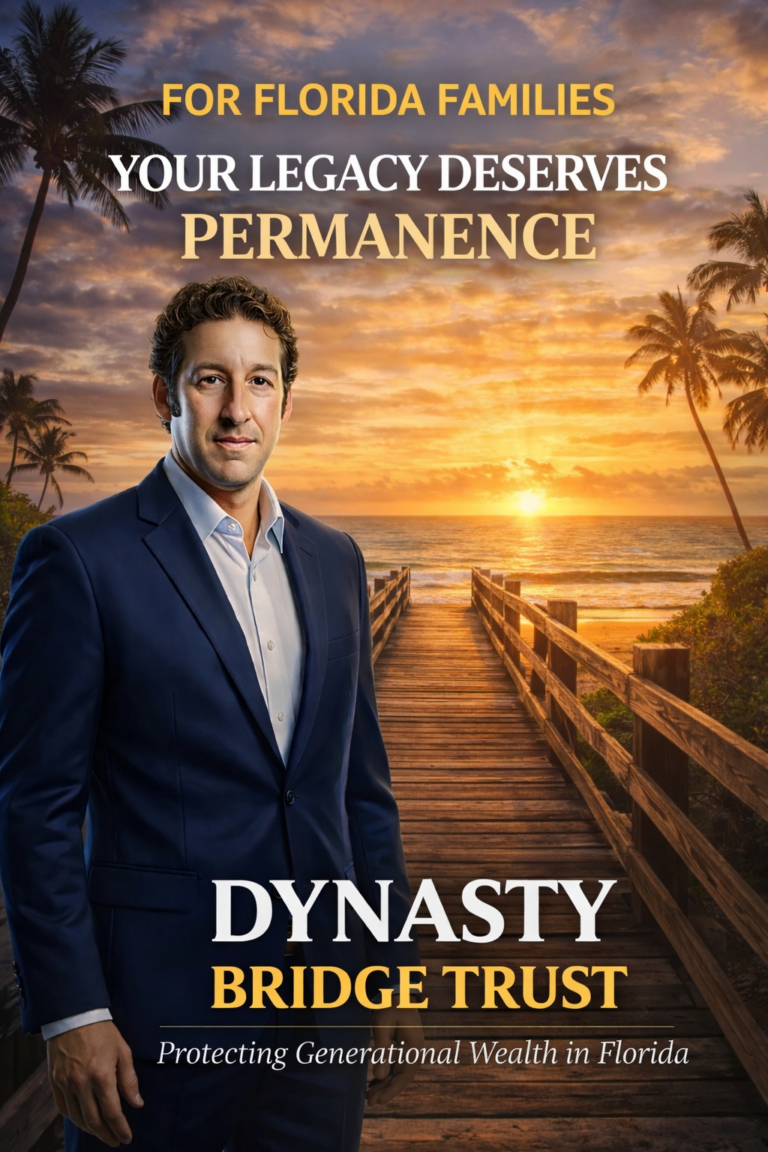
The Bridge Trust® holds the limited partnership interest. Two independent tax rules apply: the instrument satisfies the court test and control test of Treas. Reg. §301.7701-7 under IRC §7701(a)(30)(E), so the IRS classifies it as domestic; and separately it is drafted to maintain grantor-trust status under IRC §§671–677, so income is reported on your own return. No separate filing, no offshore reporting during the domestic phase.
If a genuine threat arises, an independent Trust Protector — an attorney exercising professional judgment, not you — may declare an Event of Duress. Nothing fires automatically on the filing of a complaint. The instrument disclaims automatic migration expressly, and declaring a threat does not by itself change situs, governing law, or trustee structure. What follows is a decision by an independent fiduciary who can be examined about it later.
That design is not caution for its own sake. A mechanical trigger fails twice — under Treas. Reg. §301.7701-7 on the tax side, and under contempt doctrine on the litigation side.
For physicians above roughly $12 million, the same instrument carries dynasty provisions that continue after death, so wealth passes to children inside a protective structure rather than outright — and because assets remain in your estate during life, the §1014 step-up is preserved.
No structure guarantees an outcome. What a properly built and properly timed one changes is what a creditor can reach and what it costs to try.
FAQs
Does malpractice insurance protect my personal assets? It pays claims within policy limits. A verdict above those limits becomes a personal judgment reaching your home equity, brokerage accounts, and investment property.
Are my retirement accounts protected from a malpractice judgment? Generally yes for ERISA-qualified plans, subject to exceptions. IRAs and non-ERISA plans vary by state, and in some states protection depends on what is reasonably necessary for retirement support.
Does my medical corporation or PLLC protect me? Not from your own malpractice. It addresses business liability, vicarious liability for employees, and premises exposure. If you personally commit malpractice, the patient sues you.
Should I use a Nevada or Delaware asset protection trust? Rarely, if you practice elsewhere. Alaska’s own supreme court held in Toni 1 Trust v. Wacker that a DAPT statute cannot bind other states or federal courts, and the highest-litigation states void self-settled protection by statute.
Can I protect my house? Depends entirely on your state’s homestead exemption. Florida and Texas offer effectively unlimited protection. New York’s is modest. Equity above the exemption is exposed, and you cannot move dirt — real property is governed by the law where it sits.
Am I liable for my associate’s malpractice? Generally not personally, if the practice is a properly formed and maintained PC or PLLC — the entity carries the vicarious exposure. In a general partnership you would be, because partners share joint and several liability.
What happens if a departing associate doesn’t buy tail coverage? Claims arising from their prior work at your practice can reach the practice and the remaining owners. Employment agreements should require the extended reporting endorsement and specify who pays for it.
Is tenancy by the entirety good protection for a practice owner? It is the worst fit. TBE protects against a creditor of one spouse and fails against joint liability — and a practice owner’s exposures are frequently joint, through co-owned entities and guarantees both spouses signed.
What should I do first? An exposure map. Every asset, how it is titled, what debt attaches, which statutory exemption applies, and what remains genuinely reachable. Everything else follows from that number.
Is it too late if I’ve already been sued? For that claim, largely yes — a transfer now is voidable and can worsen your position. For claims that do not yet exist, fraudulent transfer analysis is creditor-specific and forward planning remains available.
How do I evaluate an attorney selling me a structure? Ask them to walk you through the creditor’s attack, step by step, with the statutes and cases supporting each step. An attorney who cannot describe how the other side proceeds has not designed against it.
The Question That Decides It
You became a physician to practice medicine, not to manage litigation risk. But the risk is structural — most physicians will face a claim, and the system rewards aggression.
The order of operations is the part almost nobody gets right. Find out what is already protected before buying protection. Then close the gaps that remain, before there is anything to close them against.
I spent years running the collection analysis from the other side. The plans that came apart in my hands came apart for the same two reasons every time: the debtor still controlled what he claimed to have given away, or he built the thing after the claim was already in view.
Neither is fixable once a lawsuit is filed. Both are entirely avoidable before one.
You don’t rise to the level of your income. You fall to the level of your legal structure.
Structure before stress.
📞 For a confidential legal consultation, contact Bradley Legal Corp. at (888) 773-9399, or complete the intake questionnaire at btblegal.com.
By: Brian T. Bradley, Esq. – National Asset Protection Attorney