

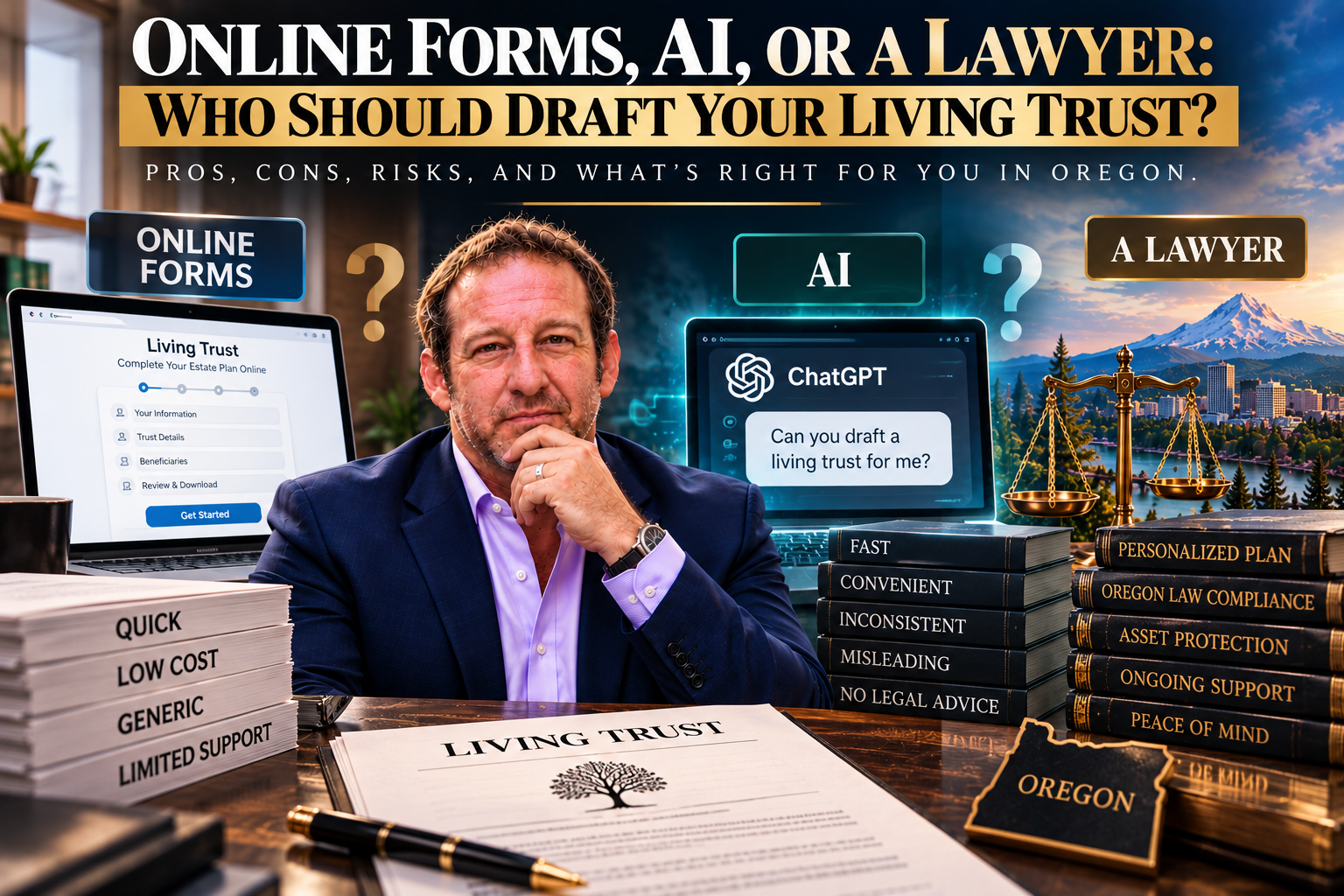
The three options do not produce the same document. That is the part most comparisons get wrong, and it is the only part that matters.
An online service costs a few hundred dollars. An AI tool costs nothing. The middle half of Oregon firms charge between about $2,050 and $2,950 for a standard revocable trust. The usual explanation for that gap is that you are paying a lawyer for service, hand-holding, and a nice office — that the paper is basically the same.
It is not the same. And unlike almost every other claim a lawyer makes about his own value, this one you can verify yourself in about fifteen minutes.
Below are five provisions an Oregon trust needs that a generic document will not have. Go look at yours.
Five things to check in the document you already have
One: a division on the first spouse’s death, if you are married and approaching $2 million.
Oregon’s estate tax rate table begins at $1 million under ORS 118.010, running from 10 to 16 percent, and a return is required once the gross estate reaches $1 million under ORS 118.160(1)(c). That threshold is among the lowest in the country. Oregon’s exclusion is also not portable — nothing in ORS chapter 118 lets a surviving spouse use what the first spouse did not.
The federal exemption is many times higher, and nearly all national source material is written to the federal number. A document generated from national defaults will typically leave everything to the surviving spouse outright, which throws away the first spouse’s $1 million.
What that costs: a couple at roughly $2 million who leave everything outright face about $100,000 in Oregon estate tax that a trust dividing on the first death would have avoided. Closer to $1.2 million the gap is nearer $20,000. The number scales fast.
What to look for: language dividing the trust into separate shares or subtrusts when the first spouse dies. If your trust simply continues for the survivor, and your combined estate including life insurance death benefits is near $2 million, that is the gap.
Two: consent to disclosure of digital asset content.
Oregon adopted the Revised Uniform Fiduciary Access to Digital Assets Act at ORS chapter 119, and two provisions in it catch almost everyone.
ORS 119.046 requires that a trustee who was not the original account user provide a certified copy of the trust instrument, or a certification of trust, that includes consent to disclosure of content. If that consent language is not in your trust, your trustee can be lawfully refused access to your accounts while holding every other document in order.
And ORS 119.016(1) provides that a direction given through a platform’s online tool “overrides a contrary direction by the user in a will, trust” — but only where the tool allows the user to modify or delete that direction at all times. Where it does, a legacy-contact setting you clicked through years ago beats your estate plan. No document fixes that; you have to go change the setting.
What to look for: an express digital assets provision granting your fiduciary authority over electronic communications content.
Three: a no-contest clause that works under Oregon law.
If you are excluding a family member, Oregon gives you an unusually strong tool. ORS 130.235(1) provides that “an in terrorem clause in a trust is valid and enforceable,” and goes further than most states — the court “shall enforce the clause against the beneficiary even though the beneficiary establishes that there was probable cause for the challenge.”
The exceptions sit in subsections (2) and (3) and are narrow: probable cause to believe the trust is a forgery or has been revoked, and challenges brought by a fiduciary acting for a protected person under ORS chapter 125 or by a guardian ad litem.
That is real deterrence. But a no-contest clause only deters a person who stands to lose something by challenging, which means somebody has to decide, on purpose, to leave that person enough to risk. A template will not make that decision for you.
Four: continuing trusts for children, with an actual distribution standard.
Check how your children take. If the trust distributes outright at eighteen or twenty-one, a nineteen-year-old gets a lump sum with nobody between him and the money.
Then check the standard governing the trustee. “Health, education, maintenance and support” behaves very differently from absolute discretion when a beneficiary is going through a divorce or a bankruptcy. That standard, together with the trust’s spendthrift provisions, shapes how much room your trustee has to protect the money.
Five: whether your retirement accounts actually follow the plan.
This one is not in the trust at all, which is exactly why it gets missed.
A qualified retirement plan — your 401(k) — must pay your surviving spouse unless the spouse has consented in writing to a different beneficiary, and that consent must name the specific nonspouse beneficiary. Under the governing Treasury regulation, a prenuptial agreement does not satisfy that requirement. If you are in a second marriage, signed a prenup, and assumed your 401(k) goes to your children, it does not.
IRAs are excluded from those survivor annuity requirements under Q&A-3(d) of the same regulation. So the same person can have two retirement accounts with two completely different default outcomes.
What to look for: pull up both beneficiary designations and read them. Not what you remember. What they say.
If three or more of those five are missing or wrong in your document, you now have a concrete answer to the question this article asks.
What is the difference between an online trust and an attorney’s?
An online form service produces a document from your answers to its questions. The quality of the output is bounded by the quality of the questionnaire, and the questionnaire is built to serve the median customer in all fifty states.
An AI tool produces a document from your prompt. It pattern-matches to the most common version of a trust it has seen, which means national defaults and federal assumptions. Your specific situation is the thing it has the least information about.
A law firm produces a document assembled for your facts. Serious estate planning firms work from professional drafting platforms built and maintained for this — WealthCounsel is the best known — which are updated as statutes and tax law change and which keep the trust, the pour-over will, the powers of attorney, and the deeds internally consistent. The lawyer selects and adapts provisions against what you actually own and who you actually want to provide for.
Those are three different processes, and they produce three different documents. The reason that is hard to see is that all three come out looking like a trust.
What do the online services’ terms actually say?
The clearest description of an online legal product comes from the company selling it. LegalZoom’s site and terms of use say the following, verbatim:
“LegalZoom is not a law firm and does not provide legal advice, except where authorized through its subsidiary law firm LZ Legal Services, LLC.”
“you are and will be representing yourself in any legal matter you undertake through LegalZoom’s legal document service”
“LEGALZOOM EXPRESSLY DISCLAIMS ALL WARRANTIES OF ANY KIND, WHETHER EXPRESS OR IMPLIED”
“OBTAINING ANY MATERIALS THROUGH THE USE OF THE SITE OR APPLICATIONS IS DONE AT YOUR OWN DISCRETION AND AT YOUR OWN RISK”
“IF THERE IS LIABILITY FOUND ON THE PART OF LEGALZOOM, IT WILL BE LIMITED TO THE AMOUNT PAID FOR THE PRODUCTS AND/OR SERVICES”
“UNDER NO CIRCUMSTANCES WILL THERE BE CONSEQUENTIAL OR PUNITIVE DAMAGES”
I want to be fair about this. Those are ordinary commercial terms. Nearly every software company you deal with has a warranty disclaimer and a liability cap, and none of it suggests bad faith. I am not quoting them to imply otherwise.
I am quoting them because they accurately describe what you are buying. If a $399 trust misses the division described above and your family pays Oregon estate tax that proper drafting would have avoided, the contract caps recovery at $399. That is disclosed in plain language before you buy. The question is whether that allocation of risk fits your situation.
For some people it genuinely does.
Can AI write my living trust?
I use AI in my own practice — for research, for surfacing issues worth chasing, for finding authority faster. I am not going to pretend it has no place, and you should be skeptical of any lawyer who does.
What it does not do is draft the instrument. Three reasons, and they are structural rather than temporary.
It only knows what you tell it. A consultation is mostly questions you did not know were relevant — the rental in Boise, the nephew on disability benefits, the limited partnership interest, the stepchildren, the group life policy through your employer. An AI answers the question you asked. It cannot ask about what you never mentioned, and the omissions are what kill plans.
It produces generic output. Ask for “a living trust for my family” and you get the most common version of that document, not the version calibrated to Oregon’s threshold, Oregon’s digital asset statute, and Oregon’s treatment of no-contest clauses. Matching clauses to your facts and your state is the entire job, and a prompt is a poor substitute for an intake.
Confident output is not correct law. These tools generate clean, well-formatted, authoritative-sounding documents, and they are fully capable of applying another state’s rules or stating a threshold that is not Oregon’s. The formatting gives you no signal either way. A document that is wrong looks exactly like a document that is right.
Who is responsible if an AI-generated trust is wrong?
When an Oregon lawyer uses AI, that lawyer is not off the hook for what it produces. The Oregon State Bar addressed this directly in Formal Opinion No. 2025-205, and the conclusion is unambiguous:
“Lawyers must verify any work done by or with the assistance of any third-party technology, including AI.”
The opinion also holds that competence under RPC 1.1 “requires understanding the benefits and risks associated with the specific use and type of AI being used,” that “[c]ompetence is an ongoing obligation,” and that lawyers generally may not bill for time spent learning these tools unless the client asks for it. It also addresses confidentiality under RPC 1.6, supervision under RPC 5.1 and 5.3, and candor under RPC 3.3.
So the real comparison is not a human against a machine. Plenty of lawyers use AI. The comparison is whether anyone is under a professional duty to verify the output and answerable if it is wrong.
When I use these tools, I am bound by that opinion, I carry malpractice coverage, and you have recourse through the Oregon State Bar. When you use them alone, the verification step does not happen and there is no recourse. And unlike nearly any other purchase, you will not be the one who discovers the problem. Your family will, years later, when nothing can be changed.
Does Oregon license nonlawyer document preparers?
No. Some states do — Arizona and Nevada register nonlawyer document preparers who can assist the public within defined limits.
Oregon does not. ORS 9.160(1) provides that “a person may not practice law in this state, or represent that the person is qualified to practice law in this state, unless the person is an active licensee of the Oregon State Bar.” ORS 9.166 gives it teeth — a court “shall enjoin any person violating ORS 9.160 from practicing law without a license” and “shall order restitution to any victim of any person violating ORS 9.160.”
Oregon’s exceptions are narrow and specific: Judicial Department staff and volunteers helping the public with court forms and processes, real estate licensees acting within the scope of their license, and title and escrow agents in limited roles within their own transactions.
Practically, your options in Oregon are a document you complete yourself or a licensed lawyer. There is no regulated middle, which is part of why the price gap looks so stark here.
When is a DIY trust good enough?
I will be specific rather than vague, because vague caveats are how lawyers pretend to be even-handed.
You may not need a trust at all. (Do I need a living trust in Oregon?) Under ORS 114.510(1)(a), an Oregon estate qualifies for a simple estate affidavit if not more than $75,000 of fair market value is attributable to personal property and not more than $200,000 to real property and manufactured homes combined. Under ORS 114.515(3), the affidavit may not be filed until 30 days after death. If you rent, your accounts are modest, and your beneficiary designations are current, a will and a power of attorney may be everything you need. (See living trust vs. will in Oregon.)
And if your situation is genuinely simple — one home in Oregon and no other real property, single or married with no children from prior relationships, no beneficiary on needs-based benefits, total estate including life insurance comfortably under $1 million, no business interest, and you will actually record the deed and retitle the accounts — then fewer of the five provisions above are in play, and less is riding on getting them right.
The further you are from that description, the more each of those five decisions costs you if it is wrong.
If you already generated one, here is the audit
Beyond the five provisions above, check these. They are the failures I see most often, in rough order of frequency.
Pull the deed to your house and read the owner’s name. If it does not name your trust, your trust does not control your house, and the estate goes through probate regardless of what the document says. This is the most common failure of all, and it has nothing to do with drafting quality. (More on funding a living trust.)
Check your account titling and beneficiary designations. Retirement accounts normally pass by designation and usually should not be retitled into the trust — but a designation naming an ex-spouse overrides everything in your plan.
Confirm there is a pour-over will, and that it nominates guardians. If you have minor children, your guardian nomination goes in your will (or another signed writing), not the trust — and in Oregon the court still makes the final appointment. People assume the trust covers it. It does not.
Check that the incapacity documents exist — a durable financial power of attorney, an advance directive, and a HIPAA authorization. These do more day-to-day work than the trust itself, because incapacity is more likely than sudden death. If you could not sign your name next month, who could sell your house?
Check for out-of-state property. A cabin in Idaho or a condo in Arizona outside the trust means a second probate in that state.
Check whether any beneficiary receives needs-based benefits. An inheritance arriving directly can cost someone their eligibility — the one problem on this list where doing nothing causes active harm rather than inconvenience.
If that audit turns up two or three issues, the fix is usually far cheaper than starting over. Bring what you have.
One thing none of them do
A living trust is not asset protection.
Where to start
I handle estate planning for families in Wilsonville, Lake Oswego, West Linn, Tualatin, Sherwood, Tigard, and Beaverton, across Clackamas and Washington Counties, and in Vancouver, Camas, and Clark County.
If you want the numbers first, I have written separately about what a living trust actually costs in Oregon — market ranges, what moves the price, and what should be included in any quote you compare. My own flat fees are published on my estate planning pricing page.
And if you already have a document from somewhere else, bring it. I would rather tell you it is fine than sell you a second one. Book a free 15-minute call or call (888) 773-9399.
Structure before stress.
Sources
- LegalZoom Terms of Use (introduction, Sections 9 and 10) and site footer
- Oregon State Bar Formal Opinion No. 2025-205, “Artificial Intelligence Tools”
- 26 C.F.R. § 1.401(a)-20, Q&A-28 and Q&A-31 (spousal consent); Q&A-3(d) (IRAs excluded)
- Legal Templates, “The Cost of Estate Planning Documents in 2026” (March 2026)
- ORS chapters 9, 114, 118, 119, 130 — ORS 9.160, 9.166, 114.510(1)(a), 114.515(3), 118.010, 118.160(1)(c), 119.016(1), 119.046, 130.235(1)–(3)
General educational information, not legal advice. No attorney-client relationship is formed by reading this article. Attorney advertising. Brian T. Bradley, Esq., Bradley Legal Corp, Wilsonville, Oregon. Licensed in Oregon, Washington, and California. Figures are stated as of October 2026.