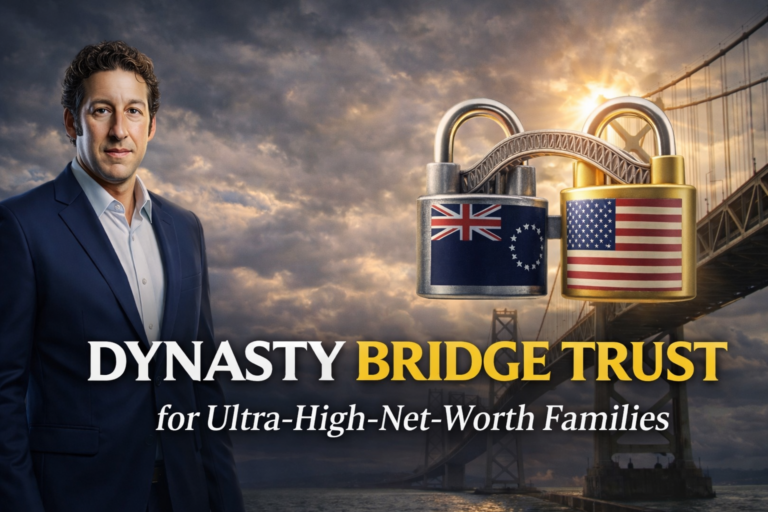


If you’ve started hearing the term “dynasty trust” from your financial advisor, your CPA, or in a conversation about generational wealth — and you’re not entirely sure what it means or whether it applies to you — this article answers every foundational question I get asked about dynasty trusts.
What they are. How they actually work. Why they’re legal. How they’re taxed. How they differ from what you probably already have. And where the Dynasty Bridge Trust™ fits into the picture for families with real exposure and real assets to protect.
What Is a Dynasty Trust?
A dynasty trust is an irrevocable trust designed to hold family wealth across multiple generations — not just your children, but grandchildren, great-grandchildren, and beyond — without restarting the estate tax clock each time wealth passes from one generation to the next.
The name is intentional. The goal is dynastic — meaning the structure is built to last long enough that the wealth you create during your lifetime continues compounding and benefiting your family for decades after you’re gone, without being carved up by taxes and legal exposure at every generational hand-off.
A standard estate plan — a revocable living trust, a will, even an A/B trust — is designed for one transfer. At death, assets move to heirs, estate taxes are calculated and paid, and the wealth that remains becomes the next generation’s personal property. Then the cycle begins again. When that generation dies, the same calculation happens. Estate taxes, probate costs, legal exposure, creditor claims — every generation starts from zero under the protection of whatever planning they happened to get around to.
A dynasty trust interrupts that cycle. Assets go in once. The trust holds them — not the individuals — and the wealth compounds inside a protected structure that survives each generation without triggering a new estate tax event.
How Does a Dynasty Trust Actually Work?
The mechanics are simpler than people expect.
You — the grantor — create an irrevocable trust and transfer assets into it. From that point forward, the trust owns those assets. Not you personally. Not your children personally. The trust.
A trustee manages the assets and makes distributions to beneficiaries according to the terms you set when you create the trust. Those terms can be as specific or as flexible as your situation requires — distributions for health, education, business investment, housing, or broad discretionary support. You decide the parameters when you build the structure.
Because no individual beneficiary owns the trust assets outright, those assets are generally not included in any beneficiary’s taxable estate at death. The trust doesn’t end when your children die. It continues for your grandchildren. Then their children. The wealth keeps moving forward inside the structure without triggering estate tax at each generational transition.
That is the core mechanism — and it is why dynasty trusts are the primary tool for families who are serious about preserving wealth across time rather than just transferring it at death.
How Long Can a Dynasty Trust Last?
Historically, a legal doctrine called the Rule Against Perpetuities limited how long a trust could remain active — generally tied to a formula based on the lives of people living at the time the trust was created, plus 21 years.
That doctrine has been significantly eroded. Today, more than 20 U.S. states have either abolished or dramatically extended the Rule Against Perpetuities specifically to attract trust business. Nevada, South Dakota, Delaware, and Alaska are the leaders — each allowing trusts to last effectively in perpetuity. A dynasty trust sited in Nevada can, under current law, last indefinitely.
This is not a loophole. These states passed legislation deliberately inviting this planning. They compete for trust business, and the legal framework they’ve built is stable, well-developed, and specifically designed to support long-duration wealth preservation structures.
Are Dynasty Trusts Legal?
Yes — fully and unambiguously.
Trusts are one of the oldest legal structures in the common law tradition, predating the United States by centuries. The Internal Revenue Code explicitly addresses generation-skipping transfers — Congress created the Generation-Skipping Transfer tax under IRC §2601 and the corresponding GST exemption under IRC §2631 precisely because dynasty-style planning is legal and the government needed a mechanism to tax it when not properly structured.
Working within the GST exemption is not a loophole. It is exactly what the statute permits. The exemption exists because Congress made a deliberate policy decision that families should be able to transfer a defined amount of wealth across multiple generations free of the GST tax — and that amount is currently $13.61 million per person.
Any remaining argument that self-settled spendthrift trusts are somehow improper or ethically questionable was resolved when Alaska became the first U.S. state to enact specific Asset Protection Trust legislation in 1997. More than 16 states have since followed. The legal and political consensus is not ambiguous — the United States has affirmatively endorsed this planning.
What Is the Generation-Skipping Transfer Tax — and Why Does It Matter?
The GST tax is a 40% federal tax imposed on transfers of wealth that skip a generation — meaning transfers to grandchildren or more remote descendants, either directly or through a trust. Without planning, every dollar that passes to your grandchildren could be subject to estate tax when it passes from you to your children, and then GST tax when it passes from your children to your grandchildren. The compounding effect on family wealth is significant.
Following the One Big Beautiful Bill Act signed into law on July 4, 2025, the GST exemption under IRC §2631 is now permanently set at $15 million per person — $30 million per married couple — beginning January 1, 2026, with annual inflation adjustments thereafter. Unlike the temporary doubling under the Tax Cuts and Jobs Act of 2017, this increase carries no automatic sunset or expiration date. The exemption will not decrease unless a future Congress specifically legislates a change.
When you transfer assets into a properly structured dynasty trust and allocate your GST exemption against those assets on Form 709, the trust carries what is called an inclusion ratio of zero. That means every future distribution from the trust to your grandchildren and beyond — regardless of how much those assets have grown — is completely free of the 40% GST tax.
The timing of when you fund the trust still matters enormously — not because of a sunset deadline, but because of math. The exemption covers the value of assets at the time of transfer, not their future value. A business interest worth $3 million today that grows to $18 million inside the trust over 20 years uses only $3 million of your exemption. The $15 million of growth moves forward entirely free of GST tax. Early transfers remove not just current value from the taxable estate — they remove every dollar of future appreciation as well. That compounding benefit is the real argument for acting now, and it doesn’t require a legislative deadline to be compelling.
“Permanent” is also not the same as unchangeable. A future Congress with different political priorities can revisit exemption levels, tax rates, or valuation rules. Planning today under favorable law is always preferable to planning under future law you can’t control.
Who Needs a Dynasty Trust?
Not everyone. But the clients who benefit most share a few common characteristics.
You have assets that are likely to appreciate significantly over time — a business, real estate portfolio, investment accounts, intellectual property — and you want that appreciation to benefit your family rather than fund estate taxes at each generational transition.
You have enough wealth that the estate tax is a real calculation, not a theoretical one. The federal estate tax exemption is also currently elevated and matched to the GST exemption at $15 million per person.
You are in a profession or business with meaningful liability exposure — medicine, law, real estate development, construction, financial services — where a lawsuit during your lifetime is a realistic risk rather than a remote possibility.
You have children or grandchildren you want to provide for, but you also want the structure to protect the assets from their creditors, divorces, and poor decisions — not just from your own estate tax.
You have already done basic estate planning — you have a revocable living trust, perhaps an A/B trust — and you’ve realized that none of it protects you while you’re alive.
If more than one of those describes you, a dynasty trust deserves serious analysis.
Is a Dynasty Trust the Same as an A/B Trust?
No. They solve different problems at different points in the wealth transfer lifecycle.
An A/B trust — also called a bypass trust or credit shelter trust — is a married couple’s estate planning tool. At the first spouse’s death, the marital estate splits into two trusts: the “A” trust (surviving spouse’s share) and the “B” trust (the decedent’s share, held in trust to use the decedent’s estate tax exemption). The goal is to double the couple’s combined estate tax exemption. It is one generation deep, activated at death, and primarily a tax efficiency tool.
A dynasty trust is multi-generational by design. It is built to survive not just the death of both spouses, but the deaths of their children, grandchildren, and beyond. It incorporates the GST exemption rather than the marital deduction. It is forward-looking rather than death-triggered. And when properly structured — as in the Dynasty Bridge Trust™ — it includes asset protection mechanisms that an A/B trust never touches.
Most clients who come to me already have an A/B trust or something similar. That existing structure doesn’t disappear inside a dynasty trust architecture — it often becomes the final distribution vehicle, the mechanism through which dynasty trust assets flow to heirs for estate planning purposes. The two tools are complementary, not competing.
How Is a Dynasty Trust Taxed?
This is where the details matter, and where having a CPA who understands trust taxation is non-negotiable.
During the grantor’s lifetime, a dynasty trust is typically structured as a grantor trust under IRC §§671–677. A grantor trust is completely disregarded as a separate tax entity — which means the trust itself does not pay income tax. All income generated inside the trust is reported directly on the grantor’s personal Form 1040, using the grantor’s Social Security number, per Treasury Regulation §1.671-4(b)(2). No separate trust tax return is required in most cases. No new tax burden is created. No additional filing complexity for the CPA.
This is an important and frequently misunderstood point. Many clients — and some advisors — assume that an irrevocable trust automatically means a separate taxpayer and a separate tax return. That assumption is wrong when grantor trust status applies. The Bridge Trust® is specifically designed to qualify as a grantor trust, making tax simplicity a feature of the structure rather than a trade-off against its protective benefits.
The AMLP — the Arizona Asset Management Limited Partnership that sits inside the Dynasty Bridge Trust™ structure — files Form 1065, the federal partnership information return, and issues K-1s to each partner, including the Bridge Trust®. LLCs held inside the AMLP as single-member entities are disregarded for tax purposes and flow up to the 1065. This is standard partnership tax compliance — nothing unusual for a CPA already working with a business-owning client.
When assets are transferred into the trust, that transfer is reported as a gift on Form 709 — the same return used to allocate the GST exemption. Again, standard estate planning compliance.
If the trust is ever triggered offshore — meaning a creditor attack activates the Cook Islands mechanism — it becomes a foreign grantor trust and additional informational filings apply: Form 3520 and Form 3520A annually. These are disclosure requirements, not additional taxes. The IRS is informed — not paid more. Penalties for failure to file are significant, which is why having a CPA experienced with foreign grantor trust reporting is mandatory if the trust is ever triggered. That said, in the domestic phase — which is where the structure operates in the absence of any threat — the filing burden is minimal by design.
What Happens to My Step-Up in Basis?
This is the question CPAs raise most often, and it deserves a direct answer — not a footnote buried in a tax section.
When someone inherits an asset — a stock portfolio, a piece of real estate, a business interest — the cost basis of that asset resets to its fair market value on the date of the decedent’s death. That reset is called a step-up in basis. It means the heir can sell the inherited asset immediately and owe no capital gains tax on appreciation that built up during the original owner’s lifetime. It is one of the most significant tax benefits in the entire U.S. tax code for wealth transfer purposes.
Assets inside an irrevocable dynasty trust that sits outside the grantor’s taxable estate generally do not receive a step-up in basis at the grantor’s death under IRC §1014. They cannot — because the step-up applies to assets included in the taxable estate, and the entire purpose of the dynasty trust structure is to remove those assets from the taxable estate permanently.
The IRS confirmed this definitively in Rev. Rul. 2023-2. Any planning strategy that claimed to deliver both estate tax exclusion and a basis step-up on the same assets is no longer viable after that ruling. If a CPA or advisor tells you there is a way to have both simultaneously on the same assets, they are either unaware of this ruling or misreading it. Every CPA in the room who does estate and trust work will know Rev. Rul. 2023-2. You should be able to cite it and explain the trade-off it creates before they bring it up.
Here is the trade-off stated plainly: you are giving up the step-up in basis on assets inside the trust in exchange for removing those assets from the 40% federal estate tax at death and the 40% GST tax at every subsequent generation. The question is whether that trade makes mathematical sense for your specific situation.
For most high-net-worth clients holding appreciating assets over long time horizons, the math resolves decisively in favor of the trust. A 40% estate tax on the full fair market value of your estate at death versus the capital gains rate — currently a maximum of 23.8% including the net investment income tax — on appreciation inside the trust that didn’t get a step-up. For assets compounding inside a protected structure for 20 or 30 years, the estate tax cost of not planning typically exceeds the capital gains cost of forgoing the step-up by a substantial margin. Run that math with real numbers for your specific asset mix and you will see why almost every serious asset protection and estate planning attorney recommends the trust in this situation.
That said, the trade-off is not identical for every asset. Highly appreciated, low-basis assets that are unlikely to continue appreciating significantly deserve individual analysis before transfer. This is not a blanket rule — it is a planning conversation.
Grantor trust swap powers — properly drafted into the structure at the outset — give you a precision tool for exactly these situations. A swap power allows the grantor to exchange assets of equivalent fair market value between the trust and their personal estate. If a specific asset has a very low basis relative to its current value and limited growth prospects going forward, swapping it out of the trust before death — bringing it back into the taxable estate for a step-up — can make sense on a case-by-case basis while leaving the rest of the trust structure intact. The swap power preserves that flexibility without requiring you to dismantle anything.
The step-up question is legitimate and worth taking seriously. It is not a reason to avoid the dynasty trust structure. It is a reason to have a skilled CPA in the room when you build it — one who understands grantor trust mechanics, can run the actual numbers for your portfolio, and knows Rev. Rul. 2023-2 cold.
Do I Lose Control of My Assets When I Put Them in a Dynasty Trust?
This is the question every client asks before they ask anything else — and the answer depends entirely on how the trust is designed.
A standard irrevocable trust requires you to give up meaningful control. That is part of what makes it effective for estate and asset protection purposes — a court cannot order you to revoke something you have no power to revoke.
The Dynasty Bridge Trust™ is specifically engineered to preserve your day-to-day control. In the domestic phase — meaning in the absence of any creditor threat — you serve as your own trustee. You manage the assets, make investment decisions, and direct the structure exactly as you would today. Nothing changes about how you interact with your wealth on a daily basis.
The offshore trustee steps in only if you declare an Event of Duress — a triggering event such as a lawsuit or creditor action. That is the insurance policy component of the structure. You maintain full control unless and until you need the protection. When you need it, it activates.
This is the critical distinction between the Dynasty Bridge Trust™ and a standard irrevocable dynasty trust. Most dynasty trust structures require you to appoint an independent trustee from the outset and give up direct control as the price of the protection. The Bridge Trust® mechanism solves that problem — you get full offshore protection available on demand, without surrendering control while the threat doesn’t exist.
What Is the Dynasty Bridge Trust™ — and How Is It Different?
The Dynasty Bridge Trust™ is a four-layer structure that combines everything a standard dynasty trust does with a level of asset protection that a purely domestic structure cannot provide.
The first layer is state-matched LLCs — entities in the jurisdiction that provides the strongest charging order protection for your asset class and state of residence. These hold the operating assets, real estate, and investments. A charging order is the exclusive remedy for a judgment creditor against an LLC interest in strong-protection states — a creditor who wins a judgment against you cannot reach the underlying assets, only the economic interest, which is practically worthless to them.
The second layer is an Arizona Asset Management Limited Partnership — the AMLP — which functions as the master holding company above the LLCs. The Bridge Trust® owns 98% of the AMLP as the limited partner, providing both economic control and the mechanism for jurisdictional transfer if the structure is ever triggered.
The third layer is the Bridge Trust® itself — a hybrid structure that operates domestically as a grantor trust under normal conditions and has the legal architecture to become an offshore trust governed by Cook Islands law if a creditor threat materializes. The Trust Protector oversees this mechanism. Because the Bridge Trust® qualifies as a grantor trust under IRC §§671–677, it requires no separate tax return in the domestic phase — income reports directly on your personal return using your Social Security number. No Form 1041. No separate tax entity. No additional filing burden.
The fourth layer is the Nevada Dynasty Trust — the generational transfer vehicle that captures the GST exemption, locks in the multi-generational structure, and ensures your wealth continues building across generations under Nevada’s perpetual trust laws.
Each layer reinforces the others. A plaintiff who gets past the LLCs faces the AMLP’s charging order protection. A plaintiff who gets past that faces a trust that can cross jurisdictional lines before they can reach the assets. A plaintiff who follows the assets offshore faces the Cook Islands Trust Act — enacted in 1984, never successfully penetrated — with its two-year statute of limitations running from the date the trust was funded, its requirement that plaintiffs pay all legal costs upfront, and its prohibition on contingent fee arrangements for attorneys practicing in its courts.
The structure does not prevent you from being sued. It changes what a plaintiff finds when they look at what you own.
My Attorney Said Dynasty Trusts Don’t Work in California. Is That True?
Half right — about the wrong problem.
California has not enacted favorable dynasty trust legislation. It still applies the Rule Against Perpetuities, limiting California-sited trusts to approximately 90 years. The California Franchise Tax Board also aggressively asserts income tax jurisdiction over trust income when California connections exist — a resident trustee, resident beneficiaries, or California-source income.
The Dynasty Bridge Trust™ is not a California trust. The dynasty component is sited in Nevada. The AMLP is Arizona. The offshore capacity is Cook Islands. California residents use out-of-state trust structures regularly and legally — what California controls is income taxation on connected income. That is a planning variable we manage, not a barrier to the structure.
The objection your attorney raised applies specifically to a California-sited dynasty trust built under California law. That is a real limitation. It does not apply here.
But What About Those Cases Where Nevada Trusts Got Pierced?”
When a skeptical attorney or CPA raises Huckaby or Kilker v. Stillman as evidence that Nevada trusts don’t work for California residents, they are citing real cases with real outcomes — and citing them for the wrong proposition.
Both cases involved Nevada Domestic Asset Protection Trusts — self-settled spendthrift trusts where the grantor created the trust, transferred assets into it, and remained a beneficiary who could receive distributions. In plain terms: the debtor tried to give their assets away while keeping access to them. California Probate Code §15304 says that if you can benefit from your own trust, your creditors can reach it too. California courts applied that rule in both cases and the trusts failed. The Nevada statutes authorizing those structures — NRS Chapter 166 — didn’t override California public policy when the debtor lived in California and the assets were California property.
A Nevada Dynasty Trust is a different structure governed by different statutes — NRS Chapter 163. The grantor is not a beneficiary. The grantor receives no distributions. Assets are transferred irrevocably for the benefit of descendants — children, grandchildren, the generations that follow. Traditional third-party irrevocable spendthrift trusts of this kind have been recognized and enforced under American law since the founding of the legal system. The self-settled doctrine that destroyed the trusts in Huckaby and Kilker simply has no application here because there is no self-settlement to attack.
One additional design point that matters for California real estate specifically: the Dynasty Bridge Trust™ does not hold California property directly inside the trust. Real estate is held inside a state-matched LLC, which sits inside the AMLP. The trust holds the LLC interest — removing the situs problem that contributed to the Huckaby outcome.
The practical answer when your attorney raises these cases: those were self-settled asset protection trusts where the debtor remained a beneficiary. This is not that. Different statute, different structure, different legal theory — and a four-layer architecture above the Nevada dynasty layer that no domestic case law has ever reached.
What Happens If the Tax Law Changes?
Two separate questions deserve separate answers.
On the trust structure side: the Dynasty Bridge Trust™ is built on Nevada and Arizona statutes that are specifically designed to support this planning and have been stable for years. Both states actively compete for trust business by strengthening their laws. The Cook Islands Trust Act has been in place since 1984 and has been tested repeatedly in litigation — always successfully. The structural foundation is durable.
On the tax side: the One Big Beautiful Bill Act made the $15 million exemption permanent in the sense that it carries no automatic sunset. But permanent is not the same as unchangeable. A future Congress can legislate exemption levels up or down — and the history of the estate tax is a history of political volatility. Planning today under favorable law is always preferable to planning under future law you cannot predict or control.
What doesn’t change regardless of what Congress does is the math on early transfers. Once assets are inside the trust and exemption is allocated, that GST-free status is locked in — even if the exemption is reduced by future legislation. The assets transferred under today’s $15 million exemption remain protected. That is the structural argument for acting now, and it doesn’t require any legislative urgency to be compelling.
How Do I Know If This Is Right for My Situation?
The Dynasty Bridge Trust™ is built for families with $1 million to $25 million or more in exposed assets — people who have built real wealth, carry real liability exposure, and have come to understand that estate planning alone doesn’t protect what they’ve built during the years they’re most at risk.
If you’re a physician, attorney, real estate developer, business owner, tech founder, or investor — and you’re sitting on assets that a plaintiff’s attorney would find worth pursuing — this is a conversation worth having before a threat materializes. Asset protection only works when it’s in place before the lawsuit is filed.
I offer legal consultations to walk through your specific situation, the right structure for your asset composition and state of residence, and what the planning actually costs and involves. There are no surprises in this process.
Structure before stress.
Call (888) 773-9399 or schedule a private legal consultation directly online.
By: Brian T. Bradley, Esq. – National Asset Protection Attorney