

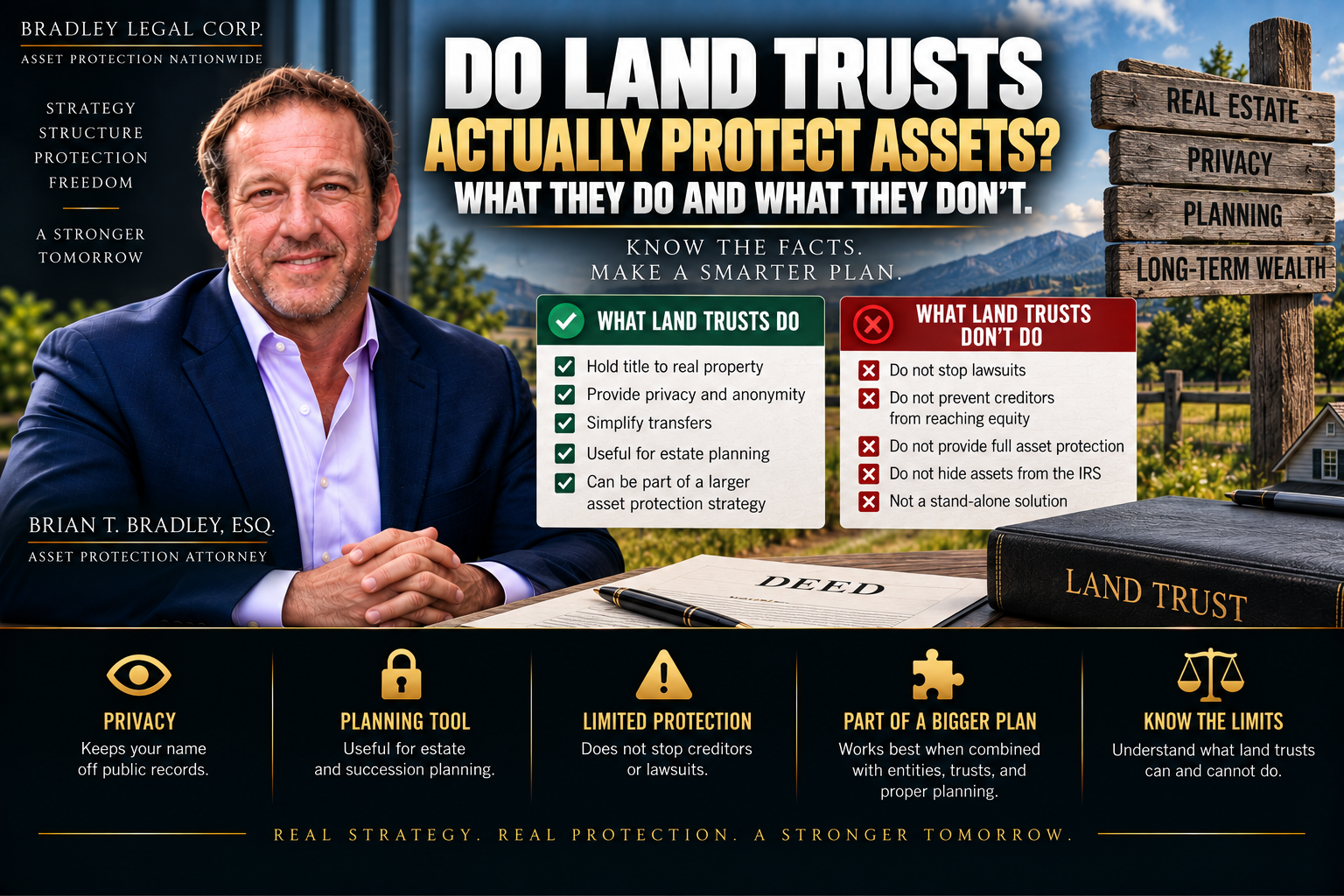
A land trust is a title-holding arrangement where a trustee holds legal title to real property and you hold the beneficial interest. It delivers real benefits: your name comes off the public record, the property passes outside probate, transfer taxes and reassessment are often avoided, and — the use almost nobody discusses — a transfer into it can fall inside the Garn-St Germain due-on-sale exception where a transfer into an LLC does not.
What it does not deliver is creditor protection. And the “land trust with an LLC as beneficiary” structure that gets marketed as protection has a problem worth understanding before you build one.
Key Points
- A land trust is a privacy and transfer tool. That is a real function, and it is not protection.
- Its strongest use is the one least discussed — a trust transfer can qualify under Garn-St Germain where an entity transfer cannot.
- ⚠️ But assigning the beneficial interest to an LLC may forfeit that exception, because the borrower stops being the beneficiary.
- Revocability is the flaw. A creditor reaches whatever you can reach.
- State law varies enormously. Illinois and Florida have developed statutes. Most states do not.
- The better answer for a rental is usually to deed it into the LLC directly.
What a Land Trust Actually Is
A trustee holds legal title to a specific parcel of real property. You hold the beneficial interest and direct the trustee. The trustee’s role is administrative — they act at your direction.
Unlike most trusts, a land trust typically holds only real property. Not cash, not securities, not business interests. One trust, one parcel, in most implementations.
The mechanics are simple. You deed the property to a trustee. The deed recorded at the county shows the trustee’s name. Your name comes off the public record. You remain the beneficiary and retain full direction over the property — sale, refinance, leasing, everything.
Most land trusts are revocable. That is not incidental. It is the source of both the flexibility people like and the protection problem discussed below.
The Four Things a Land Trust Genuinely Does
1. Privacy
The trust instrument is not a public document. The terms, the settlor, and the beneficiary are not filed anywhere a stranger can search.
The trustee’s name does appear on the recorded deed. So the property is not invisible — it is held by someone whose connection to you is not public.
That is a real function. A plaintiff’s attorney running a preliminary asset search before deciding whether to file sees fewer properties in your name.
2. Probate avoidance
A land trust functions much like a revocable living trust for a specific parcel. Beneficial interests pass to a named successor beneficiary outside probate.
For someone with property in multiple states, that can avoid ancillary probate proceedings in each one — a genuine cost and time saving.
3. Transfer tax and reassessment treatment
Land trusts are frequently exempt from state transfer taxes, and in some states from property tax reassessment, because beneficial ownership has not changed.
That varies significantly by state and it is worth confirming locally before recording anything. But where it applies, it is a real cost avoided.
4. The due-on-sale question — and this is the one almost nobody discusses
Most mortgages contain a due-on-sale clause permitting the lender to accelerate the loan on a transfer of the property.
Under 12 U.S.C. §1701j-3(d)(8), federal law bars a lender from exercising that clause on “a transfer into an inter vivos trust in which the borrower is and remains a beneficiary and which does not relate to a transfer of rights of occupancy in the property.”
A land trust is an inter vivos trust. So where the exception’s conditions are met, a transfer into one is protected by federal law.
There is no equivalent exception for a transfer into an LLC. None of the nine exceptions covers entities.
That is the land trust’s genuine structural advantage over an LLC, and it has nothing to do with creditor protection. It is about the transfer itself.
Two limits. The exceptions apply only to loans secured by residential property with fewer than five dwelling units, so commercial and larger multifamily debt is outside the statute entirely. And the implementing regulations have been read to require the borrower remain an occupant, which the statutory text does not — a genuine conflict that matters for a non-owner-occupied rental.
⚠️ The Trap in the “Land Trust With an LLC Beneficiary” Structure
The most commonly marketed version of this structure may forfeit the very Garn-St Germain protection that makes a land trust attractive in the first place.
The pitch is familiar. Put the property in a land trust for privacy. Name an LLC as the beneficiary for protection. Best of both.
Read the statutory language again.
The exception protects a transfer into an inter vivos trust “in which the borrower is and remains a beneficiary.”
Present tense. And continuing.
If you assign the beneficial interest to an LLC, you are arguably no longer the beneficiary. The condition the exception requires has stopped being satisfied.
And the promoters themselves set up both halves of this.
The most widely circulated version of this structure instructs you to “name yourself the initial beneficiary to avoid triggering due-on-sale clauses or tax reassessments” — an explicit acknowledgment that beneficiary status is what keeps the lender out of it.
Two steps later, the same material calls it “the key move” to assign the land trust’s beneficial interest to a Wyoming LLC.
Read those two instructions together. You are told to hold the beneficial interest because that is what avoids due-on-sale, and then told to give it away.
I have not found a case squarely resolving what happens next, and reasonable practitioners could argue that owning the LLC preserves beneficial status in substance. That is an argument, not a settled rule.
If you are relying on Garn-St Germain, ask whether the beneficial interest assignment breaks it — and ask the person who sold you the structure.
Why a Land Trust Is Not Asset Protection
Because it is almost always revocable, and a creditor generally reaches whatever you can reach.
This is where the marketing and the law diverge, and it is worth being direct.
A revocable land trust holding real property does not protect that property from your creditors. The analysis is the same as a revocable living trust: if you retain the power to revoke and reclaim, a court is not required to pretend that power does not exist.
Privacy is not protection. A land trust makes property harder to find in a preliminary search. It does nothing once a creditor has a judgment and a debtor’s examination, where you answer under oath what you own or control.
And the beneficial interest is itself an asset. A creditor who identifies it can reach it directly, without ever touching the land trust’s structure.
This is not a contrarian position among practitioners who litigate these questions. Florida asset protection counsel state it directly: land trusts provide privacy but not creditor protection on their own, and a judgment creditor who identifies the beneficial interest can reach it.
The narrow exception
Florida is different. Under the Florida Land Trust Act, Fla. Stat. §689.071, the statute separates legal title from beneficial ownership, the trust agreement is never recorded, and the trustee acts only at the beneficiary’s direction. Florida practitioners treat land trusts differently as a result.
Illinois also has a long-developed land trust framework, though its protections are frequently overstated.
Most states have no land trust statute at all. They recognize the arrangement under general trust law — which means the analysis defaults to ordinary trust principles, and ordinary trust principles say a revocable trust does not shield the settlor.
What Actually Protects the Property
Deed it into an LLC. That changes ownership rather than just title-holding, and it swaps the governing rule set from trust law to the LLC statute.
A transfer into an LLC does something a land trust does not. It changes who owns the property, not just who holds title on the record.
And it changes which body of law governs a creditor’s remedy. Instead of trust law — where a revocable trust is transparent — you are in the LLC statute, where a creditor’s remedy against your membership interest is a charging order in most states.
That is a materially different position, and it is the difference between a privacy arrangement and a protection structure.
The candid version: in reviewing these structures, I have not seen a land trust that was properly set up as an asset protection vehicle. The privacy is real. The protection claim does not survive scrutiny.
And an LLC alone is still not the whole answer
Charging-order protection varies enormously by state, and single-member LLCs are the weakest position everywhere. Florida codified foreclosure against them at Fla. Stat. §605.0503(4) after Olmstead v. FTC, 44 So.3d 76 (Fla. 2010). California authorizes foreclosure at Corp. Code §17705.03(b)(3), inside what its own statute calls the exclusive remedy.
And an LLC handles inside liability — a claim arising from the property. It does not stop a personal judgment against you from reaching your membership interest.
That is what the layer above it is for. An Arizona limited partnership holding the LLC interests changes the remedy again: under A.R.S. §29-341, the charging order is the exclusive remedy against a limited partner’s interest, and the section contains no foreclosure provision — an omission that reads as deliberate alongside §29-1044(B), which expressly authorizes foreclosure for Arizona general partnerships.
So When Does a Land Trust Make Sense?
When privacy is the goal and you know that is what you are buying. Keeping property off a public search is worth something, particularly for someone with a public profile or a portfolio they would rather not have catalogued.
When you are managing a due-on-sale problem on residential property with fewer than five dwelling units — and you remain the beneficiary.
When ancillary probate across multiple states is a real cost you are trying to avoid.
When your state’s transfer tax or reassessment rules make a direct LLC transfer expensive, and the land trust route is treated differently.
Where it does not make sense is as the protection layer. If someone is selling you a land trust as asset protection, ask them what happens at the debtor’s examination.
The Sequencing Question
If both a land trust and an LLC are in play, the order matters and so does the mortgage.
A property with no mortgage can generally go directly into an LLC. The due-on-sale question does not arise, and you get the LLC statute rather than trust law.
A property with a mortgage is where the analysis gets real. Transferring into an LLC is not protected by Garn-St Germain. Most lenders do not act on a performing loan — but that is a business calculation, not a legal protection.
Written lender consent removes the question entirely and costs one conversation.
And the cleanest answer of all is to buy the next property in the entity from day one. No transfer, no transfer tax question, no reassessment question, no due-on-sale question. Lenders and title companies handle it routinely. It changes which loan products you qualify for, which is the trade-off to weigh.
FAQs
Do land trusts protect assets from lawsuits?
No. A revocable land trust does not shield property from the settlor’s creditors, and the beneficial interest is itself reachable. Florida is the notable exception, under Fla. Stat. §689.071.
What does a land trust actually do?
Keeps your name off the public record, passes the property outside probate, often avoids transfer tax and reassessment, and — where the conditions are met — allows a transfer that qualifies under the Garn-St Germain due-on-sale exception.
Is a land trust with an LLC as beneficiary asset protection?
That structure adds the LLC’s protection to the arrangement. But assigning the beneficial interest to an LLC may mean the borrower no longer “is and remains a beneficiary,” which is what the Garn-St Germain exception requires — so it can cost you the federal transfer protection.
Why not just deed the property into the LLC?
Usually you should. It changes actual ownership and moves the analysis from trust law to the LLC statute. The reason people hesitate is the due-on-sale clause, which is a real consideration on mortgaged property.
Does a land trust avoid the due-on-sale clause?
It can, where the property is residential with fewer than five dwelling units, the borrower remains a beneficiary, and occupancy rights do not change. Note that the statute and the implementing regulations do not entirely agree on whether occupancy is required.
Does a land trust avoid property tax reassessment?
Often, because beneficial ownership has not changed — but this varies by state and should be confirmed locally before recording.
Are land trusts legal in every state?
The arrangement is generally recognized, but only some states have developed land trust statutes. Illinois and Florida do. Most states apply general trust law, which is less favorable.
Will a land trust hide my property from a creditor?
It makes the property harder to find in a preliminary search. It does nothing once a creditor has a judgment and can compel sworn testimony about what you own or control.
Is it too late if I’ve already been sued?
For that claim, largely yes. A transfer now is voidable and typically worsens your position. Forward planning against claims that do not yet exist remains available.
The Bottom Line
A land trust is a privacy and transfer tool. It is a good one. Your name comes off the record, the property avoids probate, transfer taxes and reassessment are often avoided, and a mortgaged residence can move into it under federal protection an LLC transfer does not get.
It is not a protection structure, and the version marketed as one — land trust with an LLC beneficiary — may quietly cost you the federal transfer protection that made the land trust worth having.
What protects property is changing who owns it, and then putting something above that entity so a personal judgment does not reach the ownership interest.
If someone is selling you privacy and calling it protection, that is the question to ask: what happens at the debtor’s examination?
Structure before stress.
📞 For a confidential legal consultation, contact Bradley Legal Corp. at (888) 773-9399, or complete the intake questionnaire at btblegal.com.
By: Brian T. Bradley, Esq. – National Asset Protection Attorney