

Dr. Renee had done everything right.
Board-certified orthopedic surgeon. Twelve years in practice. Malpractice coverage through one of the largest carriers in the country — $2 million per claim, $4 million aggregate. She paid $52,000 a year for that policy and rarely thought about it.
Then a patient filed suit alleging she had knowingly recommended an unnecessary procedure to generate surgical fees.
Intentional conduct.
Her carrier issued a Reservation of Rights letter within thirty days. Six months later, coverage was denied entirely. The insurer took the position that the allegations triggered the policy’s intentional-act exclusion.
Dr. Renee spent the next two years defending a $3.8 million lawsuit with her own money.
Her practice.
Her investment accounts.
Her rental properties.
The policy she had paid $52,000 a year to maintain sat on the sideline.
⸻
Insurance Is a Levee. Not Higher Ground.
Real estate investors understand this better than most people.
When you buy property in a flood zone, your lender requires flood insurance. You pay the premium every year. But what does that policy actually cover?
The structure. Under defined conditions.
It does not protect your equity. It does not cover unrelated liability claims that arise during the disaster. It does not prevent a creditor from attaching the property after a judgment against you personally.
When the extraordinary event arrives — the kind the policy was never designed to handle — the levee breaks.
Engineers do not design levees to survive catastrophic floods. They design them for normal conditions. When the 100-year event arrives, the question is simple:
Did you build on higher ground?
Insurance is the levee.
Asset protection is higher ground.
That distinction is not a metaphor. It is the entire point of this article.
What Insurance Actually Covers — and Where It Stops
Insurance answers one narrow question:
Will a carrier pay a claim under defined conditions?
It does not answer what happens when damages exceed policy limits.
It does not answer what happens when coverage is contested or denied.
It does not answer what happens when defense costs burn through limits before a case is resolved.
In recent years, insurers have increasingly relied on reservation-of-rights defenses and coverage litigation to challenge claims. Even policies issued by highly rated carriers can become the subject of disputes when serious allegations are involved.
One of the most common triggers is the intentional-act exclusion.
Many liability policies contain language similar to:
“An insurer is not liable for losses caused by the willful act of the insured.”
In California, this principle is codified directly in Insurance Code §533.
When allegations of intentional conduct appear in a complaint, insurers often defend under a reservation of rights while simultaneously asserting that coverage may ultimately be excluded. If intentional conduct is later established, indemnity can be denied entirely.
Recent decisions illustrate how courts analyze these disputes.
In United Talent Agency v. Markel American Insurance Co. (9th Cir. 2025), the court concluded that certain claims fell outside policy coverage because they were characterized as part of a willful course of conduct.
Similarly, in San Bernardino County v. Everest National Insurance Co. (Cal. Ct. App. 2025), the court held that allegations centered on retaliation and intentional misconduct fell within exclusionary policy language.
The pattern is consistent.
The more serious the allegation — the one that threatens real financial exposure — the more likely coverage becomes contested.
The Real Estate Parallel
Marcus owned eleven rental units across three LLCs in Washington State. Every property carried liability insurance. Every LLC had been properly formed.
When a tenant filed a fair-housing discrimination claim, the insurer denied coverage based on the policy’s intentional-conduct exclusion.
Marcus assumed his LLC structure would contain the damage.
But courts in several jurisdictions have allowed remedies beyond traditional charging orders when single-member LLCs are involved, including foreclosure or turnover of the membership interest in certain circumstances.
Once the lawsuit moved forward, the plaintiff’s lawyers pursued the assets behind the entities.
Personal brokerage accounts.
Cash reserves.
Equity in other properties.
From Marcus’s perspective, the result felt unjust.
From the court’s perspective, it was routine.
His structure had been built for normal conditions.
The 100-year flood arrived.
⸻
Why Domestic Trusts Don’t Solve This
When insurance coverage becomes uncertain, many advisors recommend Domestic Asset Protection Trusts (DAPTs) as the next layer of protection. The same advisors who recommended the insurance in the first place – your CPA and estate planning attorney – are typically not equipped to close this gap.
The structural limitation is straightforward:
Domestic trusts are evaluated by domestic courts — the same courts creditors use.
For example:
• California Probate Code §§15304 and 18200 allow creditors to reach a settlor’s interest in certain self-settled trusts.
• New York EPTL §7-3.1 contains similar limitations.
• Oregon and Washington have comparable statutory frameworks.
• Federal bankruptcy law under 11 U.S.C. §548(e) allows avoidance of certain self-settled trust transfers going back ten years.
In Battley v. Mortensen (Bankr. D. Alaska 2011), a court unwound a domestic asset-protection trust under that federal provision.
A DAPT can be a stronger levee.
It is still not higher ground.
The weakness is structural, not drafting. When the final jurisdiction of a trust sits inside the same legal system as the creditor’s judgment, the protection has a ceiling — and courts set that ceiling.
⸻
Three Variables. One Framework.
Every enforcement outcome ultimately turns on three questions.
Timing.
Courts do not oppose planning. They oppose reaction. A structure built before a claim arises is generally treated as legitimate planning. A structure created after a claim becomes foreseeable is treated as a transfer. Understanding when a claim becomes legally foreseeable is more nuanced than most people assume.
Control.
Courts look beyond paperwork to behavior. If a physician retains effective authority over trust assets, or an investor remains the true decision-maker behind an entity structure, courts may treat those assets as reachable regardless of labels.
Jurisdiction.
This is the factor most investors overlook. A domestic judgment has no automatic force in jurisdictions that do not recognize foreign creditor judgments. In those jurisdictions, a creditor must start over under local law — often facing far higher burdens of proof and shorter limitation periods.
Timing, control, and jurisdiction determine whether assets survive enforcement pressure.
⸻
How the Bridge Trust® Addresses Those Variables
The Bridge Trust® structure was developed to combine domestic tax treatment with the jurisdictional protections of an offshore trust.
While operating normally, the trust functions as a domestic grantor trust under IRC §§671–677 and §7701. During this period the trust is reported for tax purposes like other grantor trusts.
If a legitimate creditor threat arises, the trust instrument allows a Trust Protector to issue a formal Declaration of Duress. That decision is made by an independent attorney acting under the authority of the governing instrument.
When that declaration occurs, control shifts to a pre-designated Cook Islands trustee.
No new assets are transferred.
No new entity is created.
The offshore capacity was built into the structure when the trust was originally funded.
That timing distinction matters. The structure existed before the claim, and the trustee who ultimately controls the assets operates under a jurisdiction that does not recognize foreign judgments.
Cook Islands law requires a creditor to re-litigate the case locally, prove fraudulent transfer beyond a reasonable doubt, and satisfy strict statutory limitation periods.
These jurisdictional barriers are why offshore asset-protection trusts have historically proven difficult for foreign creditors to penetrate when they are established before any claim exists and administered by independent trustees.
⸻
The Takeaway
Dr. Renee had a levee. It handled twelve years of normal conditions.
When the 100-year claim arrived, she discovered she had never built on higher ground.
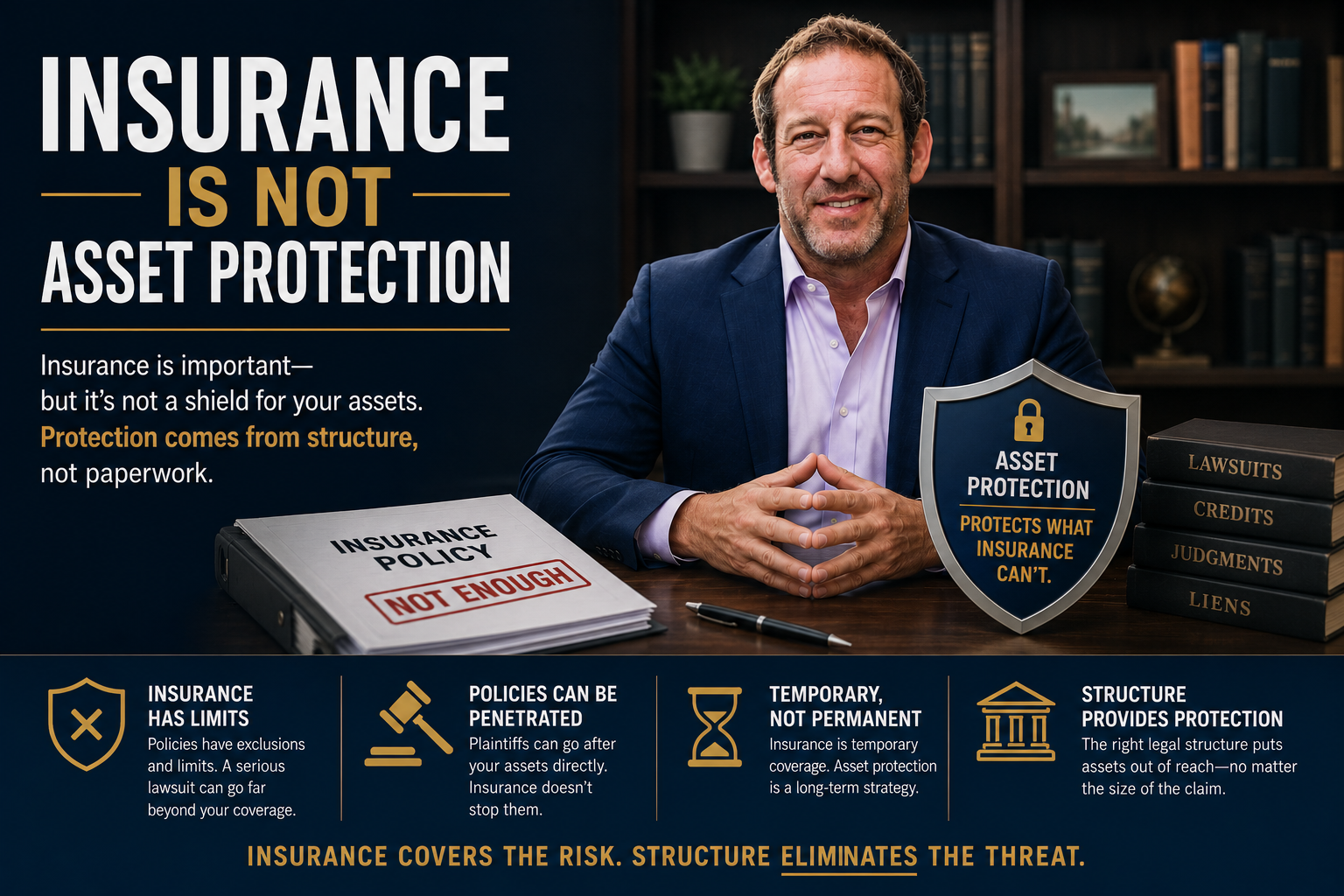
Insurance remains a necessary part of professional risk management. But it is not asset protection, because it operates entirely within the jurisdiction of the courts creditors use — with limits and exclusions defined by the carrier.
Domestic trusts can add another layer. But they remain subject to the same legal system that issues the judgment.
True asset protection changes the enforcement equation.
It alters what a court can compel.
One serious claim in a high-litigation state can erase a medical practice, a rental portfolio, or decades of accumulated wealth.
The time to build higher ground is before the flood.
You don’t fall to the level of your insurance limits.
You fall to the level of your legal structure.
📞 Call (888) 773-9399 today to schedule a consultation with an asset protection lawyer and secure your financial future.
By: Brian T. Bradley, Esq.