
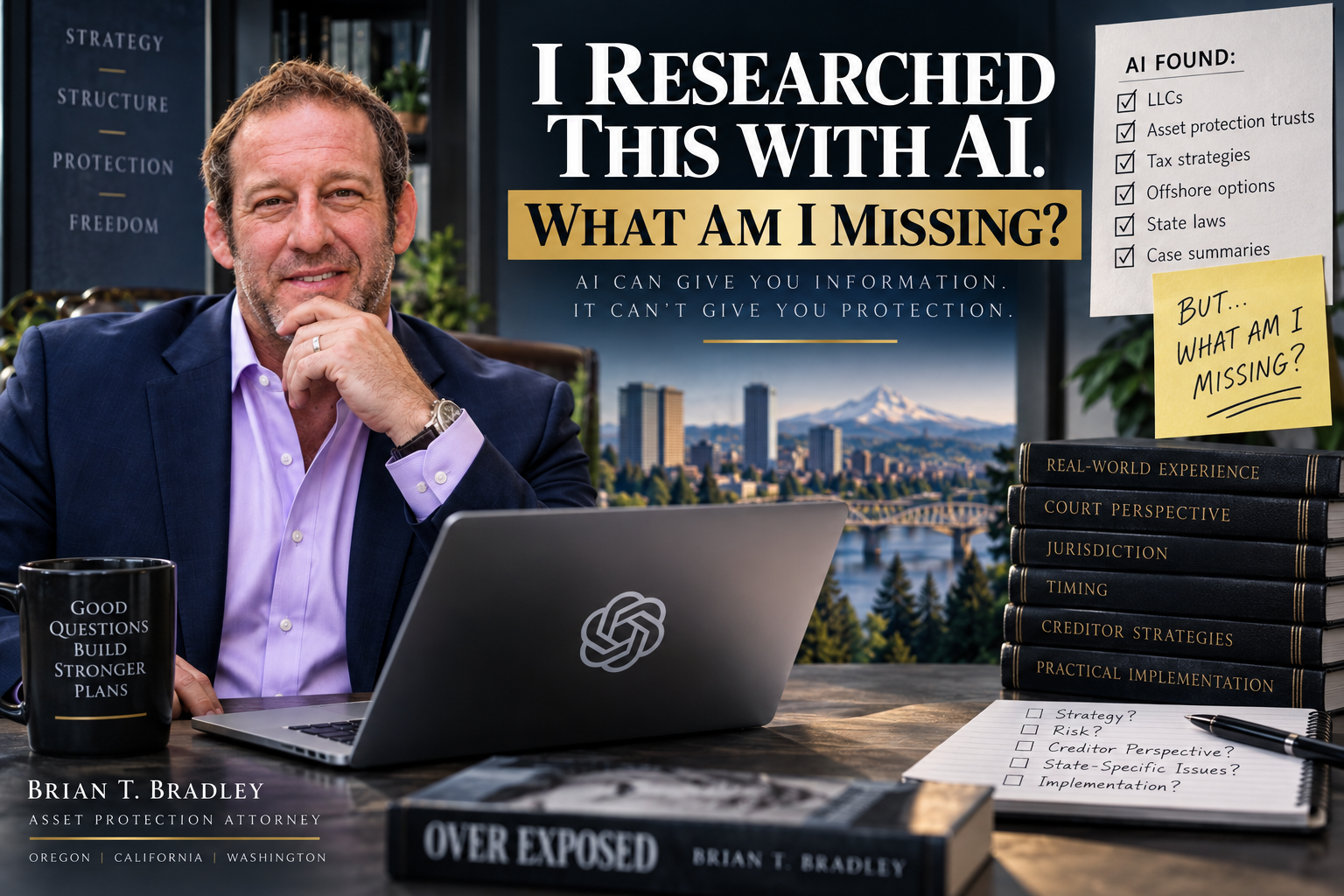
You may have found this page through the exact tool this article is about. That is fine, and I am not going to tell you to stop using it. AI research on legal questions is genuinely useful and most people should do more of it, not less. But the failure mode people worry about — made-up cases — is not the one most likely to affect you. The dangerous version is a summary that is entirely accurate and still leads to the wrong conclusion, because the detail that determines your outcome did not fit in the answer.
And there is a second issue almost nobody mentions: your conversation with an AI is not privileged.
Key Points
- The common failure is not fabrication. It is a real case cited for a proposition it never held.
- AI answers are accurate on average and can be wrong for you specifically. That is a structural property of summaries, not a defect.
- ⚠️ Your AI research is not privileged. A federal court so held in February 2026.
- Document review optimizes for finding issues — and in this field, some of the provisions it flags are the ones doing the work.
- Use it for orientation, vocabulary, and questions. Those are what it is genuinely good at.
The Example I Use
Ask any AI tool about offshore asset protection trusts and you will eventually get FTC v. Affordable Media — the Anderson case.
The summary comes back roughly like this: a couple set up a Cook Islands trust, a court ordered them to bring the money back, they said they could not, the court held them in contempt, and they went to jail.
Every one of those facts is true.
And the conclusion most readers draw from it — offshore trusts do not hold up against a U.S. court — is wrong.
What actually happened
When the duress provision fired, the Cook Islands trustee removed the Andersons as co-trustees. That part worked.
But they stayed on as trust protectors. And a protector can fire the trustee.
So the Ninth Circuit said, in effect: if you can still pick up the phone and remove the person holding your money, your inability to comply is something you created. That is not impossibility. That is contempt.
And here is the half the summary almost never includes. The Cook Islands trustee refused the repatriation order. The FTC then litigated in the Cook Islands — and lost, the last time in December 2005. The assets were never repatriated.
So what does the case actually teach?
The offshore structure held. The drafting failed.
They kept a lever in their own hand, and the court reached the hand rather than the structure.
That is a lesson about retained control, and it is the single most important design principle in this entire field. It is also a paragraph, not a bullet point — which is exactly why it gets compressed out of a summary.
Why This Happens, and Why It Is Not a Glitch
A generative AI is not a database of verified authorities. It is a system that predicts the next most plausible piece of text. It has no internal concept of legal truth, and no way to know which detail in a case is the one that decides your situation.
There are three ways AI output goes wrong in legal contexts, and they are not equally likely to affect you.
Fabricated cases. Citations to decisions that do not exist. This is the famous one — Mata v. Avianca, Inc., 678 F. Supp. 3d 443 (S.D.N.Y. 2023), where an attorney filed a brief citing six nonexistent opinions and the court imposed sanctions.
Fabricated quotes attached to real cases. The case exists. The language does not.
And real cases cited for propositions they never held. This is the one that matters for you, and it is the least discussed.
Anderson is that third category. The case is real. The facts in the summary are real. The proposition drawn from it is not what the case decided.
The problem is compression, not accuracy
This is worth being precise about, because “AI hallucinates” is the wrong diagnosis for the risk you actually face.
An AI answering a general question produces a general answer. That answer is optimized to be right for the typical case, because that is what a short response can carry.
Your situation is not the typical case. It has a specific state, a specific asset mix, specific timing, and specific documents. The detail that determines your outcome is frequently the detail a general summary drops — not because the summary is wrong, but because including it would make the answer longer than the format allows.
Here is the version that makes this concrete.
Type chest pain into any of these tools and you will get back that it is probably muscular or reflux. Statistically, that is the correct answer. It is also the answer that kills the person having an atypical heart attack.
The summary is accurate on average, very general, and wrong for you specifically.
That is the whole problem with researching your own legal or medical situation this way. There is a great deal of substance in the detail.
One you can test yourself right now
Here is a live example, and it happened to me on my own content.
Ask any AI tool whether a Swiss bank issues a Form 1099 to a U.S. account holder.
You will most likely get back that it does not — that Form 1099 is a U.S. information return, that foreign financial institutions are not U.S. payors, and that you report foreign account income yourself from the bank’s statements.
Every part of that is correct as a general rule.
And it is wrong here.
Swiss banks that have entered a Qualified Intermediary agreement with the IRS assume certain U.S. withholding and reporting obligations — which can include issuing Forms 1099 to U.S. account holders on reportable income. A U.S. client with an account at a QI bank may well receive one, exactly as they would from a domestic bank.
The general rule about foreign payors is sound. It simply does not contemplate the QI regime, which is a specific arrangement that changes the answer for a specific set of institutions.
That is the same failure at a third level. Anderson is a case interpreted correctly on its facts and wrongly on its meaning. Chest pain is a diagnosis correct on average and fatal in the exception. This one is a factual rule that is accurate in general and inverted in context.
Go run it. Then ask a follow-up: “What about banks with a Qualified Intermediary agreement?” You will usually get the correction immediately.
Which is the whole point. The information was available. It just was not in the first answer, and the first answer is what most people act on. And the AI output has now framed the structure in your mind.
⚠️ And Your AI Research Is Not Privileged
This is the concern attorneys who work with wealthy families are raising publicly — not that the AI is wrong, but that the conversation is discoverable.
When you talk to an attorney, that conversation is protected. When you talk to an AI, it is not.
In United States v. Heppner, No. 1:25-cr-00503-JSR (S.D.N.Y. Feb. 10, 2026), a federal court held that materials a defendant created using a public AI tool — discussing his own legal defense strategy — were not protected by attorney-client privilege or the work-product doctrine.
And the detail that makes it worse is easy to miss. The client had not been directed by counsel to use the tool. He later gave the AI-generated materials to his lawyers anyway — and the court still allowed the government to obtain them.
Handing it to your attorney afterward does not fix it. The disclosure to a third party had already happened.
Three protections, and they are not the same thing
Confidentiality is your attorney’s ethical duty. It is the broadest of the three.
Attorney-client privilege is evidentiary. It protects confidential communications made for the purpose of legal advice — and it can be waived by sharing with a third party.
Work-product doctrine protects materials prepared in anticipation of litigation.
A consumer AI tool is a third party.
Why this matters more here than almost anywhere else
Think about the shape of the questions someone asks in this situation. How do I protect assets from a lawsuit. What happens if I move this. Is it too late.
Timed near a claim arising, a transcript of that research is close to the best evidence a creditor’s attorney could hope for. It is the kind of record that turns a defensible transfer into a fraudulent one — not because the questions were improper, but because intent is the issue and you documented your thinking.
This is not a hypothetical raised by people selling legal services. One Florida wealth attorney told CNBC she gets calls every week from clients asking about advice they received from a chatbot. Her stated concern was not accuracy — she said mistakes are correctable. It was that clients putting documents and searches into these tools are waiving protections they do not know they have.
Firms are revising engagement letters over this, with language warning that inputting attorney communications or work product into AI software can cost those communications their privileged status.
The rule of thumb that actually works
If you would not want it read aloud in court, or shown to your family during a lawsuit, do not type it into an AI tool.
What the Courts Are Seeing
A public database maintained by legal researcher Damien Charlotin tracks roughly 1,490 court decisions worldwide — more than a thousand in the United States as of May 2026 — where a party relied on AI-generated material and a court responded.
Courts are now identifying two to three such cases per day, up from roughly two per week before spring 2025.
Sanctions have escalated. $5,000 in Mata. $15,000 per attorney plus opposing fees in Whiting v. City of Athens at the Sixth Circuit. And in People v. Crabill, suspension from practice.
ABA Formal Opinion 512, issued July 2024, is explicit that a lawyer using generative AI retains the duties of competence, candor, and confidentiality — and that reliance on AI output without independent verification can violate the duty of competent representation. Texas, California, Florida, New York, New Jersey, Pennsylvania, and North Carolina have issued their own guidance.
If the profession that does this for a living is being sanctioned for insufficient verification, that is worth knowing before relying on an unverified answer about your own money.
Reviewing a Document With AI: What the Tool Is Optimizing For
Upload an instrument and ask an AI to find problems, and it will find problems. That is the task you gave it. Understanding what it is measuring against is what makes the output useful.
This is worth walking through, because document review is where the compression problem shows up most concretely — and because the output can be genuinely valuable if you know how to read it.
A review prompt evaluates a document against general drafting norms. That is the correct default. Most trusts are ordinary trusts, and the general norms are right for them.
Asset protection instruments are deliberately built outside the general case. Several of their most important provisions look unusual to a reviewer applying ordinary standards — because they are unusual, on purpose.
The provisions most likely to get flagged, and what they do
“This trust is irrevocable but treated as a grantor trust — that appears contradictory.” It is not. Revocability is a state law question. Grantor trust status is an income tax question under IRC §§671–677. An irrevocable trust can be a grantor trust, and this one is drafted to be one deliberately.
“The settlor is a beneficiary. That creates self-settled trust exposure.” Correct as a general rule, and it is the design here. The settlor’s retained interest keeps the gift incomplete, which keeps the assets in the gross estate, which preserves the §1014 step-up. Remove it and you lose the basis adjustment — which is what happens to most offshore trusts under Rev. Rul. 2023-2.
“The trustee has absolute discretion with no ascertainable standard.” Standard estate planning practice says add one. In this context, an ascertainable standard is what a creditor argues gives them something to compel. Absolute discretion is why they cannot.
“The settlor retains a power of substitution, which looks like retained control.” That is §675(4)(C), and it is intentional. It supports grantor trust status, and it is the mechanism practitioners have been retrofitting into older trusts since Rev. Rul. 2023-2.
“The governing law and the registration jurisdiction are different.” Also intentional. Those are two separate legal questions and the structure depends on the distinction.
“The duress provisions could be characterized as transfer triggers.” The provisions exist at formation, years before any claim. That is what makes them governance rather than a reactive transfer.
Every one of those flags is defensible in the abstract
That is what makes this genuinely hard, and it is not a criticism of the tool. The AI is applying rules that are correct for the ordinary case to a document built to sit outside the ordinary case.
It is the same phenomenon as the Anderson summary, at the document level instead of the case level. Accurate general knowledge, applied to a specific thing it does not have the context to evaluate.
And the suggested changes are not neutral. Add an ascertainable standard, remove the settlor’s beneficial interest, tighten the trustee’s discretion — and you have a document that reviews well and protects considerably less.
How to Use That Output Well
The list is worth having. A client who understands their own structure well enough to ask hard questions about it is a client who will maintain it correctly. That is a good outcome and it is worth the conversation.
What makes the difference is how the output gets used.
Bring the questions rather than the conclusions. “What does this clause do?” opens the analysis. “This clause is wrong and should be changed” skips the step where you find out why it is there.
Ask what each provision is for. Not as a challenge — as a request. What does this do, what happens without it, and what would change if we altered it.
And apply this test:
If your attorney cannot explain, in plain language, why a specific clause is in your document, that is a real problem and you should press on it.
That standard cuts in both directions, which is why it is the right one. A provision that cannot be explained probably should not be there. A provision that can be explained, and whose removal would weaken the structure, is not a drafting error because a general-purpose reviewer flagged it.
One thing the output cannot be is a second opinion. A second opinion comes from someone who has your full facts, has read the whole instrument in context, understands what you are trying to accomplish, knows the law of your state, and carries professional responsibility for being wrong.
A review prompt has none of those things, and it was not built to. That is not a limitation of the technology. It is a description of what you gave it.
What AI Research Is Genuinely Good For
I want to be clear that I am not arguing against this. A prospective client who has done real research with these tools is easier to work with, not harder — they arrive with vocabulary, with a framework, and with better questions.
Use it for orientation. What is a charging order. What is a spendthrift provision. What is the difference between a revocable and an irrevocable trust. These are stable, well-documented concepts and the answers are reliable.
Use it to build vocabulary. Walking into a consultation knowing what a limited partner is, or what fraudulent transfer means, makes the conversation dramatically more productive.
Use it to map the landscape. What kinds of structures exist. What are the general categories.
Use it to generate questions. The best thing an AI can do for you here is help you figure out what to ask. Bring the list.
What It Cannot Do
It does not know your facts. Which state you live in, where each asset sits, whether you signed a personal guarantee, whether a claim is already foreseeable, what your existing documents actually say. Those are the variables that determine the answer.
And it only knows what you type into it — which means it depends on you already knowing what matters. A significant part of this work is surfacing issues a client did not know were issues. You cannot prompt for a problem you have not identified.
It does not know which detail is load-bearing. In Anderson, the load-bearing fact is that the settlors retained protector powers. A summary that omits it is still accurate — and useless.
It cannot walk you through execution. States impose different requirements for witnesses, notarization, and self-proving affidavits. A perfectly drafted document is useless if it is signed incorrectly.
It cannot coordinate the pieces. Beneficiary designations override a will regardless of what the will says. An AI answering a question about trusts does not know what your beneficiary forms say.
And it does not carry a duty to you. An attorney has obligations of competence, loyalty, and confidentiality, and malpractice exposure if those are breached. A chatbot has none of that, and its output is not privileged.
So Does It Replace Legal Drafting?
No, and the reason is more specific than “AI can’t practice law.”
Asset protection is drafting. The difference between a structure that holds and one that does not is almost never the concept — it is the specific provisions, in a specific instrument, matched to a specific person’s facts and a specific state’s law.
Anderson is the proof. Same jurisdiction. Same type of trust. Same general concept. One drafting decision — who holds the protector power — determined whether the settlors went to jail.
That difference is what you are hiring an attorney for. And it is exactly what gets smoothed out of a summary, because it takes a paragraph or a page to explain and does not fit in a fast bullet point.
FAQs
Is AI reliable for legal research? For general concepts, largely yes. For anything that turns on your specific facts, your state, your timing, or your documents, no — because a general answer cannot contain information it was not given.
What’s the most common way AI gets legal questions wrong? Not fabrication. In this area the most common problem is a real case cited for a proposition it never held, or an accurate summary that omits the detail determining the outcome.
What did FTC v. Affordable Media actually decide? That settlors who retained trust protector powers over their own offshore trust could not claim impossibility of compliance and could be held in civil contempt. The Cook Islands trustee refused repatriation and the FTC later lost in the Cook Islands courts. It is a case about retained control, not about offshore trusts failing.
Is my conversation with an AI privileged? No. In United States v. Heppner (S.D.N.Y. Feb. 10, 2026), a federal court held that materials a defendant created using a public AI tool about his own defense strategy were not protected — even though he later gave them to his lawyers.
What’s a simple rule for what to type into an AI? If you would not want it read aloud in court, or shown to your family during a lawsuit, do not enter it.
I had an AI review my trust and it found a lot of issues. What now? Bring the list and ask what each provision does. In asset protection specifically, several of the items most likely to be flagged — the settlor’s beneficial interest, absolute trustee discretion, a retained substitution power — are doing deliberate work.
Why would an AI flag provisions that are intentional? Because it evaluates against general drafting norms, which are correct for ordinary trusts. These instruments are built outside the ordinary case on purpose.
How do I tell a real drafting problem from a deliberate provision? Ask what the clause does and what happens without it. If it cannot be explained in plain language, that is a genuine problem. If it can, and removing it would weaken the structure, it is not an error.
Can AI draft my trust? It can produce something that reads like a trust. Whether the specific provisions do what you need, under your state’s law, with your facts — that is the entire question.
Should I stop using AI to research this? No. Use it for orientation, vocabulary, and building a list of questions. Then verify anything expensive, and have the sensitive part of the conversation with someone who owes you a duty.
The Bottom Line
The risk is not that the machine lies to you. It usually does not.
The risk is that it tells you something true, in a general way, and you apply it to a situation it knows nothing about.
Anderson is a real case. The couple really went to jail. And the reason they went to jail — that they kept the power to fire the trustee — is the thing that determines whether the same structure works or fails for you.
That is a detail. And detail is what a summary is designed to remove.
Do the research. Come in with questions. Then get someone to look at your actual facts, read your actual documents, and tell you what the summary left out.
Structure before stress.
📞 For a confidential legal consultation, contact Bradley Legal Corp. at (888) 773-9399, or complete the intake questionnaire at btblegal.com.
By: Brian T. Bradley, Esq. – National Asset Protection Attorney