
The step-up in basis under IRC §1014 depends on one thing: whether the assets are included in the decedent’s gross estate. A traditional dynasty trust is funded by a completed gift, which removes them — and forfeits the step-up by design. For families above the federal exemption that trade is rational. For families below it, the capital gains cost is paid to solve an estate tax problem that does not exist.
And Rev. Rul. 2023-2 makes the test explicit: grantor trust status alone will not put assets in your estate.
Key Points
- Estate inclusion is the entire test under §1014. Not trust type, not tax status, not jurisdiction.
- A completed gift removes assets from the estate. That is what a traditional dynasty trust and a SLAT both do.
- Rev. Rul. 2023-2 targets IDGTs — trusts deliberately built so assets sit outside the estate.
- An incomplete gift keeps them in. That is a structurally different trust, and the ruling’s premise is absent.
- Below the exemption, the forfeit buys nothing. There was no estate tax to avoid.
- The substitution power is the retrofit everyone is now using on trusts that already made the gift.
The Call
A tech founder in his mid-fifties called me with a question his estate planning attorney had not been able to answer.
He had built a software company that was recently acquired in part. He held $6 million of acquirer stock with a cost basis under $200,000. His wife was a practicing cardiologist. Their combined net worth — the stock, a brokerage account, two homes, retirement accounts — was approximately $14 million.
His estate planning attorney had recommended transferring the acquirer stock into a dynasty trust. The stock would likely appreciate further; getting it out of the estate now would lock in gift tax exemption against future estate tax exposure; it would pass to the next generation insulated from probate.
The recommendation was not wrong as estate tax planning. It was incomplete.
What the attorney did not explain was that funding a traditional dynasty trust with that stock would cost his children roughly $1.85 million in federal capital gains tax when they eventually sold.
And he did not have an estate tax problem to solve in the first place.
He had an advisor solving for transfer tax exposure he did not face, by sacrificing a benefit he could not afford to forfeit.
The Exemption Reality Most Advisors Don’t Explain
The federal exemption is $15 million per individual and $30 million per couple. Most families being advised to fund a traditional dynasty trust sit well below it.
For these families, federal estate tax is not the problem. No tax at the first death because of the unlimited marital deduction. No tax at the second because the estate falls under the doubled exemption.
State exposure is a different question and should be addressed where it exists. New York’s 2026 basic exclusion is $7.35 million. Massachusetts is $2 million. Oregon is $1 million. Washington is $3 million for deaths on or after July 1, 2026. Connecticut matches the federal amount.
⚠️ New York carries a trap worth naming. If the taxable estate exceeds 105% of the exclusion — $7,717,500 in 2026 — the exclusion is lost entirely and the whole estate is taxed from the first dollar, at rates running up to 16%. That cliff turns a modest overage into a seven-figure swing, and it is the single strongest argument for planning in New York at values most families would not think require it.
But for clients in non-estate-tax states, or well below the federal exemption, the traditional dynasty trust is being recommended to solve a problem the exemption already solves.
Removing assets from the estate at funding only matters if those assets would otherwise trigger tax above the exemption. The cost of that unnecessary planning is what nobody is calculating.
What the Step-Up Actually Is
Under IRC §1014, property acquired from a decedent takes a basis equal to fair market value at death. Decades of appreciation are wiped clean — but only for assets in the gross estate.
A founder buys $200,000 of stock that grows to $8 million over twenty years.
Sell during life: capital gains on $7.8 million of appreciation. At the 20% federal rate plus the 3.8% net investment income tax, roughly $1.86 million federal, before state tax.
Die holding it, with the stock in the gross estate: heirs take a basis of $8 million. They can sell the next day and owe zero federal capital gains tax.
For most families the step-up is the single largest tax benefit in the Internal Revenue Code. And it is available only when the asset is part of the gross estate at death — which is exactly what a traditional dynasty trust is designed to defeat.
Why Traditional Dynasty Trusts Forfeit It by Design
A traditional dynasty trust is funded through a completed gift. The grantor transfers assets in, relinquishes ownership and control, and the trust becomes the owner.
That is the entire point. The completed gift consumes lifetime exemption and — the central design feature — removes the assets from the gross estate. Future appreciation accrues outside the estate and escapes the 40% rate above the exemption.
But the same removal forfeits the step-up. The trust takes carryover basis — the grantor’s original $200,000 — and keeps it until sale.
When the trust or the heirs sell at $8 million, capital gains tax is owed on the full $7.8 million. At combined federal rates of 23.8%, roughly $1.86 million. In California, at a combined rate above 37%, over $2.85 million.
Above the exemption, that cost is justified — the estate tax saved exceeds the capital gains paid.
Below it, the cost is paid for nothing. The estate tax that would have been owed without the trust is zero.
Estate Inclusion Is the Entire Test
Not trust type. Not tax status. Not jurisdiction. The question §1014 asks is whether the assets were in the decedent’s gross estate — and the IRS said so directly in 2023.
This is the part that determines everything else, and it is worth stating precisely because a great deal of published material on this topic states it loosely.
What Rev. Rul. 2023-2 decided
In March 2023 the IRS ruled on a specific structure: an intentionally defective grantor trust — an irrevocable trust funded by a completed gift, where the grantor retained a power causing grantor trust status for income tax purposes, and where the assets were deliberately outside the gross estate.
Held: no §1014 basis adjustment.
The reasoning is narrow. Section 1014(a) applies to property “acquired from a decedent,” and §1014(b) lists seven categories of what that means. The Service worked through all seven and concluded that assets in an irrevocable grantor trust outside the gross estate fit none of them.
Even though the grantor paid the trust’s income tax for life, the assets were not acquired or passed from a decedent within the meaning of §1014(b).
What the ruling actually establishes
That income tax ownership under chapter 1 and estate inclusion under chapter 11 are separate questions. Grantor trust status governs who reports the income. It does not, on its own, put assets in your gross estate.
Which means the operative test is estate inclusion, and any structure claiming to preserve the step-up has to answer that question directly.
And the Bridge Trust® is not the trust the ruling addressed
The IDGT in Rev. Rul. 2023-2 was funded by a completed gift. That is what put the assets outside the estate.
The Dynasty Bridge Trust® is funded without a completed gift. No lifetime exemption is consumed at funding. No gift tax return reports a completed transfer. The assets remain includible in the gross estate under IRC §§2036 and 2038 — which is the qualifying condition §1014 requires.
The ruling’s premise is absent, so its holding does not reach the structure.
Two independent tax rules operate alongside that. The instrument satisfies the court test and control test of Treas. Reg. §301.7701-7 under IRC §7701(a)(30)(E), so the IRS classifies it as domestic. Separately, it maintains grantor-trust status under IRC §§671–677, so income is reported on the settlor’s own return and no separate trust return is required.
Both are real benefits. Neither is what preserves the step-up. The absence of a completed gift is.
And below the exemption there is no cost to keeping them there
The estate is sheltered by the $30 million couple exemption. There is no estate tax to avoid. Keeping the assets in the estate costs nothing in transfer tax exposure and captures the full step-up.
The Question to Ask Any Advisor
If you are told a structure preserves the step-up, the follow-up is one sentence:
“Are the assets in my gross estate at death, and what puts them there?”
If the answer is “it’s a grantor trust,” that answer is incomplete — and Rev. Rul. 2023-2 is why. Grantor trust status is a chapter 1 income tax concept. Estate inclusion is a chapter 11 question.
If the answer is “there was no completed gift, so the assets never left your estate” — that is the answer §1014 actually cares about.
The Tool Everyone Else Is Retrofitting
After Rev. Rul. 2023-2, practitioners holding existing completed-gift trusts needed a remedy. The one they landed on is the substitution power.
Where a grantor trust holds a low-basis asset, the grantor exercises a non-fiduciary power to swap it for higher-basis property of equal value. The low-basis asset returns to the grantor’s estate and, held until death, becomes eligible for the §1014 adjustment.
That works, and estate attorneys have been implementing it since 2023. It requires two things: the instrument has to contain the power, and someone has to exercise it in time.
A structure drafted from inception with a §675(4)(C) substitution power stated for that express purpose is not solving the problem after the fact. It has the tool because the design contemplated it.
That is a difference in sequence rather than a claim of superiority. But for a client whose existing irrevocable trust contains no such power, it is the difference between having a remedy and not.
The Protection and Dynasty Layers
The trust agreement is governed by Nevada law and registered offshore from inception, in both Belize and the Cook Islands. The Belize registration starts the offshore limitation period at day one; the Cook Islands recognizes the trust as of that original filing date and supplies the pre-committed successor trustee.
If a credible threat arises, an independent Trust Protector — an attorney exercising professional judgment, not the settlor — may declare an Event of Duress. Nothing fires automatically on the filing of a complaint. A licensed offshore trustee that honored a foreign court order lacking local jurisdiction would face personal liability and loss of license.
At death, the §1014 step-up is captured on assets includible in that spouse’s estate, and the trust continues into its dynasty phase under Nevada law — which abolished the common-law rule against perpetuities and permits a term of up to 365 years under NRS 111.1031, the duration the instrument uses.
⚠️ And the allocation deadline is the first death
GST exemption allocation is planned around the first spouse’s death, not the second.
The exemption is not portable between spouses. There is no DSUE equivalent under IRC §2010(c). Exemption unallocated when the first spouse dies is permanently gone, and the survivor is left with only their own against everything the family owns.
Allocation is made on Form 706 at that time. The trust instrument does not allocate exemption — that is a filing, and it is where dynasty planning most often fails quietly.
A Note on SLATs
A Spousal Lifetime Access Trust is also funded by completed gift, so the same step-up forfeit applies. Section 1014 does not reach assets outside the gross estate. The SLAT takes carryover basis and keeps it.
And it adds three failure modes.
Reciprocal trust doctrine risk. Under United States v. Estate of Grace, 395 U.S. 316 (1969), courts can uncross mirrored trusts and treat the assets as if each grantor funded one for their own benefit — collapsing the gift treatment entirely.
No creditor protection. The assets are reachable by anyone with a claim against the beneficiary spouse, and the indirect-access mechanism is what exposes them.
And the liquidity trap. Access runs through the beneficiary spouse and closes if that spouse predeceases the grantor or the marriage ends.
The full analysis is its own article — see SLATs vs. the Dynasty Bridge Trust® below.
Side-by-Side: The Math on a $14 Million Estate
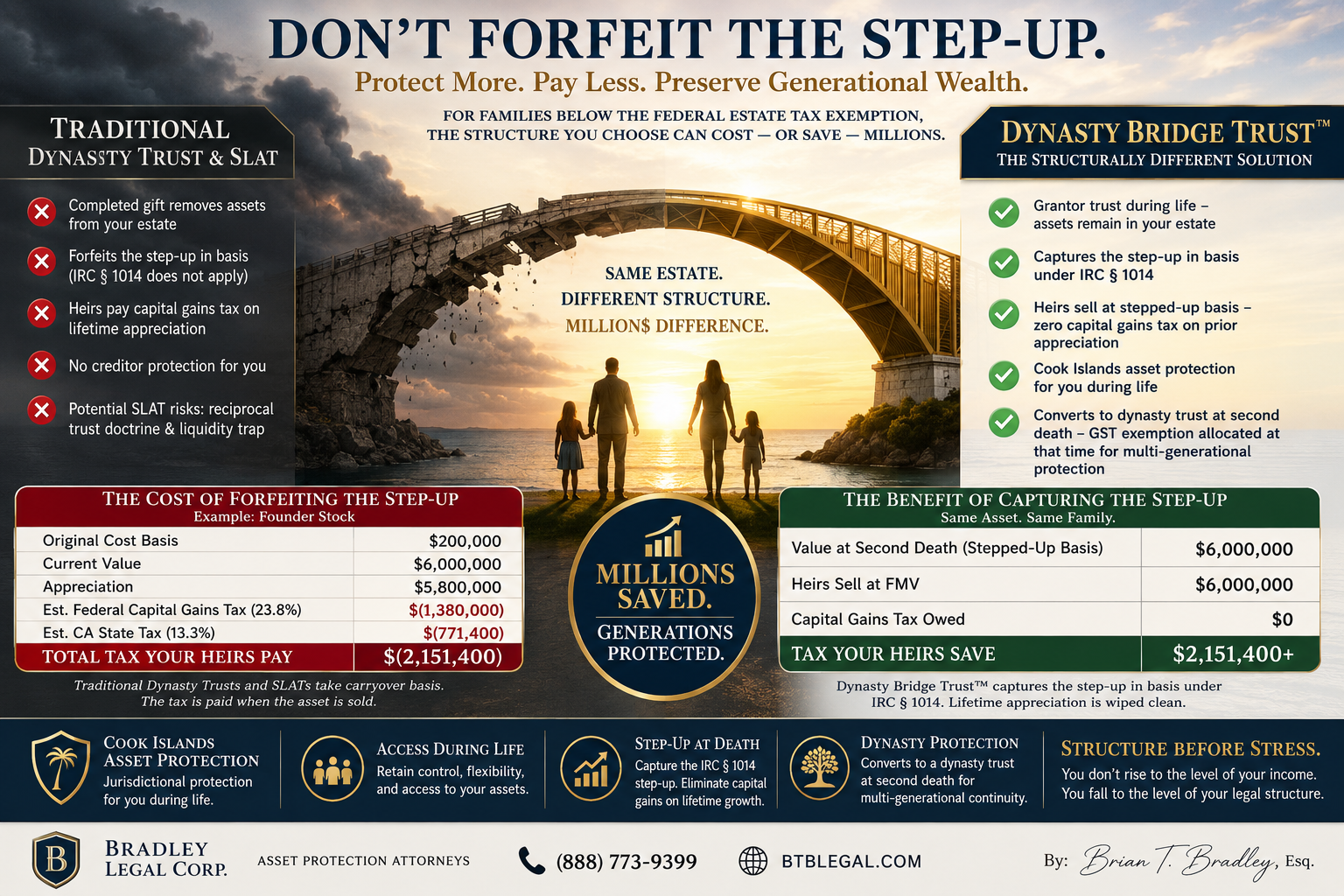
Combined net worth $14 million, below the federal exemption, holding $6 million of stock with a $200,000 basis.
Under a traditional dynasty trust
The stock transfers in at funding, consuming $6 million of lifetime exemption. The assets leave the estate. The trust takes carryover basis of $200,000.
At sale, capital gains tax is owed on the appreciation. At a current value of $6 million, roughly $1.38 million federal. If the stock appreciates to $10 million before sale, roughly $2.33 million federal. Plus state tax anywhere with an income tax.
Estate tax saved: zero. The estate fell below the exemption regardless.
Net cost: $1.38 million to $2.33 million in federal capital gains tax that would not have been paid had the assets stayed in the estate.
Under the Dynasty Bridge Trust®
The stock transfers in without a completed gift. No exemption consumed at funding. The assets remain in the estate — which is fine, because the estate is below the exemption.
At death, §1014 applies. Basis steps up from $200,000 to then-current fair market value. Heirs can sell with zero capital gains tax on the lifetime appreciation.
Estate tax at the second death: zero.
Net tax cost: zero. The dynasty protection is captured. The lifetime creditor protection is captured. The step-up is captured.
When a Traditional Dynasty Trust Still Makes Sense
It is not a wrong tool. It is a tool for a specific situation — families meaningfully above the federal exemption facing real exposure to the 40% rate.
For them the math reverses. Estate tax saved on appreciation outside the estate over a multi-decade lifetime exceeds the capital gains paid because the step-up was forfeited.
And even above the exemption the analysis is rarely binary. Sophisticated structures frequently use a traditional dynasty trust for the portion of the estate above the exemption while preserving low-basis appreciated assets in the estate for the step-up. That is multi-tool architecture, not a one-size recommendation.
There are also specific uses — charitable lead trusts, GRATs, intentionally defective grantor trusts — with their own design logic where the step-up question may not control.
But for the broad band of families being advised to fund a traditional dynasty trust as general estate planning, those families are paying a tax cost the planning benefit does not justify.
The Decision Framework
First, do you have an actual federal estate tax problem? Below the $30 million couple exemption, most families do not. Check your state separately.
Second, do you hold appreciated assets where the step-up matters? Concentrated positions, founder stock, real estate bought decades ago.
Third, do you want access during your lifetime? A completed gift means you no longer have it.
Fourth, do you face creditor exposure? A traditional dynasty trust provides none for the settlor.
And fifth — are the assets in your gross estate, and what puts them there? That is the question §1014 turns on, and it is the one most recommendations never answer.
FAQs
What is the step-up in basis? Under IRC §1014, the cost basis of assets in a decedent’s gross estate resets to fair market value at death. Heirs owe capital gains only on appreciation after that date.
What determines whether the step-up applies? Estate inclusion. Whether the assets were part of the decedent’s gross estate. That is the whole test.
Why does a traditional dynasty trust forfeit it? Because it requires a completed gift, which removes the assets from the gross estate.
Doesn’t grantor trust status keep assets in my estate? Not on its own. Rev. Rul. 2023-2 addressed an intentionally defective grantor trust — grantor status for income tax, assets deliberately outside the estate — and held there was no §1014 adjustment. Income tax ownership under chapter 1 and estate inclusion under chapter 11 are separate questions.
Then why does the Dynasty Bridge Trust® preserve it? Because it is not an IDGT. There is no completed gift, so the assets remain includible in the gross estate under IRC §§2036 and 2038 — the condition §1014 requires. The ruling’s premise is absent.
What if my existing trust was a completed gift? If the instrument contains a substitution power, the grantor can swap low-basis trust assets for higher-basis property of equal value before death. That requires the power to exist and someone to exercise it in time.
Is the step-up worth losing estate tax planning? Below the exemption there is no estate tax planning being lost. Above it, the analysis depends on estate size, asset composition, and the relative magnitude of each.
When is GST exemption allocated? Around the first death, on Form 706. The exemption is not portable, so exemption unallocated at the first death is permanently lost.
Are SLATs better on the step-up question? No. Both rely on completed gifts and both forfeit §1014 by design. The SLAT adds reciprocal trust doctrine risk, no creditor protection, and a liquidity trap on top.
The Bottom Line
The Dynasty Bridge Trust® is not a refinement of the traditional dynasty trust. It is a structurally different answer — designed for families below the federal exemption who still want multi-generational protection.
Completed-gift planning, whether a dynasty trust or a SLAT, solves transfer tax exposure these families do not face, at the cost of a step-up they cannot afford to lose.
And the test is simpler than most of the material on this subject suggests. Are the assets in your gross estate at death? If yes, §1014 applies. If no, it does not — and the IRS has already ruled on the version where people hoped grantor trust status would bridge that gap.
Structure before stress. You don’t rise to the level of your income. You fall to the level of your legal structure.
📞 For a confidential legal consultation, contact Bradley Legal Corp. at (888) 773-9399, or complete the intake questionnaire at btblegal.com.
By: Brian T. Bradley, Esq. – National Asset Protection Attorney