

A Case Review of Linscott v. Kittrell
The Kittrells did several things right on paper. Their Children’s Trust was irrevocable by its terms. It contained an express anti-reversion clause disclaiming any interest in the trust estate. The named beneficiaries were their children and grandchildren. They were never named as beneficiaries at all.
An Arizona bankruptcy court held it was a self-settled trust anyway, avoided the transfer under 11 U.S.C. §548(e), and entered a $6.5 million judgment against the trust.
The decisive provision was a four-word description of who could receive trust property. The Kittrells fell inside it.
Key Points
- The class definition was the flaw. A power of appointment exercisable in favor of “descendants of the Grantor’s parents” includes the grantors.
- The anti-reversion clause did not help. It prevented a reversion by operation of law, not designation as a beneficiary.
- They were grantors, trustees, and beneficiaries. The court said so in those words.
- The trust failed all four pillars — timing, control, jurisdiction, and collectibility.
- This ruling threatens structures that pretend. A trust designed to look like the settlor is excluded, while contemplating adding them back, is exactly what failed here.
- Two separate questions. Collectibility decides what a creditor can reach. It does not decide what a court can order you to do.
What Happened
On October 21, 2014, Murphy and Barbara Kittrell formed the Kittrell Children’s Trust under Arizona law. They were the sole grantors. They were also the named trustees, and they signed the Trust Agreement in both capacities.
The stated purpose, in §1.04, was to allow them “to transfer individual interests in various assets to [their] children.”
They admitted at trial there was another purpose. Murphy testified he restructured the businesses and formed the trust because creditors were interfering with them. Barbara testified they formed it at least in part to protect assets against certain creditors she perceived to be “thieves.”
What went in
The Kittrells held interests in entities managing two Arizona cannabis operations, Greenmed and Purplemed. Contemporaneously with signing the Trust Agreement, they restructured — forming MKHS, LLC and its subsidiaries, and MKHS Holding Company, LLC to sit above them.
They then transferred their 100% ownership interest in MKHS Holding to the Children’s Trust.
What that left them
No other material assets beyond an encumbered home held in a separate trust and encumbered vehicles.
Litigation pending against them. Outstanding judgments exceeding $1.5 million, unsatisfied at the time of the transfer and still largely outstanding at the petition date.
And no gift tax return was filed for the transfer.
They filed Chapter 7 on February 25, 2022. Their Chapter 7 trustee, Christopher G. Linscott, brought this adversary proceeding. Trial was held April 21–22, 2026. Judgment issued July 24, 2026.
⚠️ The Four Words
The Trust Agreement looked protective. Section 2.01 made it irrevocable, with the grantors retaining “no right to alter, amend, revoke or terminate.” Section 2.02 disclaimed any reversionary interest. Then §2.03 gave the power away — and defined the class too broadly.
Section 2.03 granted the Kittrells’ son, Niko, a Limited Power of Appointment, with each power expressly “exercisable in a non-fiduciary capacity.” He could:
“add to the beneficiaries entitled to receive income or principal any person or persons who are descendants of the Grantor’s parents, or an organization described by the provisions of section 170(c) and section 2055(a)”
“remove any person as a beneficiary … provided that the remaining beneficiaries are persons who are descendants of the Grantor’s parents”
“revoke the Trusts created hereunder and distribute the trust estate to any person or persons who are descendants of the Grantor’s parents“
Read the class definition. Murphy and Barbara Kittrell are descendants of their own parents.
That single phrase meant their son could add them as beneficiaries, remove everyone else so that they were the sole beneficiaries, or simply revoke the trust and hand them the assets.
And in 2020 they made it explicit
On July 15, 2020, at Murphy’s direction, the son exercised that power to amend the Trust Agreement — adding authority to “direct the Trustee to transfer the trust estate to a Trust created by Grantors or Surviving Grantor.”
The court’s observation: “by its plain language, the First Amendment authorizes Mr. N. Kittrell to order that the assets held by the Children’s Trust be transferred to another trust created by the Kittrells, subject to no restrictions.”
The anti-reversion clause did not fix it
The Kittrells argued §2.02 foreclosed the whole analysis — they could not be beneficiaries because the instrument disclaimed any reversionary interest.
The court rejected it in a footnote:
“The Anti-Reversion Clause merely serves to prohibit assets held by the Children’s Trust from reverting to the Kittrells as a matter of law. The Anti-Reversion Clause does not preclude the Kittrells from being made beneficiaries of the Children’s Trust, or from receiving or accessing benefits they are otherwise entitled to under the Trust Agreement.”
A reversion and a designation are different events. The clause addressed one and left the other wide open.
And the court found the contrary testimony not credible. When the Kittrells and their son testified that the power of appointment was inconsistent with the grantors’ intent, the court held that testimony “directly contrary to the plain and controlling language of the Trust Agreement.”
Why “Beneficiary” Was Easier to Prove Than They Expected
§548(e) does not define the term. The court borrowed Arizona’s definition, and it reaches further than most people assume.
Section 548(e)(1) permits a trustee to avoid a transfer made within ten years of the petition where (A) the transfer was to a self-settled trust or similar device, (B) by the debtor, (C) the debtor is a beneficiary, and (D) the debtor acted with actual intent to hinder, delay, or defraud.
Element (C) is where these cases turn, and it turned quickly here.
The court noted that the Code does not define “self-settled trust,” but that “it is generally accepted that a trust in which the grantor is also a beneficiary is a self-settled trust” — citing Rodriguez v. Cyr (In re Cyr), 602 B.R. 315, 334 (Bankr. W.D. Tex. 2019) and the BAPCPA House Report.
For “beneficiary,” it looked to state law. Under A.R.S. §14-1201(4), a beneficiary “includes a person who has any present or future interest, vested or contingent.”
Contingent counts. That is the whole distance between “we are not named beneficiaries” and “we are beneficiaries.”
And they were beneficiaries a second way
Beyond the instrument, the court found the Kittrells held vested beneficial interests based on conduct — holding themselves out as owners, claiming the business income and losses on personal returns, pledging trust assets as loan collateral, and paying off millions in personal obligations with trust assets.
The instrument supplied more. Section 2.04 named Murphy individually as “the Substitutor,” with power “acting solely in a non-fiduciary capacity within the meaning of Code Sec. 675(4)(C), without the approval or consent of any person, including the Trustee,” to swap trust assets for property of equivalent value. Sections 6.01 and 6.04 let them hold and register trust property in their own names without disclosing the trust, sell to and buy from the trust, and lend to and borrow from it.
Intent Was Not a Close Question
The court applied the badges of fraud from Acequia, Inc. v. Clinton (In re Acequia, Inc.), 34 F.3d 800, 806 (9th Cir. 1994): pending or threatened litigation, transfer of substantially all property, insolvency, a special relationship with the transferee, and retention of the property after transfer.
Every one was present.
Two outstanding judgments and a pending lawsuit at the time of transfer. Substantially all material assets moved. Nothing left for creditors but an encumbered home and cars. The transferee was a trust for their own children. And they kept complete control.
Then the admissions. While the Kittrells testified the trust was legitimate estate planning, they had admitted forming it at least in part to hinder and evade creditors — and the court found “the Kittrells’ primary intent was to shield valuable assets from their creditors.”
Once badges are established, the burden shifts. Quoting Waldron v. Huber (In re Huber), 493 B.R. 798, 812 (Bankr. W.D. Wash. 2013), the transferee must then prove a “legitimate supervening purpose.”
They did not.
The Administration Was Its Own Case
A trust is not a document. It is a pattern of conduct, and this one documented itself.
No distributions were ever made to any named beneficiary.
The trust was never divided into separate shares for each living beneficiary when the oldest child turned forty, as §4.01 required.
There were no separate bank accounts, books, or records. No written statements were ever furnished to beneficiaries, despite §7.04 requiring annual statements and records open to inspection. The Kittrells testified they gave oral accountings at weekly family dinners.
The trust never filed a tax return. Instead the Kittrells claimed MKHS income and losses on their personal returns — more than $10 million of losses over a three-year period — which for some time produced no individual tax liability at all.
Trust assets guaranteed Murphy’s personal obligations. He held himself out as sole member and owner of trust-owned entities, including in tax returns signed under penalty of perjury. He transferred ownership interests in trust-owned entities in his personal capacity.
The transactions that followed
Fewer than sixty days before the petition, the MKHS entities sold the Purplemed assets for $15 million. Murphy signed the purchase agreement on behalf of every entity involved and as the defined “Kittrell Representative,” and signed the escrow agreement personally, as a seller.
In excess of $11 million of debt the Kittrells were personally liable for was paid out of that sale, plus a “Balance to Seller” of $1,975,121.19.
Post-petition, a management agreement for Greenmed brought in $125,000 monthly payments, an $18 million purchase option, and $525,000 in personal loans to Murphy — on terms providing that if he failed to repay, the trust-owned entity would repay on his behalf.
His explanation: he was exercising his “trustee responsibility.” “I am the person in charge, and I had to be the borrower for the company.”
And the Kittrells’ salaries were funded out of those monthly payments.
The Court Reached the Same Result Twice
Even if §548(e) had failed, the assets were estate property. That belt-and-suspenders holding is what makes this decision durable.
On the avoidance theory, the court held the transfer avoidable under §548(e)(1) and recoverable under §550(a).
On the alternative theory, it held the assets were property of the estate under §541 and recoverable under §542(a) — because the Kittrells held the equitable interests and could exercise powers over the assets for their own benefit.
Quoting Cutter v. Seror (In re Cutter), 398 B.R. 6, 18–19 (B.A.P. 9th Cir. 2008): “powers that a debtor who is trustee of a trust may exercise for his or her own benefit become property of the estate.”
The court’s own summary:
“The Kittrells are, in effect, the Settlors, Trustees, and beneficiaries of the Children’s Trust.”
⚠️ The Valuation Finding Is the One That Should Scare People
The transfer happened in 2014. The court valued it as of the 2022 petition date.
Under §550(a), a court ordinarily values property as of the transfer date — but it has discretion. Quoting USAA Fed. Sav. Bank v. Thacker (In re Taylor), 599 F.3d 880, 890 (9th Cir. 2010), the purpose is “to restore the estate to the financial condition it would have enjoyed if the transfer had not occurred.”
The Kittrells argued the MKHS entities had no value in 2014. They may well have been right.
It did not matter. Sixty days before the petition, Purplemed sold for $15 million with an option on Greenmed for another $15 million, and a later option valued Greenmed at $18 million.
The court found the trustee entitled to no less than $15 million. He had asked for $6.5 million — the amount needed to pay every allowed claim in full — and that is what the judgment ordered, plus pre-judgment interest from February 2022 and post-judgment interest at the federal rate.
A transfer made when the asset was worth little, that later becomes valuable, can be unwound at the later value. Ten years of growth in a structure that fails the test is ten years of growth handed to a trustee.
Why This Trust Failed: The Four Pillars
Every asset protection structure rests on four questions. The Kittrell Children’s Trust failed all four, and any one would have been enough.
Timing — fatal
The transfer was made with judgments over $1.5 million outstanding and litigation pending. Substantially all material assets moved in a single transaction. And the Kittrells admitted the purpose was to protect assets from creditors.
That is the element-(D) finding, and nothing else in the structure could have survived it. No drafting, no jurisdiction, and no trustee arrangement cures a transfer made with actual intent to defeat creditors who already exist.
Control — fatal
Grantors. Trustees. Effective beneficiaries. Murphy testified he made every decision for every entity, in every capacity. Trust assets secured personal loans, paid personal debts, and funded personal salaries.
A court does not need a theory to reach assets controlled that completely. It needs only to describe what happened, which is what the §541 holding does.
Jurisdiction — absent
Arizona trust. Arizona trustees. Arizona entities. Arizona assets. Arizona court.
There was no jurisdictional layer at all. Every asset and every decision-maker sat inside the reach of the court that ruled.
Collectibility — zero
A judgment against a trust whose trustees are the debtors, holding assets the court can see, is collectible on its face. The Chapter 7 trustee now holds a $6.5 million judgment he can enforce.
The Structures This Ruling Actually Threatens
There is an irony in this decision, and it is worth being precise about. The trusts most exposed by Kittrell are not the ones that openly include the settlor. They are the ones built to look like they don’t.
Some structures in this field are designed around a specific move. The settlor is excluded as a beneficiary at formation. A trust protector, a family member, or another party holds power to add them back later. The purpose is to avoid self-settled status on paper while preserving the settlor’s eventual access in substance.
That is precisely what the Kittrell Children’s Trust was. The settlors were not named. Their son held a non-fiduciary power to add them. The instrument disclaimed reversion. And the court looked straight through all of it, because Arizona law counts a contingent interest as a beneficial interest — and a power that can be exercised in your favor gives you one.
The lesson is not that those structures are always invalid. A power that genuinely excludes the settlor — drafted so that no one can ever exercise it in the settlor’s favor — does not raise the issue. The lesson is that a structure whose design depends on appearing to exclude the settlor, while contemplating their return, is a structure a court will read by its substance.
The approach I use starts from the opposite premise. Do not pretend a structure is something it is not. State plainly what it is, and then look at what actually happens when it is tested.
Would a Bridge Trust® Have Produced a Different Result?
On §548(e), no — and that is worth saying clearly. On collectibility, very likely yes. And on the question of what a court can order the settlor personally to do, the answer is more careful than either.
What would have been the same
The Bridge Trust is self-settled from the outset. The client is a beneficiary and the structure does not pretend otherwise. So Kittrell‘s central question — are the settlors really beneficiaries? — does not arise. The answer is openly yes.
Which means §548(e) applies for ten years, exactly as it would to any fully foreign asset protection trust.
On these facts — judgments outstanding, litigation pending, admitted intent — a Bridge Trust would fail element (D) just as the Children’s Trust did. A bankruptcy court would likely avoid the transfer and likely deny discharge. Offshore registration does not cure a transfer made to defeat existing creditors, and nothing in the structure is designed to.
What would have been different
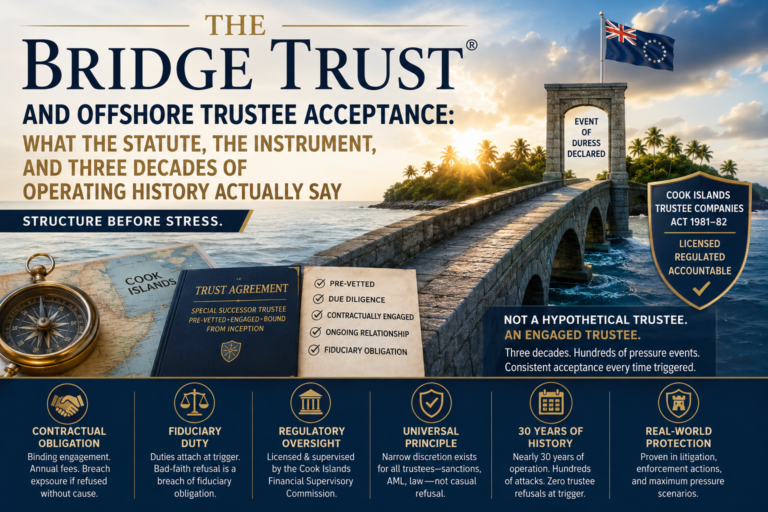
Control. The client does not serve as trustee of the protective layer. An independent Trust Protector — an attorney exercising professional judgment, not the client — decides whether an Event of Duress is declared. Distribution discretion sits with the trustee, not with the client.
Jurisdiction. Once the trust crosses the bridge, administration moves to a pre-committed Special Successor Trustee in the Cook Islands or Nevis. At that point it is a fully foreign trust.
Collectibility. The Kittrell trustee holds a judgment against assets sitting in Arizona under Arizona trustees. Against assets held offshore by an independent foreign trustee, a bankruptcy trustee holds a judgment and a much harder problem. A court can avoid the transfer. Whether it can actually reach assets no longer within its jurisdiction is a different question.
⚠️ Two Different Questions, and They Need to Be Kept Apart
Asset protection answers what a creditor can reach. Contempt answers what a court can order you to do. Those are separate questions with separate answers, and conflating them is how people end up surprised.
The civil contempt risk cannot be eliminated by moving assets offshore. If a court concludes that your inability to repatriate was self-created, it can pursue contempt regardless of where the assets sit and regardless of whether the trustee cooperates. That is true of every offshore structure, including this one.
What changes the analysis is not geography. It is four facts.
Timing. Was the structure implemented and funded before any claim existed and before any order issued?
Control. What powers did the settlor actually retain?
Who declares. Is duress declared by an independent Trust Protector, or by the settlor?
Who refuses. Is the refusal coming from an independent, licensed offshore trustee exercising its own fiduciary judgment?
Why Kittrell and Harnack fail that test
The Kittrells funded with judgments outstanding and admitted intent. Timing fails at the first question.
In re Marriage of Harnack, 2022 IL App (1st) 210143, is materially different from a properly built structure on the same axis. The transfers were made during the divorce and in violation of a standing order barring asset transfers. The Belize trustee refused to comply, citing duress, and the Illinois court never reached the trust assets — and the settlor has been held in civil contempt in the Cook County Jail since June 2022. That is not a close case, and the court did not treat it as one.
And FTC v. Affordable Media, LLC, 179 F.3d 1228 (9th Cir. 1999) fails on control. The Cook Islands trustee refused, the FTC later litigated there and lost, and the assets never came back. The settlors went to jail anyway, because they had named themselves protectors of their own trust — so the power to reverse the duress declaration never left their hands.
What a properly timed structure actually changes
In a structure established before any claim, where the settlor holds no power to reverse it, the Protector’s independent exercise of the duress power strengthens the impossibility argument. The inability is not something the debtor manufactured in response to a lawsuit. It is the product of decisions made years earlier, exercised by someone who is not the debtor.
That is a materially better position. It is not an absolute guarantee against a contempt finding, and anyone who tells you otherwise is describing something the law does not provide.
The honest framing is two sentences. A well-built, well-timed structure changes what a creditor can collect. It improves, but does not eliminate, exposure to coercive remedies directed at the person.
Why Most Clients Never Reach This Question
The Bridge Trust exists because a fully foreign trust asks too much of most clients during the years they do not need it.
A fully foreign trust carries annual trustee fees, international administration, and the foreign-trust reporting regime under Forms 3520 and 3520-A — every year, whether or not a creditor ever appears. For most clients, the protection is worth having and the ongoing burden is not.
The platform reports that the trust crosses the bridge in a small share of cases. For the rest, it operates domestically for tax purposes, with no foreign-trust reporting, while the offshore capacity remains available.
That is the argument for the structure, and Kittrell does not change it. What Kittrell sharpens is how plainly the timing requirement should be stated. The structure’s value depends on being built before it is needed.
What This Case Actually Teaches
Read the class definition in every power of appointment
A power of appointment is only as safe as the class it can be exercised in favor of. “Descendants of the Grantor’s parents” sounds like a way to describe children, siblings, nieces, and nephews. It also describes the grantors.
A power drafted to exclude the settlor, the settlor’s estate, the settlor’s creditors, and the creditors of the settlor’s estate does not raise the issue. That language exists for exactly this reason.
Ask the same question of every discretionary power in any structure — decanting authority, sub-trust creation, trustee distribution discretion: can this be exercised, by anyone, in a way that benefits the person who funded the trust?
An anti-reversion clause is not a substitute
It prevents a reversion by operation of law. It does not stop someone from designating you.
Do not be grantor, trustee, and effective beneficiary
Any two of those is a question. All three is an answer.
Do not build a structure whose design depends on appearances
If the plan only works because it looks like the settlor is excluded, a court will read the substance.
And the administration is evidence
No distributions in eight years. No separate accounts. No records. No trust tax return. Income and losses on the personal return. Trust assets pledged for personal loans. Personal debts paid from trust proceeds.
Any one of those is explainable. Together they answer the question the instrument was drafted to avoid.
What Genuinely Works
A real third-party trust. One created and funded by someone else, which you do not control and cannot compel. You made no transfer to it, so §548(e) has nothing to reach.
That is the most durable protection in this field, and it is available only to the person receiving rather than the person giving. If you are passing wealth down, leaving it outright exposes it to your child’s creditors, divorce, and bankruptcy. Leaving it in a properly structured continuing trust does not.
And the distinction has to be real. A trust that names your children while you continue to treat the assets as yours is not a third-party trust. It is your trust with their names on it — which is precisely what the Kittrells built.
FAQs
Can a trust for my children be treated as my own trust?
Yes. In Kittrell, the settlors were never named beneficiaries, the trust was irrevocable, and it contained an anti-reversion clause. The court still found it self-settled, because a power of appointment could be exercised in their favor and because they operated it as their own.
What was the actual drafting error?
A power of appointment exercisable in favor of “any person or persons who are descendants of the Grantor’s parents.” The grantors are descendants of their own parents, so the class included them.
Doesn’t an anti-reversion clause prevent this?
No. The court held it prevents assets reverting by operation of law; it does not prevent someone from adding the settlors as beneficiaries.
What does “beneficiary” mean under §548(e)?
The Code does not define it. The court applied Arizona’s definition — any present or future interest, vested or contingent.
How far back can a bankruptcy trustee reach?
Ten years under §548(e), measured from the petition date. Most state fraudulent transfer statutes run four years.
Is the transfer valued when it happened or later?
A court ordinarily values at the transfer date but has discretion. Here it valued as of the petition date, so a 2014 transfer supported a finding of no less than $15 million.
Which structures does this case threaten most?
Those designed to look like the settlor is excluded while contemplating adding them back later. A court reads the substance, and a power that can be exercised in the settlor’s favor makes them a beneficiary.
Does §548(e) apply to a Bridge Trust?
Yes, for ten years — exactly as it would to a fully foreign trust. The Bridge Trust is openly self-settled; it does not pretend otherwise.
Would a Bridge Trust have saved the Kittrells?
Not on §548(e) — they funded with judgments outstanding and admitted intent. Assets held offshore by an independent trustee are harder to reach than assets in Arizona under the debtors’ own control, but that addresses collection, not the separate question of coercive remedies against the person.
If the offshore trustee refuses, can I still be held in contempt?
Possibly. The risk cannot be eliminated by moving assets offshore. What matters is whether the structure predates any claim or order, what powers the settlor retained, whether an independent Protector declared duress, and whether an independent trustee made the refusal. Those facts improve the impossibility argument substantially. They do not guarantee an outcome.
What kind of trust actually protects against this?
A genuine third-party trust — created and funded by someone else, not controlled by you, with distributions you cannot compel.
The Bottom Line
The Kittrells’ trust said all the right things. Irrevocable. No power to amend or revoke. No reversionary interest, specifically disclaimed.
And a single class definition in a power held by their son made them contingent beneficiaries of their own trust. Then eight years of running it as a personal account removed any doubt.
It failed on every pillar. Funded with judgments outstanding. Controlled entirely by the debtors. Held entirely inside the court’s jurisdiction. Collectible on its face.
The most important lesson is not about drafting. It is that structures built to look like something they are not get read for what they are. Be honest about what a structure is. Then build it early enough that honesty costs you nothing.
Collectibility decides what a creditor can reach. Timing and control decide what a court is willing to believe about what you can do.
I spent the early part of my career on the plaintiff’s side of civil litigation. The structures that came apart came apart for the same two reasons every time: the debtor still controlled what he claimed to have given away, or he built it after the claim was already in view.
The Kittrells managed both, and a four-word phrase is what let the court say so.
Structure before stress.
📞 For a confidential legal consultation, contact Bradley Legal Corp. at (888) 773-9399, or complete the intake questionnaire at btblegal.com.
By: Brian T. Bradley, Esq. — National Asset Protection Attorney
Case References
Linscott v. Kittrell (In re Kittrell), No. 4:22-bk-01130-BMW, Adv. No. 4:22-ap-00206-BMW (Bankr. D. Ariz. July 24, 2026) (Memorandum Decision); 2026 WL 2151539 (judgment)
Rodriguez v. Cyr (In re Cyr), 602 B.R. 315 (Bankr. W.D. Tex. 2019)
Acequia, Inc. v. Clinton (In re Acequia, Inc.), 34 F.3d 800 (9th Cir. 1994)
Waldron v. Huber (In re Huber), 493 B.R. 798 (Bankr. W.D. Wash. 2013)
Cutter v. Seror (In re Cutter), 398 B.R. 6 (B.A.P. 9th Cir. 2008), aff’d, No. 09-60014 (9th Cir. Dec. 8, 2011) (mem.)
USAA Fed. Sav. Bank v. Thacker (In re Taylor), 599 F.3d 880 (9th Cir. 2010)
FTC v. Affordable Media, LLC, 179 F.3d 1228 (9th Cir. 1999)
In re Marriage of Harnack, 2022 IL App (1st) 210143
11 U.S.C. §§541, 542(a), 548(e), 550(a); A.R.S. §14-1201(4)