

Why Does This Matter More Than Ever?
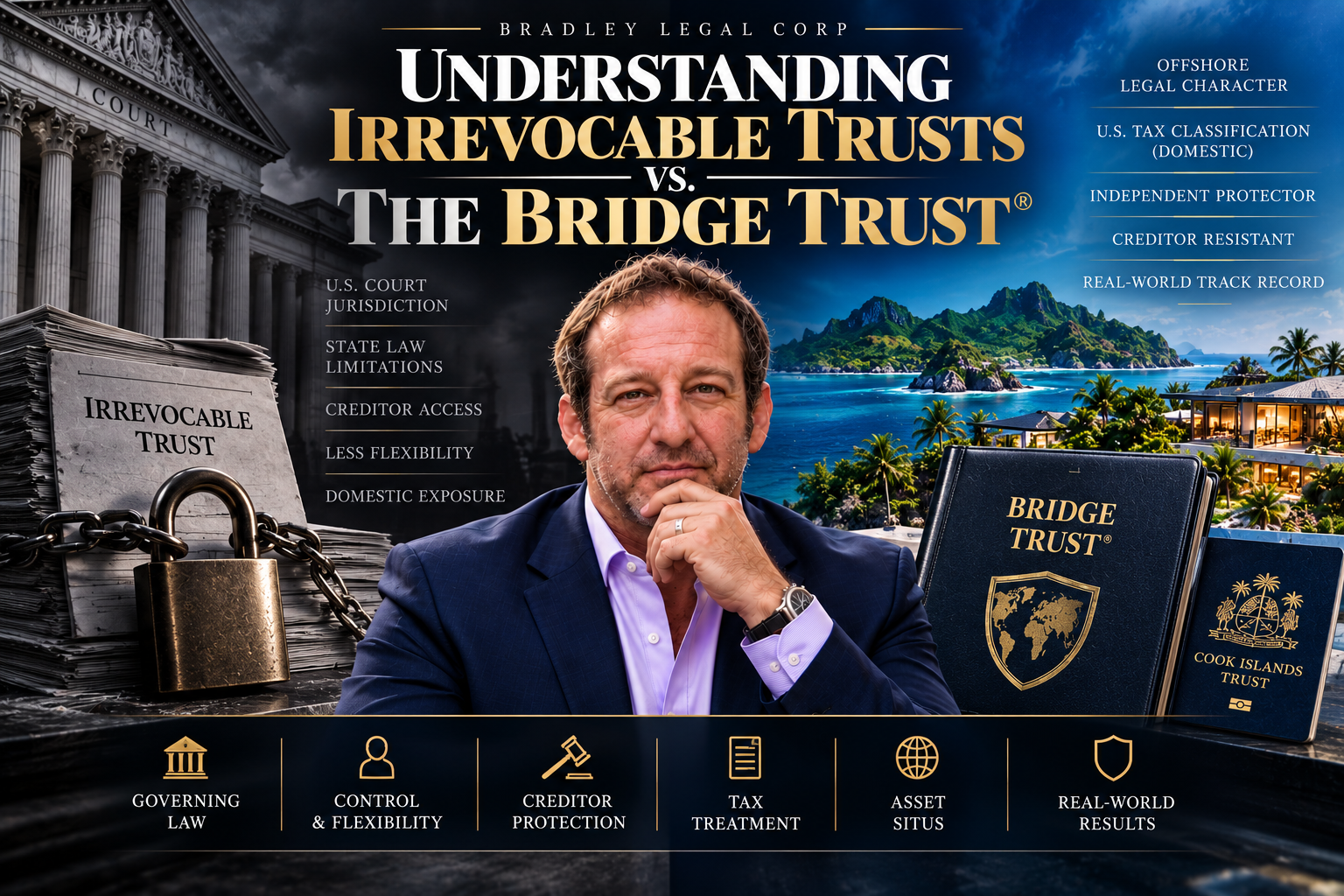
In today’s lawsuit-driven legal climate, wealth isn’t lost because people make bad investments — it’s lost because they’re unprepared legally. High-net-worth families and professionals are discovering that traditional “irrevocable trusts” — once promoted as the gold standard of protection — often fail when tested in U.S. courts.
That’s where The Bridge Trust®, a hybrid structure developed nearly 30 years ago, changes the equation — combining domestic familiarity with offshore strength under full IRS compliance.
What Does This Look Like in Practice?
Meet Jane and Tom, a physician and a business owner. Like many successful couples, they’ve worked decades to build wealth through their practice, investments, and real estate. Their CPA set up an LLC. Their estate attorney drafted a revocable and later an irrevocable trust. On paper, everything looked fine — until Jane faced a malpractice scare that could have put millions at risk.
When they asked, “Are we actually protected?” the answer shocked them.
The Common Misconception — “I Already Have an Irrevocable Trust”
An irrevocable trust can be valuable for estate-tax efficiency or gifting, but for lawsuit defense, its power is limited. Once assets are transferred, control is gone — and courts routinely look through these structures when they smell “control in disguise.”
Do You Lose Control and Liquidity?
When you move assets into a traditional irrevocable trust, you no longer legally own or control them. That means you can’t sell, refinance, or reposition those assets without the trustee’s consent — and you can’t reclaim them if life changes.
Example: Jane places a vacation home into her irrevocable trust. Ten years later, she wants to sell it to fund a business expansion — but she can’t without triggering taxes and trustee approval. The trust owns it, not her.
What Is the Tax and Administrative Burden?
Irrevocable trusts are separate taxable entities. They require their own EIN, annual Form 1041 filings, and can face the highest compressed tax brackets (hitting the top bracket at roughly $15,650 of income in 2025). For many families, that means paying more for a structure that adds compliance risk, not lawsuit protection.
Does an Irrevocable Trust Stop a Lawsuit?
Not reliably, and the reported decisions are consistent about why. A domestic irrevocable trust is construed and enforced by U.S. courts — the same system the creditor is already in. Every case below failed on one of three things: when the structure was built, who kept control of it, or whose courts decided the question.
U.S. case law has consistently shown domestic irrevocable trusts offer weak protection once courts suspect the intent was pre-litigation shielding.
• Battley v. Mortensen (In re Mortensen), 2011 Bankr. LEXIS 5560 (Bankr. D. Alaska 2011) — the court found the debtor solvent when he created the trust and found it “created in accordance with Alaska law.” It failed anyway, under 11 U.S.C. §548(e)’s ten-year reach-back. Correct jurisdiction and correct formalities were not enough.
• Waldron v. Huber (In re Huber), 493 B.R. 798 (Bankr. W.D. Wash. 2013) — an Alaska trust with an Alaska trustee and Alaska LLCs, held by a Washington debtor. The court invalidated the transfers under Washington’s statute, RCW 19.36.020. Choosing Alaska did not import Alaska’s courts.
• United States v. Huckaby, No. 2:23-cv-00587-DAD-JDP (E.D. Cal. Mar. 2, 2026) — the court agreed Nevada law governed construction of the trust under Restatement §277, then held it did not matter: under §280, creditor access to land is decided by the law of the situs. California property, California law, and the spendthrift protection failed under Prob. Code §15304. Note what the court declined to do — it refused to void the transfer and refused to find alter ego or nominee status.
• Toni 1 Trust v. Wacker, 413 P.3d 1199 (Alaska 2018) — Alaska’s own supreme court held that the state’s exclusive-jurisdiction statute “cannot unilaterally deprive other state and federal courts of jurisdiction.” A state cannot legislate other states out of the case.
• Dahl v. Dahl, 345 P.3d 566 (Utah 2015) — the forum applied its own law over the trust’s chosen governing law, though in a divorce rather than a creditor action, which limits how far it travels.
The common thread is jurisdiction: a domestic trust stays inside the U.S. court system, where the same judge hearing the creditor’s claim construes the trust, can compel the trustee, and can decide which state’s law governs access to the assets. A court does not have to void a transfer to reach what is in the trust — as Huckaby shows, it can leave the transfer intact and simply hold that the protection does not apply.
How Is the Bridge Trust® Different?
The Bridge Trust® was engineered to solve exactly those weaknesses. It is a Cook Islands trust that is also registered in Belize from inception, with a licensed offshore trustee in the Cook Islands or Nevis engaged from day one as Special Successor Trustee. At the same time it is classified as domestic for federal tax purposes under the court and control tests of Treas. Reg. §301.7701-7, with Nevada named in the instrument as the administrative situs that supports the court test. What changes under pressure is who administers the trust — not where the trust is. It was offshore in legal character from the day it was signed.
Do You Keep Control?
Yes — while the trust is in its domestic posture, you serve as trustee and manage the assets as you did before.
While the trust is domestic, you remain the managing trustee and beneficiary. You control bank and brokerage accounts, real estate, and investment decisions.
If a credible threat appears, an independent Trust Protector — an attorney who holds no beneficial interest in the trust and is not subject to your direction, and who is not your defense counsel — may declare an Event of Duress. That declaration suspends your authority as trustee by the terms of the instrument. Appointing the offshore Special Successor Trustee and repositioning any assets are separate, discretionary decisions that follow.
How Is It Taxed and Reported?
It is tax-neutral, which means it produces no tax benefit and no additional filing in its domestic posture.
Because the trust satisfies the court and control tests of Treas. Reg. §301.7701-7, it is classified as domestic for federal tax purposes, and in that posture no Form 3520 or 3520-A is required and there is no separate trust return. Income flows to your personal return under IRC §§671–677, and assets remain estate-includible, which preserves the §1014 basis step-up. It is tax-neutral by design — it produces no shelter, no deferral, and no deduction. Anyone selling an asset protection structure as a tax strategy is describing something else.
What Protection Does It Actually Provide?
It changes where the assets sit and who a creditor has to persuade — not whether a U.S. court has power over you.
The trust is a Cook Islands trust that is also registered in Belize from inception, with a licensed offshore trustee in the Cook Islands or Nevis engaged from day one as Special Successor Trustee. The Belize registration starts the offshore limitation clock at formation rather than at the moment a threat appears. Cook Islands law does not recognize U.S. judgments, requires a creditor to re-litigate locally under a beyond-reasonable-doubt standard, and imposes short limitation periods running from the transfer.
Be precise about what the case law shows, because this is where most summaries stop at half the story. In FTC v. Affordable Media, LLC, 179 F.3d 1228 (9th Cir. 1999), the Cook Islands trustee refused the U.S. repatriation order and the money never came back. When the FTC then went after the trust in the Cook Islands, it lost there too — on August 10, 1999 the Cook Islands High Court rejected its attempted takeover on every point and awarded costs against it. The Andersons were still jailed for civil contempt, and the reason is the lesson: they had stacked their own roles. They served as co-trustees and as protectors of their own trust, and as protectors they held the power to certify that no event of duress existed — which would have unwound the freeze. The court found they retained control, and control is what a contempt order attaches to.
Lawrence v. Goldberg (In re Lawrence), 279 F.3d 1294 (11th Cir. 2002), makes the same point from the drafting side. The court held the duress clause void because it “leaves to the settlor and the Trustees the discretion to determine when an event of duress has occurred.” Who makes that determination is the whole question, which is why the Protector must be independent of the settlor.
Read both cases for what they actually hold. Affordable Media involved a Ponzi scheme, fraud proceeds, and a federal agency as creditor — facts that limit how far it travels. The lesson in both is separation of roles, not that offshore jurisdiction is magic or that it is worthless.
Why Does Timing Decide Everything?
Because the planning window closes when a claim becomes reasonably foreseeable — not when the complaint is filed.
Asset protection only works before trouble starts. Once you’re in litigation, any transfer—even into a trust—can be attacked as a fraudulent transfer. That’s why The Bridge Trust® is built proactively: you stay in control now, but the system is ready if needed later.
What Is the Legal Bottom Line?
U.S. courts have reached domestic trusts for decades, and the reported decisions are consistent about why: the structure was built too late, the settlor kept control a court could compel, or the forum was never outside the U.S. system. Every one of them failed on timing, control, or jurisdiction.
No structure makes anyone judgment-proof, and no attorney can promise a courtroom outcome. What a properly built and properly timed structure changes is what a creditor can realistically reach, how long it takes, what it costs to try — and therefore the position you negotiate from. That is a smaller claim than this industry usually makes, and it is the one that holds up.
What Should You Do Next?
If nothing has happened yet, this is the right time to look at it. If you have already been served, the honest answer is that the window has closed and what remains is defense.
Jane and Tom chose the Bridge Trust® because it answered the question their existing plan did not: what happens if a judgment exceeds their coverage. A traditional irrevocable trust can do real work for estate and gifting purposes. It was not built for lawsuit exposure, and it does not become a lawsuit tool because a client needs one.
If your current plan leaves you guessing, the questions worth asking are the same ones a court asks: when was it built, who controls it, whose courts enforce, and what can a creditor actually collect. A plan is only as good as its weakest answer — and timing is the one that cannot be fixed later.
You don’t rise to the level of your income.
You fall to the level of your legal structure.
For a legal consultation, call me at (888) 773-9399.
Structure before stress.
By: Brian T. Bradley, Esq.
Not ready to talk yet?
Take my 2-minute Lawsuit Exposure Test
Answer yes or no. You get an exposure score and see where your risk actually comes from.
Take the Lawsuit Exposure Test

